

Key Takeaways
- The declarations page is a concise summary of your auto insurance policy, not the full contract.
- It lists coverage types, limits, deductibles, vehicle details, and premium breakdown in one place.
- Errors on your declarations page can affect claims — always verify details when you receive it.
- Understanding split limits versus combined single limits reveals your true liability exposure.
- Your declarations page does not list exclusions — those appear in a separate policy section.
What you will need
What a Declarations Page Actually Is
The declarations page (often called the "dec page") is a one-to-three-page summary that sits at the front of your auto insurance policy. Think of it as the policy's cover sheet: it consolidates the most important facts about your coverage into a readable snapshot. It is not the full legal contract — the full policy document, endorsements, and exclusions all live behind it.
Insurers are required to provide a declarations page when you purchase or renew a policy. It is also the document most often sent when you request proof of coverage for a lender, employer, or state requirement. Understanding it helps you confirm you have the coverage you paid for — and spot problems before you ever need to file a claim. For a broader orientation on navigating insurance documents generally, see how to read an insurance policy without getting lost.
What you will need
How to Read Each Section Step by Step
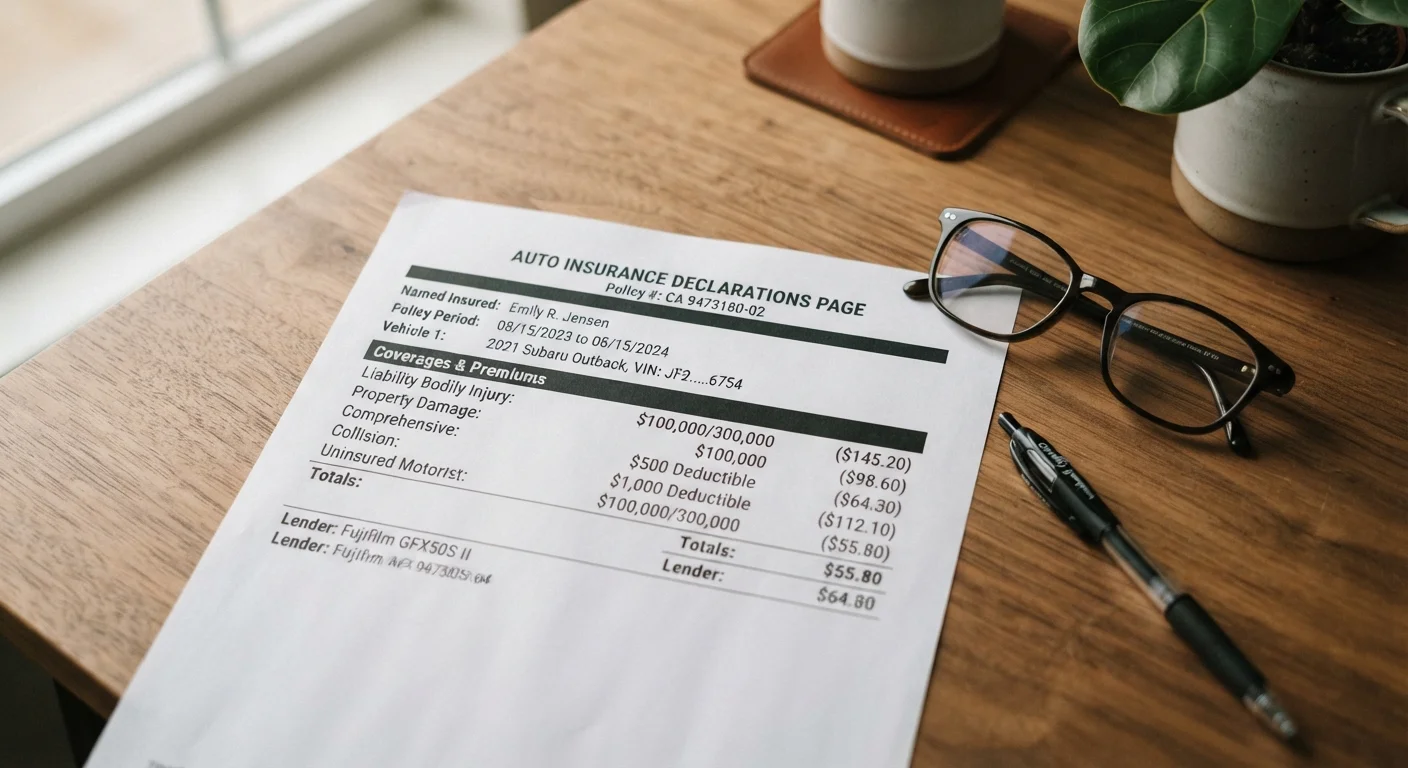
Most declarations pages follow a predictable layout. Working through them in order keeps the process manageable. Follow the steps below to decode every key section.
Confirm the Named Insured and Policy Period
The top of the declarations page identifies the named insured — the person(s) legally covered as the primary policyholder — and the policy period, which shows the exact start and end dates of coverage. Verify that your full legal name is spelled correctly and that the coverage dates reflect what you expect. An expired or incorrectly dated policy can leave you unprotected.
Check the Vehicle Information
The declarations page lists each covered vehicle by year, make, model, and VIN (Vehicle Identification Number — the unique 17-character code assigned to every car). Cross-reference the VIN against your registration document. An incorrect VIN means the insurer may have rated your policy against the wrong vehicle, which could affect a claim.
Review Your Coverage Types and Limits
This is the most detailed section. Each coverage type is listed alongside its limit — the maximum amount the insurer will pay per occurrence or per policy period. Common coverages include:
- Liability: Covers injuries and property damage you cause to others. Often shown as split limits (e.g., 100/300/100, meaning $100,000 per person bodily injury / $300,000 per accident bodily injury / $100,000 property damage) or as a combined single limit (one total pool for all liability claims from one accident).
- Collision: Pays to repair or replace your vehicle after an accident regardless of fault.
- Comprehensive: Covers non-collision losses such as theft, weather damage, or hitting an animal.
- Uninsured/Underinsured Motorist (UM/UIM): Protects you when the at-fault driver carries little or no insurance.
- Medical Payments (MedPay) or Personal Injury Protection (PIP): Covers medical costs for you and passengers, regardless of fault.
For plain-language definitions of each term, see our auto insurance coverage glossary.
Locate Your Deductibles
A deductible is the amount you agree to pay out of pocket before your insurer covers the rest of a claim. Deductibles typically apply to collision and comprehensive coverages. The declarations page will list the deductible amount per coverage type — for example, a $500 collision deductible means you pay the first $500 of repair costs after a covered accident.
Identify Any Endorsements or Riders
Endorsements (also called riders) are optional add-ons that modify your base policy — examples include roadside assistance, rental car reimbursement, or gap coverage. These are listed on the declarations page with their own premium amounts. Confirm that any endorsements you requested are present, and remove any you no longer need at your next renewal.
Review the Premium Breakdown and Lienholders
The declarations page itemizes your total premium by coverage type, letting you see exactly what each element costs. If you finance or lease your vehicle, your lender or leasing company will appear as a lienholder or loss payee — meaning they have a financial interest in claim proceeds. Verify the lienholder name and address are accurate; an incorrect entry can delay claim payments to your lender and create complications for you.
Common Mistakes and What to Do About Them
Even minor inaccuracies on a declarations page can complicate a claim. A misspelled name, wrong VIN, or missing lienholder can create disputes during the settlement process. If you spot an error, contact your insurer or agent immediately and request a corrected declarations page — insurers typically issue a revised version within a few business days.
It is also worth noting that the declarations page will not tell you everything. It summarizes coverage but does not detail what is excluded. Exclusions — situations your policy explicitly will not pay for — are described in the policy's exclusions section. Understanding what your exclusions page is really telling you is a critical next step once you've reviewed your dec page. Similarly, before assuming a specific situation will be covered, use a verification checklist: verify what your insurance actually covers before a claim arises.
Your Dec Page Is a Summary, Not the Full Policy
The declarations page does not contain the complete terms, conditions, or exclusions of your coverage. Critical limitations — such as which situations are not covered — appear only in the full policy document. Never rely solely on the declarations page to determine whether a specific event will be covered. Read the full policy and speak with a licensed insurance agent if you have questions about your coverage.
This article provides general information about auto insurance documents and is not personalized insurance, legal, or financial advice. Coverage terms, limits, and requirements vary by insurer, state, and individual policy. Always review your actual policy documents and consult a licensed insurance agent or adviser for guidance specific to your situation.