

Key Takeaways
- A lower premium is not always the cheaper option when you factor in what you'd owe after a claim.
- Your deductible only matters when you file a claim — your premium is a constant, recurring cost.
- Choosing a deductible you can't afford to pay out of pocket defeats the purpose of having coverage.
- The right deductible depends on your savings, driving habits, and how often you're likely to file a claim.
- Policies with low premiums can carry higher long-term costs if the deductible is set too high.
Deductible vs. Premium Trade-Off
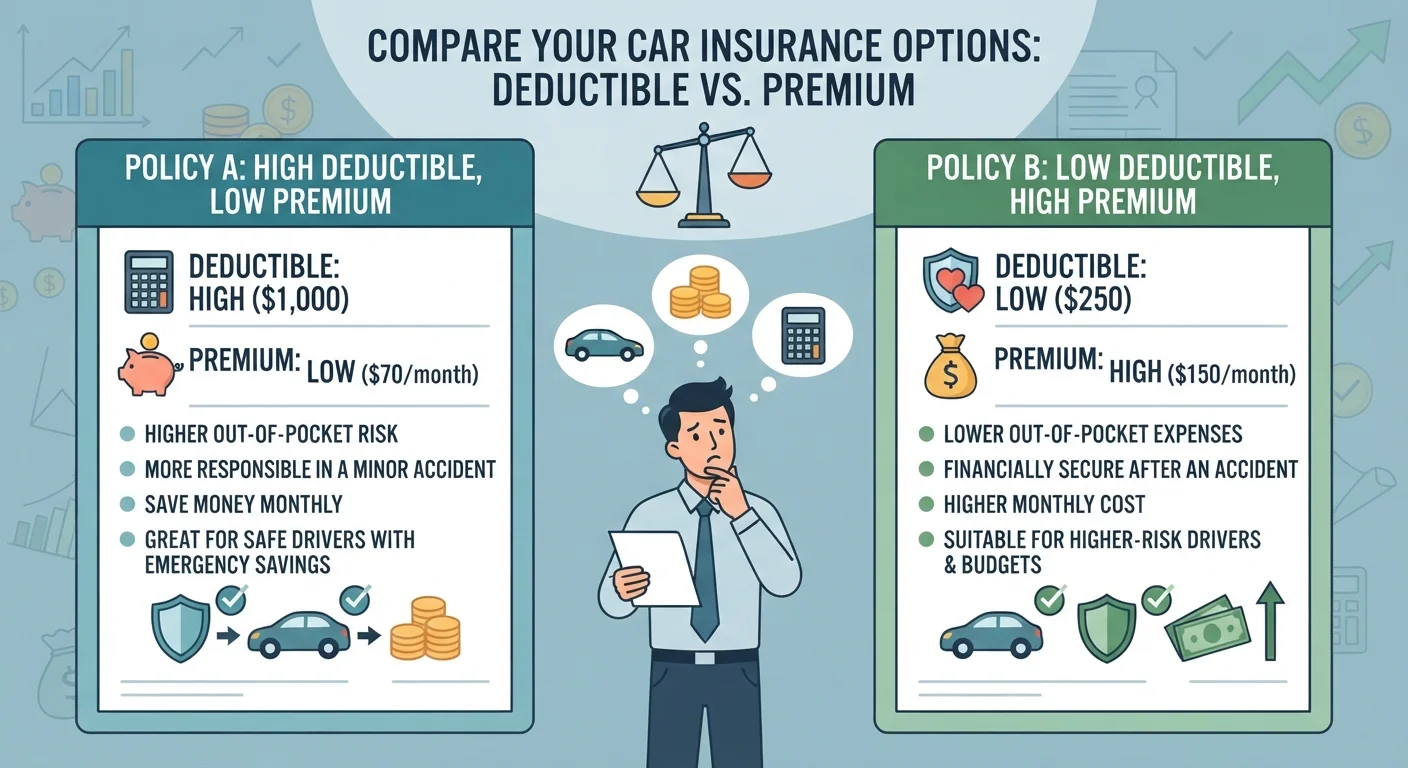
Your deductible is the amount you pay out of pocket before your insurance kicks in on a claim. Your premium is what you pay regularly — usually monthly or annually — to keep your policy active. These two numbers move in opposite directions: raising your deductible typically lowers your premium, and vice versa. The choice between them determines not just your routine costs, but your real financial exposure when something goes wrong.
Insurers calculate this inverse relationship based on risk transfer — a higher deductible means you absorb more risk, reducing the insurer's expected payout and therefore your premium.
The Real Cost Is What You Pay When It Counts
Most drivers focus on premium when shopping for auto insurance — it's the number on the monthly bill, the most visible cost. But the premium only tells part of the financial story. The deductible — the amount you pay before your insurer covers the rest of a claim — can have an equal or greater impact on what you actually spend over time.
To understand the full picture, see our breakdown of how deductibles and premiums work together in a real policy. The short version: your premium is the cost of keeping coverage active; your deductible is the cost of actually using it. Optimizing one without considering the other leaves you exposed in ways that aren't obvious until a claim arrives.
$500–$1,500
Common auto insurance deductible range
Most U.S. auto insurance policies offer deductible options within this range for collision and comprehensive coverage, according to industry data from the Insurance Information Institute.
~15–30%
Typical premium reduction from doubling your deductible
The Insurance Information Institute notes that raising a deductible from $200 to $500 can reduce collision and comprehensive premiums by roughly 15–30%, though savings vary by insurer and driver profile.
Why the Inverse Relationship Matters
Insurers design policies around a straightforward principle: the more risk you agree to absorb yourself, the less they charge you to carry the policy. Agreeing to a $1,000 deductible instead of a $500 one signals that you'll handle smaller losses personally, reducing the insurer's expected payout — and your premium drops accordingly.
The problem is that this trade-off isn't neutral. It only works in your favor if you have the liquidity to cover that deductible when a claim occurs. A driver who lowers their monthly bill by $30 by raising their deductible from $500 to $1,500 saves $360 per year — but owes an additional $1,000 out of pocket the moment they file a claim. If that $1,000 isn't accessible, the lower premium becomes a liability rather than a savings strategy.
As our analysis of why low-premium policies can cost more in the long run explores, the visible monthly savings can mask a larger financial exposure hiding in the fine print.
Use the Break-Even Test Before Deciding
Divide the annual premium savings by the difference in deductible amounts. The result tells you how many claim-free years you need before the higher deductible pays off. If that number is two or three years and your driving history is clean, a higher deductible may make sense. If it's five or more years, the math likely favors keeping the lower deductible.
How to Think Through Your Deductible Decision
There's no universal right answer for deductible selection — it depends on three factors specific to your situation:
- Your emergency savings: Only choose a deductible you could pay without going into debt. If your savings buffer is thin, a lower deductible protects you even if it raises your monthly bill.
- Your claim likelihood: Drivers with long commutes, vehicles parked in high-traffic areas, or histories of minor accidents may file more frequently. Higher frequency makes a lower deductible more cost-effective over time. Factors like location and driving record directly shape this calculation.
- Your vehicle's value: If your car is older and its market value is low, a high deductible might exceed what the insurer would pay in a total-loss scenario — making comprehensive or collision coverage less useful. This is also a key consideration when evaluating whether gap insurance applies to your situation.
This article is for general informational purposes only and does not constitute personalized insurance, financial, or legal advice. Coverage terms, premiums, and deductibles vary by insurer, policy, and state. Consult a licensed insurance agent or adviser for guidance specific to your circumstances.