

Key Takeaways
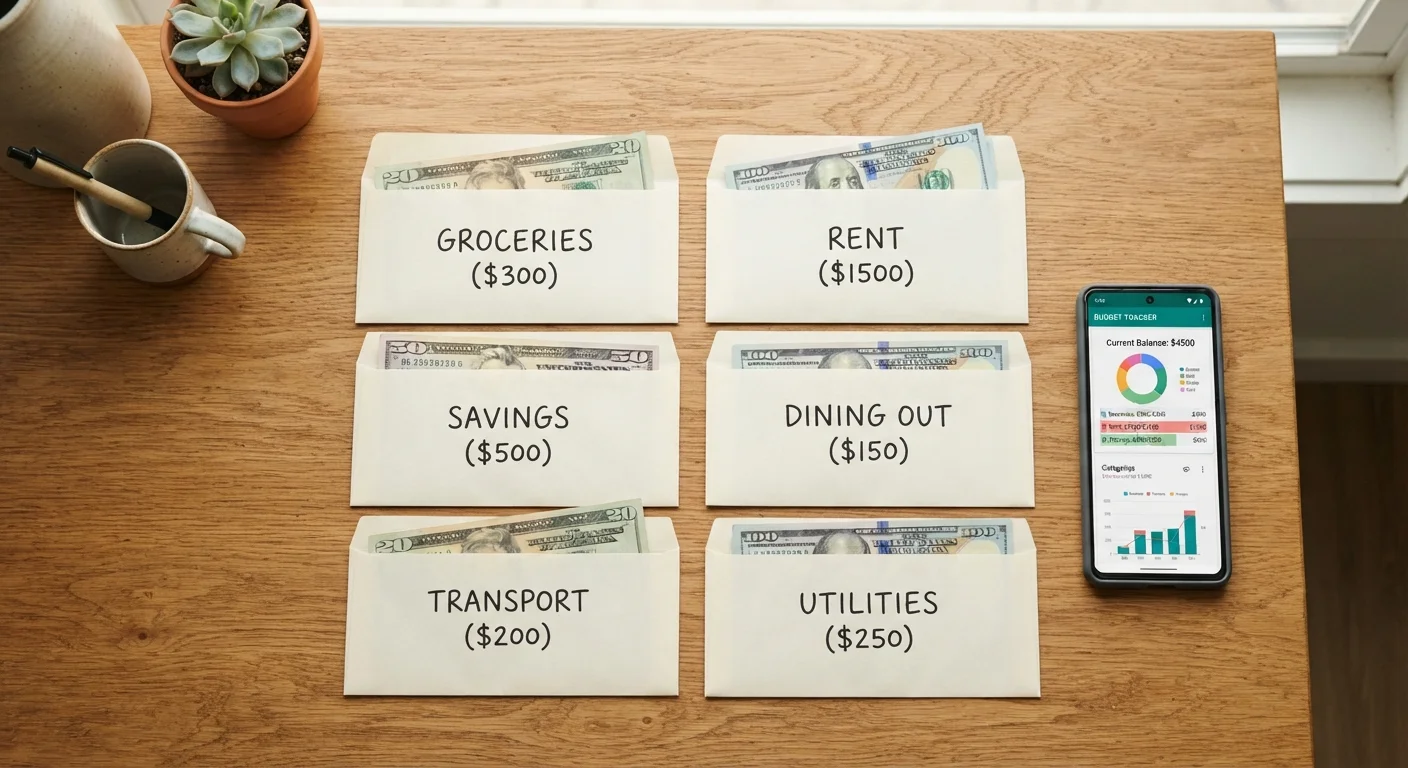
- Envelope budgeting assigns every dollar to a spending category before the month begins.
- The method works for cash-heavy households but requires adaptation for digital transactions.
- Digital tools can replicate envelope logic without requiring physical cash.
- Its greatest strength is creating a visceral, real-time awareness of spending limits.
- The system suits people who overspend in specific categories more than those with complex finances.
Creates instant, visual awareness of spending limits
Seeing a nearly empty envelope makes overspending feel concrete in a way that a bank balance does not. This behavioral feedback is particularly effective for categories where people habitually overspend, such as dining or entertainment.
Eliminates end-of-month budget surprises
Because each category is capped at the start of the period, there is no mechanism for unchecked spending to accumulate. Overruns in one category are immediately visible rather than discovered after the fact.
Simple enough to require no financial background
The system has no formulas, ratios, or software requirements. If you can count cash and label an envelope, you can implement it — making it accessible to people who feel overwhelmed by more technical budgeting frameworks.
Forces intentional allocation of every dollar
Dividing income into envelopes before spending begins mirrors zero-based budgeting principles, where every dollar has a purpose. This reduces idle money that drifts toward unplanned purchases.
Naturally limits debt accumulation on discretionary spending
Spending only physical cash means you cannot spend money you do not have in a given category, which can act as a structural brake on credit card reliance for day-to-day purchases.
Cash-centric design clashes with digital payments
Most US consumers now pay via debit card, credit card, or mobile wallet. Maintaining physical envelopes requires withdrawing cash regularly, which adds friction and may incur ATM fees.
Difficult to apply to automatic or recurring bills
Subscription services, mortgage payments, insurance premiums, and utility auto-drafts do not lend themselves to cash envelopes. These categories must be tracked separately, creating a two-system household.
Rigid category structure can misfire on variable expenses
Expenses like car repairs or medical copays are unpredictable in timing and size. An envelope system needs either a dedicated buffer category or frequent mid-month reallocation to handle genuine surprises.
Requires consistent manual discipline to maintain
Unlike automated savings tools or bank alerts, the envelope method only works if the user faithfully records every transaction and respects category limits. There is no built-in enforcement mechanism beyond personal commitment.
Less practical for households with shared or complex finances
When multiple earners or accounts are involved, coordinating who holds which envelope and reconciling shared expenses adds logistical complexity that can undermine the system's simplicity advantage.
Our Verdict
Envelope budgeting remains a genuinely effective framework for controlling discretionary spending, particularly for people who tend to lose track of category-level limits. Its cash-based origins are a friction point in a world of tap-to-pay and online subscriptions, but digital adaptations preserve the core discipline without requiring a trip to the ATM. Like any budgeting method, its value depends entirely on consistent use.
Best for consumers who struggle with overspending in specific categories and want a simple, visual system — whether they prefer physical cash or a digital envelope app.
What Envelope Budgeting Actually Is
Envelope budgeting is a zero-based cash management method: you divide your take-home income into labeled envelopes — groceries, gas, dining out, entertainment — and spend only what is physically in each envelope. When an envelope is empty, spending in that category stops until the next budget period.
The system predates personal finance software by decades and was widely popularized as a debt-reduction and savings tool. Its appeal is simplicity: no spreadsheets, no apps, no formulas. The physical act of handing over cash and watching the envelope thin out creates immediate feedback that a card swipe does not.
If you are new to budgeting altogether, start with the foundational concepts before adopting any specific method. Understanding your income, fixed expenses, and variable spending is a prerequisite for envelope budgeting to work.
The Advantages Worth Taking Seriously
The envelope method's staying power is not nostalgia — it addresses real behavioral patterns that trip up even disciplined spenders.
Creates instant, visual awareness of spending limits
Seeing a nearly empty envelope makes overspending feel concrete in a way that a bank balance does not. This behavioral feedback is particularly effective for categories where people habitually overspend, such as dining or entertainment.
Eliminates end-of-month budget surprises
Because each category is capped at the start of the period, there is no mechanism for unchecked spending to accumulate. Overruns in one category are immediately visible rather than discovered after the fact.
Simple enough to require no financial background
The system has no formulas, ratios, or software requirements. If you can count cash and label an envelope, you can implement it — making it accessible to people who feel overwhelmed by more technical budgeting frameworks.
Forces intentional allocation of every dollar
Dividing income into envelopes before spending begins mirrors zero-based budgeting principles, where every dollar has a purpose. This reduces idle money that drifts toward unplanned purchases.
Naturally limits debt accumulation on discretionary spending
Spending only physical cash means you cannot spend money you do not have in a given category, which can act as a structural brake on credit card reliance for day-to-day purchases.
~60%
US adults living paycheck to paycheck
A broad range of consumer surveys conducted in recent years consistently finds that a majority of American adults report spending most or all of their monthly income, underscoring the need for structured spending frameworks.
1 in 3
Adults with no written budget
NFCC consumer financial literacy surveys have repeatedly found that a significant share of US adults do not use any formal budgeting system, leaving spending decisions largely reactive.
For couples managing money together, the system creates a shared, visible record of what has been allocated and what remains. Managing joint finances is one area where envelope logic — even a digital version — can reduce disagreements because both partners see the same limits.
The Limitations That Matter in a Cashless World
The envelope method was designed for an era when most transactions were cash. That assumption now creates genuine friction for the majority of US households.
Cash-centric design clashes with digital payments
Most US consumers now pay via debit card, credit card, or mobile wallet. Maintaining physical envelopes requires withdrawing cash regularly, which adds friction and may incur ATM fees.
Difficult to apply to automatic or recurring bills
Subscription services, mortgage payments, insurance premiums, and utility auto-drafts do not lend themselves to cash envelopes. These categories must be tracked separately, creating a two-system household.
Rigid category structure can misfire on variable expenses
Expenses like car repairs or medical copays are unpredictable in timing and size. An envelope system needs either a dedicated buffer category or frequent mid-month reallocation to handle genuine surprises.
Requires consistent manual discipline to maintain
Unlike automated savings tools or bank alerts, the envelope method only works if the user faithfully records every transaction and respects category limits. There is no built-in enforcement mechanism beyond personal commitment.
Less practical for households with shared or complex finances
When multiple earners or accounts are involved, coordinating who holds which envelope and reconciling shared expenses adds logistical complexity that can undermine the system's simplicity advantage.
Credit Card Rewards and Envelope Budgeting
Many consumers rely on credit cards to earn rewards or build credit history — a habit that conflicts with a pure cash envelope approach. If you use a credit card for day-to-day purchases, you can still apply envelope logic by treating each card category as a virtual envelope and paying the balance in full each month. This preserves the category-level discipline without foregoing card benefits, but it requires honest tracking because the physical spending brake of cash is removed.
People with variable or irregular income face an additional layer of difficulty. If your paycheck fluctuates month to month, pre-allocating fixed amounts to envelopes requires a baseline estimate that may not match reality. Budgeting on irregular income calls for frameworks built around income floors, not fixed monthly splits.
Adapting the Method for Digital Households
The envelope concept does not require physical cash to work. Several approaches replicate the same category-based discipline without an ATM visit.
- Digital envelope apps: Some personal finance apps are built explicitly on envelope logic, allowing you to create virtual categories, fund them at the start of each period, and track deductions in real time as you spend.
- Dedicated bank accounts per category: Some households open multiple checking or savings accounts — one for groceries, one for discretionary spending — and transfer the budgeted amount at the start of each month. Card spending from each account mirrors the envelope constraint.
- Spreadsheet tracking: A manually updated spreadsheet can replicate envelope logic if you record every transaction against its category and monitor remaining balances regularly.
None of these workarounds is as viscerally immediate as emptying a physical envelope, but they preserve the structural discipline. The complete guide to building a personal budget covers how to combine multiple frameworks to suit your actual lifestyle.
This article is for general informational and educational purposes only and does not constitute personalised financial or budgeting advice. Consider consulting a qualified financial professional for guidance tailored to your circumstances.