

Key Takeaways
- A budget is a spending plan, not a restriction on your lifestyle.
- Budgets work equally well at any income level — high or low.
- A budget does not eliminate financial stress on its own; it provides clarity.
- Budgets require regular review and adjustment to stay useful.
- Every budget looks different — there is no single correct format.
Budget
A budget is a written or digital plan that maps out how you intend to use your money over a set period — typically a month. It lists expected income and assigns that income to specific categories, such as housing, groceries, savings, and discretionary spending. The goal is intentionality: knowing where your money is going before it leaves your account.
In formal financial planning, a budget is sometimes called a "spending plan" or "cash flow plan" to emphasize its forward-looking, decision-making function rather than any connotation of restriction.
The Simple Truth: A Budget Is a Plan
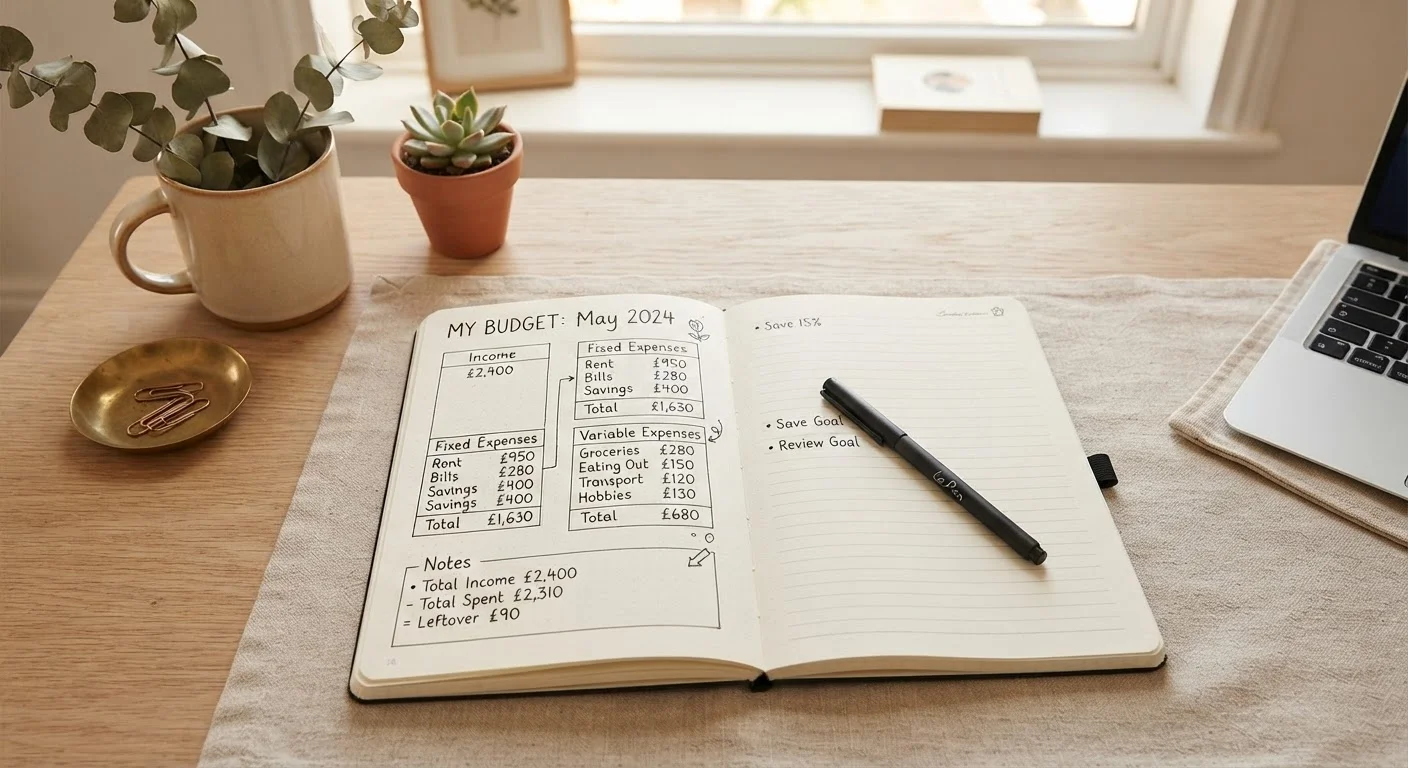
Strip away every assumption and a budget is nothing more than a written plan for your money. Before the month begins — or the paycheck arrives — you decide in advance which expenses get funded, how much goes to savings, and what's left over for everything else.
That's it. No complicated formulas. No judgment about your choices. A budget is a decision-making tool you build ahead of time so that when money arrives, you're directing it rather than wondering where it went.
For a deeper dive into vocabulary like net income, discretionary spending, and sinking funds, see Essential Budgeting Terms Defined — a plain-language reference for the terms that come up most often.
Start With One Month, Not a Year
New budgeters often try to plan twelve months at once, which quickly becomes overwhelming. Begin with a single month. Capture your income, list every expected expense, and assign the difference to savings or a specific goal. Revisit and refine the following month. Progress builds from repetition, not from perfection on day one.
What a Budget Is Not
Misconceptions about budgeting stop many people from starting. Here are the most persistent myths worth setting aside:
- A budget is not a punishment. It doesn't tell you that you can't buy coffee or go to a concert. It tells you how much you've decided you can spend on those things.
- A budget is not a sign you're struggling financially. Households at every income level use budgets — including those with significant wealth. Planning is not a symptom of scarcity.
- A budget is not set-in-stone. Life changes. So does a good budget. An irregular expense, a raise, or a new financial goal all warrant an update.
- A budget is not the same as being cheap. Generosity, travel, and personal enjoyment can all be budget line items. Budgeting is about intentionality, not minimalism.
Budgeting Myths That Keep People Stuck explores these beliefs in greater depth, fact-checking the assumptions that most commonly derail people before they start.
Budgets Look Different for Everyone
There is no universally correct budgeting format. Some people prefer percentage-based frameworks (like allocating 50% to needs, 30% to wants, and 20% to savings); others itemize every category in detail. What matters is that the format you use reflects your actual life and that you return to it regularly. A simple plan you actually use will always outperform a sophisticated one you abandon.
What a Budget Actually Does (and Doesn't Do)
Understanding a budget's real function prevents disappointment and keeps expectations grounded.
A budget gives you clarity. When you know exactly how much is allocated to rent, groceries, and savings, you make faster, more confident spending decisions. Clarity reduces financial anxiety — not because the numbers magically improve, but because uncertainty disappears.
A budget surfaces trade-offs. When income is fixed, choosing to spend more in one category means spending less in another. A budget makes those trade-offs visible, so you choose them deliberately rather than discover them after the fact.
A budget does not create money you don't have. If expenses outpace income, a budget shows you that gap clearly — which is useful — but it can't close the gap on its own. Addressing a deficit may require reducing expenses, increasing income, or both.
A budget does not run itself. Budgets require consistent review. An unused budget provides no benefit. The plan must be revisited, compared against actual spending, and adjusted as needed.
~1 in 3
U.S. adults who follow a written budget
Surveys by the National Foundation for Credit Counseling have consistently found that fewer than half of American adults maintain a detailed household budget.
3x
More likely to feel financially secure
Research published by the Consumer Financial Protection Bureau suggests that individuals who actively track and plan spending report significantly higher feelings of financial control compared to those who do not.
How to Think About Budgeting Going Forward
Once the myths are cleared away, budgeting becomes far less intimidating. Think of it as a monthly conversation you have with your finances — a check-in where you decide what matters most and make sure your money reflects those priorities.
Every effective budget shares three elements: a realistic picture of income, a complete list of expected expenses, and an explicit plan for the difference (whether that's savings, debt paydown, or a specific goal).
The format — spreadsheet, app, pencil and paper — matters far less than the habit of doing it consistently. If you're ready to put these ideas into practice, Personal Budgeting From the Ground Up is a step-by-step starting point. And if you find yourself abandoning the plan after a few weeks, Why Budgets Fall Apart After Week Two explains what typically goes wrong and how to course-correct.
This article is for general informational and educational purposes only and does not constitute personalised financial advice. Consult a qualified financial professional for guidance specific to your circumstances.