

Key Takeaways
- Zero-based budgeting assigns every dollar of income a specific purpose, leaving zero unallocated.
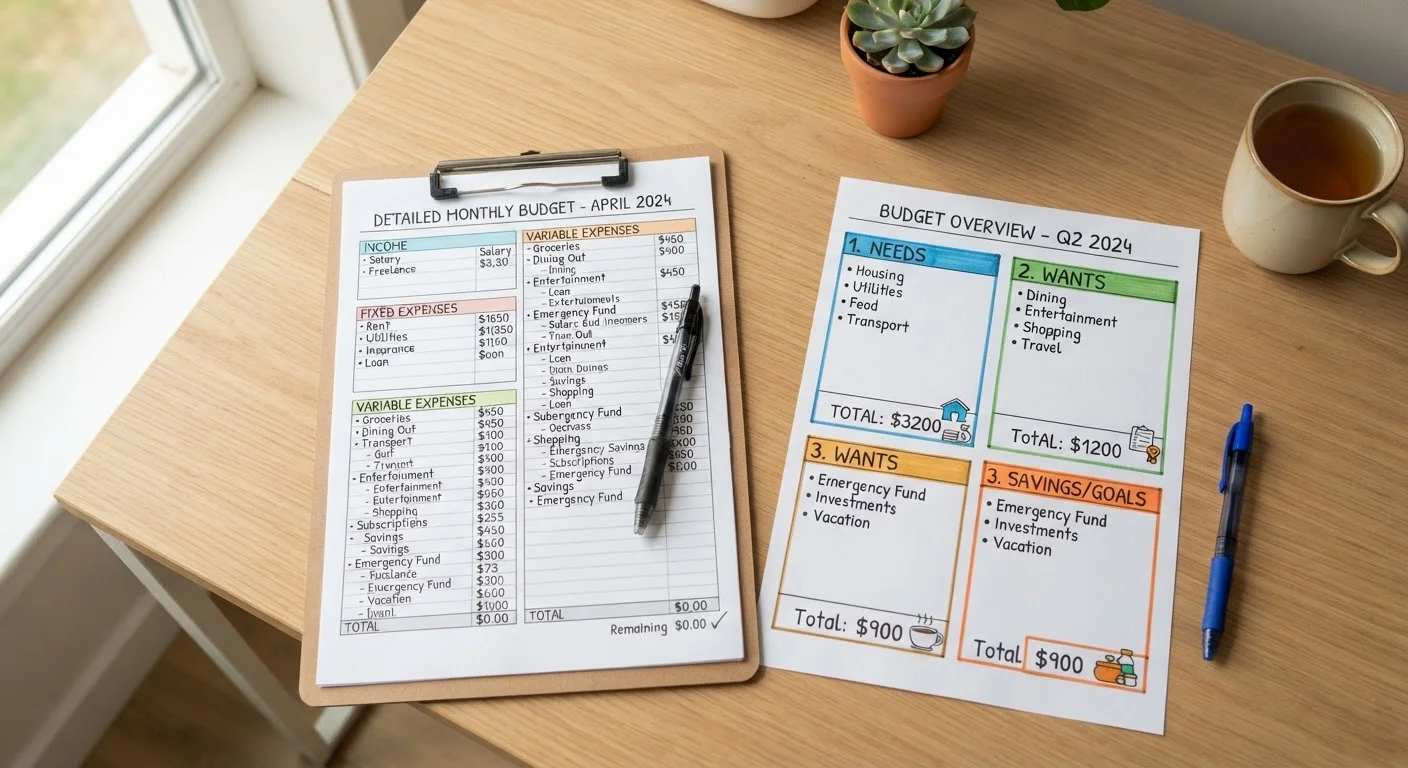
- The 50/30/20 rule divides income into three broad buckets: needs, wants, and savings.
- Zero-based budgeting demands more time but delivers granular spending insight.
- The 50/30/20 rule is easier to maintain but may lack precision for tight financial situations.
- Neither method is universally superior — the best choice depends on your income type and financial goals.
- Both frameworks are tools for general financial planning and not substitutes for professional financial advice.
Option A
Zero-Based Budgeting
The meticulous, dollar-by-dollar approach.
Best for: People who want complete visibility into every spending decision and are willing to invest time each month.
Option B
The 50/30/20 Rule
The streamlined, percentage-driven framework.
Best for: People who want a simple, sustainable structure without tracking every individual expense.
If you have variable or irregular income
Zero-Based Budgeting
Rebuilding the budget from scratch each month lets you adapt allocations to what you actually earned rather than a fixed percentage of an unpredictable figure.
If you want a low-effort budget you can stick to long-term
The 50/30/20 Rule
Three broad categories are easy to monitor and require minimal ongoing maintenance, making consistency more achievable.
If you are aggressively paying down debt or building an emergency fund
Zero-Based Budgeting
Deliberate dollar allocation makes it easier to redirect money toward a specific goal without anything slipping through the cracks.
If you have a stable salary and healthy savings habits already in place
The 50/30/20 Rule
A steady income makes percentage-based categories reliable, and structured savings allocation supports continued progress without micromanagement.
How Each Framework Works
Understanding the mechanics of each approach is the fastest way to judge which one fits your life. If you are new to budgeting in general, our introduction to personal budgeting covers the foundational concepts worth knowing before you choose a method.
Zero-Based Budgeting
Zero-based budgeting (ZBB) starts from zero every month. You take your expected take-home income and assign every dollar to a category — rent, groceries, debt repayment, savings, entertainment — until your income minus your allocations equals zero. That doesn't mean spending everything; savings and investments are categories too. The goal is that no dollar is unaccounted for.
The 50/30/20 Rule
The 50/30/20 rule, popularized in personal finance literature, divides after-tax income into three buckets: roughly 50% toward needs (housing, utilities, groceries, minimum debt payments), 30% toward wants (dining out, subscriptions, hobbies), and 20% toward savings and debt repayment above minimums. The percentages are guidelines, not rigid mandates — your situation may call for adjustments.
Key Differences at a Glance
The two frameworks share the same ultimate goal — intentional money management — but diverge significantly in structure, time commitment, and the control they give you.
| Criterion | Zero-Based Budgeting | The 50/30/20 Rule |
|---|---|---|
| Core structure | Every dollar assigned a category | Income split into three percentage buckets |
| Setup time | High — rebuilt each month | Low — set once, review periodically |
| Spending visibility | Very granular | Broad category level |
| Flexibility | High for reallocation; low for spontaneity | High within each bucket |
| Best income type | Variable or irregular | Stable, predictable |
| Ideal for specific goals | Yes — pinpoint allocation | Moderate — savings bucket is broad |
| Learning curve | Steeper | Gentle |
The most practical difference comes down to granularity versus simplicity. Zero-based budgeting surfaces exact spending patterns; the 50/30/20 rule gives you a high-level health check. For a deeper look at how these two methods compare alongside a third alternative, see this three-framework comparison.
Strengths and Limitations
Both methods have documented advantages — and both carry real trade-offs worth understanding before committing.
Zero-Based Budgeting
- Strengths: Eliminates mindless spending; forces deliberate prioritization; highly effective for debt payoff or savings goals.
- Limitations: Time-intensive to build and maintain each month; requires close tracking of actual spending against allocations; can feel rigid if life is unpredictable.
The 50/30/20 Rule
- Strengths: Fast to set up; easy to remember; forgiving enough to stick with long-term; works well with stable incomes.
- Limitations: Broad categories can mask overspending within a bucket; the 50% needs allocation may be unrealistic in high cost-of-living areas; less precise for specific goals.
~33%
Americans with a detailed monthly budget
Gallup polling has consistently found that fewer than one in three U.S. adults maintain a detailed household budget, suggesting most people rely on informal spending habits.
2–3 hrs
Typical monthly setup time for zero-based budgeting
Financial educators generally estimate that building and reconciling a zero-based budget takes two to three hours per month, compared to under 30 minutes for a percentage-based review.
If your income fluctuates month to month — as it does for freelancers or gig workers — zero-based budgeting's reset-from-scratch design is particularly useful. Our article on budgeting with irregular income explores this scenario in depth.
This article is for general informational and educational purposes only and does not constitute personalized financial advice. Consult a qualified financial professional for guidance tailored to your circumstances.
Making Your Choice — and Getting Started
There is no universally correct budgeting method. The right framework is the one you will actually use consistently. A few questions can help narrow it down:
- How stable is your income? Stable salary favors the 50/30/20 rule; variable income favors zero-based budgeting.
- How specific is your current goal? A precise goal — eliminating credit card debt in 18 months — benefits from zero-based budgeting's allocation precision.
- How much time can you commit? If monthly tracking feels daunting, the 50/30/20 rule's simplicity makes consistency more achievable.
Combining Elements From Both Methods
Some people find it useful to use the 50/30/20 rule as a starting framework and then apply zero-based budgeting logic within the needs category, where overspending is most common. This hybrid approach captures simplicity at the top level while adding precision where it matters most. There is no rule against mixing elements — what counts is deliberate, consistent tracking.
Once you have chosen a framework, the monthly budget reset checklist can help you review your progress and adjust at the end of each month. After your budgeting habit is stable, the next step is putting those savings to work — explore the Saving & Investing hub for foundational concepts on growing what you set aside.