
Putting Money in a Savings Account vs. Investing It: Thinking Through the Trade-Offs

Key Takeaways
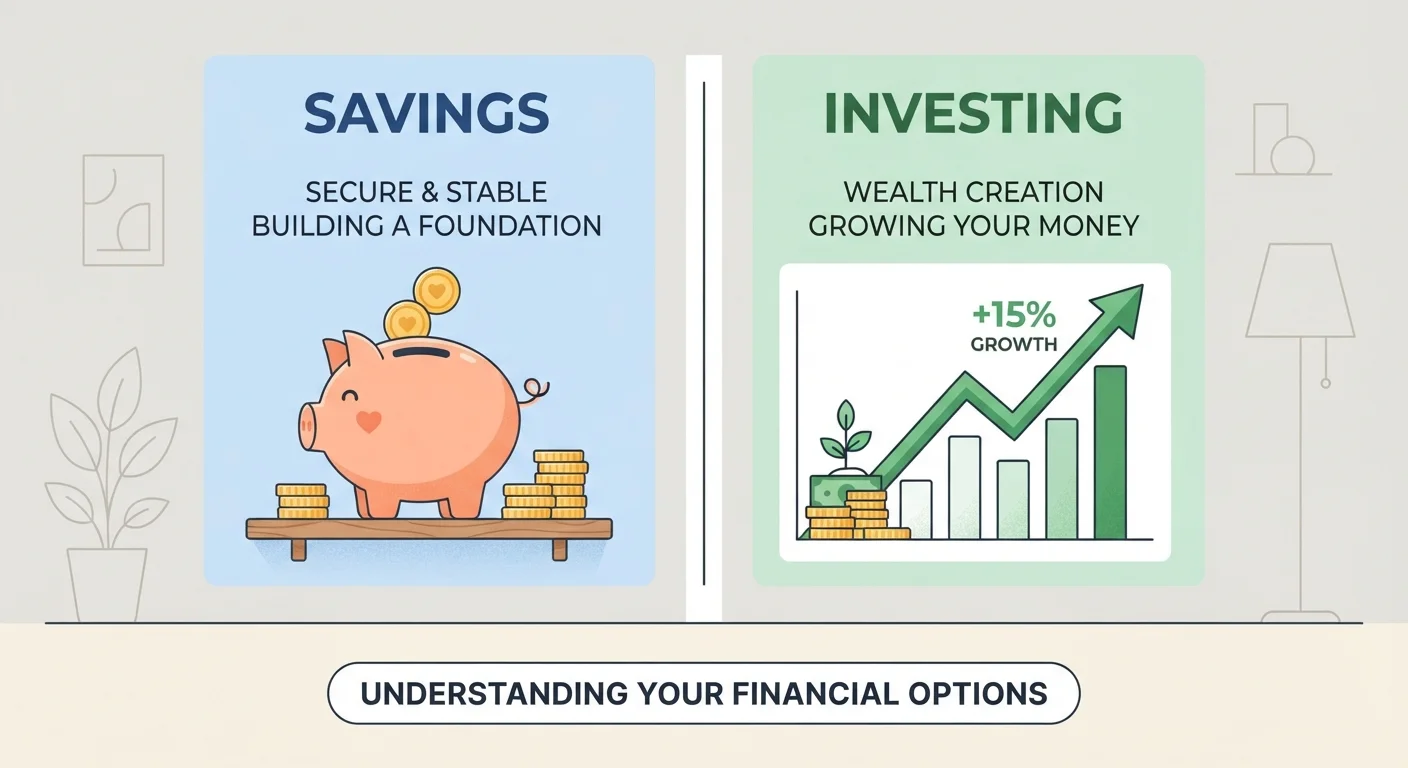
- Savings accounts protect principal and provide liquidity; investing involves risk but offers greater long-term growth potential.
- An emergency fund covering three to six months of expenses is widely recommended before prioritising investments.
- Time horizon is the single most important factor in deciding how much to save versus invest.
- Inflation can quietly erode the purchasing power of money left in low-yield savings accounts over time.
- Both tools serve distinct purposes and are most effective when used together in a personal financial plan.
Option A
Savings Account
The stable, accessible foundation for short-term needs.
Best for: Holding an emergency fund, short-term goals, and money you may need within the next one to three years.
Option B
Investing
The long-term growth engine with inherent risk.
Best for: Building wealth over a horizon of five or more years, such as retirement or long-term financial independence.
If you have no emergency fund yet
Savings Account
Building a cash cushion first protects you from having to sell investments at a loss during an unexpected expense or income disruption.
If your goal is at least five or more years away
Investing
Longer time horizons allow investment portfolios to recover from market downturns and benefit from compound growth over time.
If you need the money within one to two years
Savings Account
Short time horizons make market volatility a real risk; keeping funds in a savings account preserves their value when you need them.
If you carry high-interest debt
Savings Account
Paying down high-interest debt typically delivers a guaranteed 'return' that outpaces most investment gains on a risk-adjusted basis.
If your financial foundations are stable and your horizon is long
Investing
Once core savings are in place, investing gives surplus money the best structural opportunity to grow faster than inflation over decades.
What Each Approach Actually Does
A savings account is a deposit account held at a bank or credit union that earns interest while keeping your money safe and accessible. The principal — the amount you deposit — is protected, and in federally insured institutions, accounts are typically covered up to established limits by programs such as the FDIC (Federal Deposit Insurance Corporation) for banks or NCUA for credit unions. The trade-off is that interest rates on standard savings accounts are often modest, and over long periods, returns may not keep pace with inflation.
Investing means putting money into assets — such as stocks, bonds, mutual funds, or exchange-traded funds — with the expectation that they will grow in value over time. Unlike a savings account, investing carries risk: the value of investments can fall as well as rise, and there are no guarantees of returns. However, historically, diversified investment portfolios have generated higher average returns over long periods than savings accounts, which is why investing is commonly associated with long-term wealth building. For a grounded introduction to how risk works in this context, see The Role of Risk in Investing.
| Criterion | Savings Account | Investing |
|---|---|---|
| Principal protection | Yes (federally insured up to limits) | No — value can decline |
| Typical return potential | Low to moderate | Higher over long periods (not guaranteed) |
| Liquidity | High — easy access to funds | Variable — selling at wrong time risks loss |
| Best time horizon | Short term (0–3 years) | Long term (5+ years) |
| Inflation risk | Moderate — may not keep pace | Lower over long periods historically |
| Complexity | Simple — deposit and earn interest | Requires more understanding and decisions |
The Role of Time Horizon and Liquidity
The most practical way to think about this choice is through two lenses: when you'll need the money, and how quickly you need to be able to access it.
If you anticipate needing funds within one to three years — for a home repair, a car, or an upcoming large purchase — a savings account is generally more appropriate. Markets can decline significantly over short periods, and if you need to withdraw during a downturn, you could end up with less than you put in. Savings accounts let you access money quickly without that uncertainty.
If your goal is further out — retirement, for example, or building a larger asset base over a decade or more — investing becomes more relevant. The longer the time horizon, the more opportunity there is to ride out periods of market volatility and benefit from the compounding effect of returns over time. To understand how compounding works in practice, Compound Interest: The Concept That Powers Long-Term Saving provides a clear explanation.
3–6 months
Recommended emergency fund size
Financial educators broadly recommend this range of living expenses as a cash buffer before prioritising investments.
5+ years
Suggested minimum investment horizon
A longer time horizon is generally advised to weather market volatility and give investments meaningful time to grow.
Liquidity — how quickly and easily you can convert an asset to cash without loss — is another key distinction. Savings accounts are highly liquid. Many investments, while accessible in principle, can lose value if sold at the wrong moment.
Building the Foundation: Why Savings Often Come First
Most financial educators suggest establishing a solid savings base before directing significant money toward investments. The core reasoning: without a cash buffer, an unexpected expense — a medical bill, job loss, or urgent repair — can force you to sell investments at an inopportune time, potentially locking in a loss.
A commonly cited guideline is maintaining an emergency fund covering three to six months of essential living expenses in a readily accessible account. This isn't a universal rule, and individual circumstances vary widely, but the underlying principle is sound: liquidity provides stability that investments cannot reliably offer in the short term.
Once that foundation is in place, many people find it worthwhile to explore whether any surplus income could be directed toward investments — but that decision depends on personal goals, debt levels, income stability, and risk tolerance. The Before You Invest checklist is a useful self-assessment tool before taking that step.
Everyone's Starting Point Is Different
There's no single correct order of financial priorities. Someone with stable income and no high-interest debt may be comfortable building savings and beginning to invest simultaneously. Others may need to address debt or income variability first. These decisions are personal, and a licensed financial adviser can help you map out an approach suited to your circumstances.
For those looking to improve how they track spending and set aside money consistently, Budgeting Basics offers accessible frameworks to get started.
Thinking About Both Together
Savings accounts and investing aren't competing choices — they're complementary tools that serve different roles within an overall financial picture. Most people benefit from having both: a cash reserve for near-term needs and stability, and an investment component aimed at longer-term growth.
One practical consideration worth noting is inflation. Money sitting in a low-interest savings account gradually loses purchasing power if the interest rate doesn't keep pace with rising prices. This doesn't mean savings accounts are a poor choice — they're essential for certain purposes — but it does suggest that holding more than you need for liquidity and near-term goals in a low-yield account may work against long-term financial resilience. For details on one savings option with more competitive rates, see High-Yield Savings Accounts: How They Work and What to Watch For.
Ultimately, the right balance depends on your specific situation. If you're new to investing and want to understand what opening an account actually involves, Your First Investment Account: What to Expect Before You Open One is a practical starting point. And for building consistent habits that support both saving and investing over time, Habits That Support Long-Term Financial Resilience offers evidence-informed guidance.
This article is for general informational and educational purposes only and does not constitute personalised financial, investment, tax, or legal advice. Consult a qualified financial adviser before making decisions based on your individual circumstances.