

Key Takeaways
- Not all product claims carry the same legal weight — some are regulated, many are not.
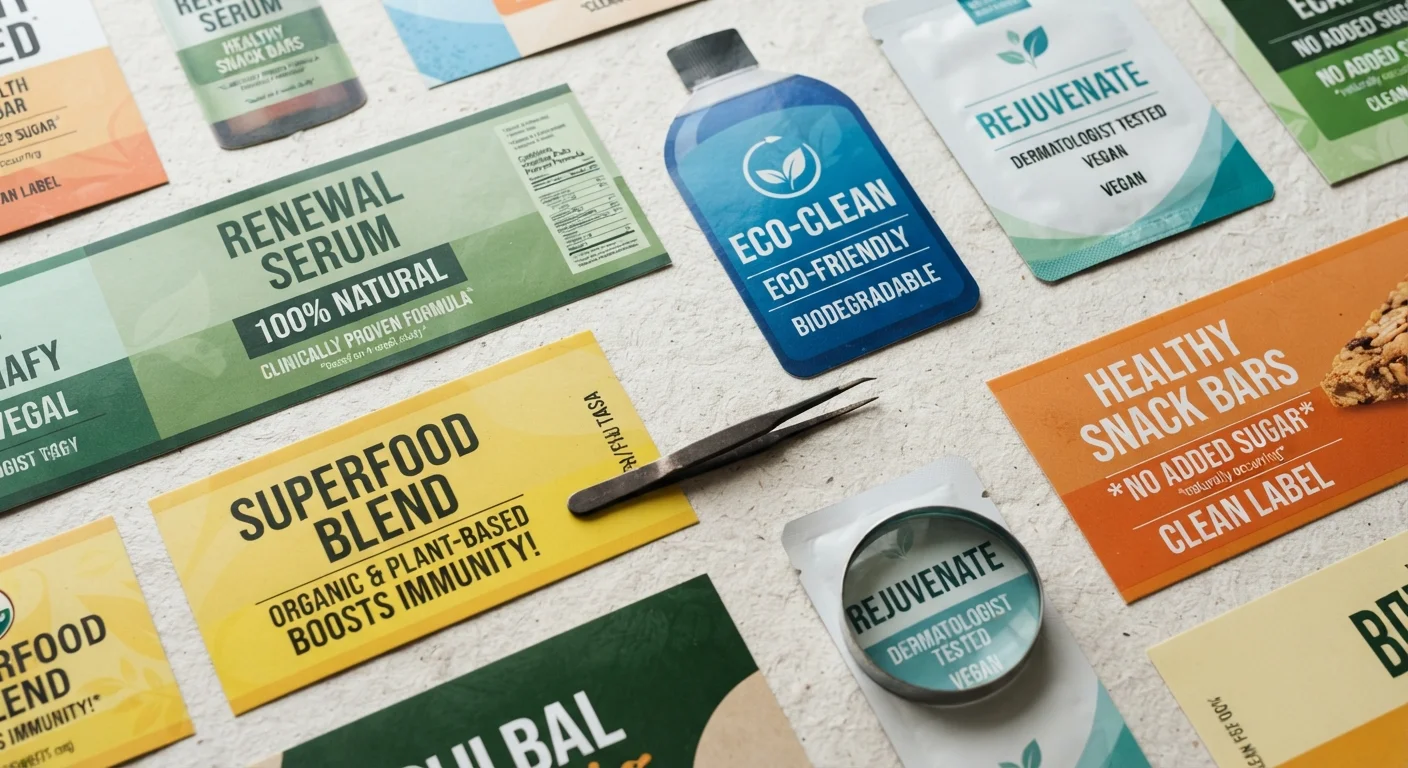
- Words like 'natural,' 'clean,' and 'eco-friendly' have no universal legal definitions in most product categories.
- Health claims on food and supplement packaging are subject to stricter federal rules than general advertising language.
- Vague superlatives like 'best' or 'most effective' are typically classified as non-provable 'puffery.'
- The FTC requires that objective advertising claims be backed by competent and reliable evidence.
- Reading claims critically — and checking for specifics — is your strongest defense against marketing spin.
Product Claim
A product claim is any statement a brand makes about what its product does, contains, or represents — on packaging, in ads, or online. These claims range from tightly regulated and legally enforceable to completely unregulated and purely subjective. Understanding the difference helps you evaluate what a product can actually deliver versus what it's simply implying.
In the U.S., the Federal Trade Commission (FTC) oversees advertising claims, while the Food and Drug Administration (FDA) regulates specific categories like drugs, food labels, and cosmetics. Enforcement thresholds and evidentiary standards vary significantly across those agencies and product types.
The Spectrum: Regulated Claims vs. Pure Spin
Not every phrase on a product label operates under the same rules. U.S. law creates a rough spectrum — from claims that require documented evidence to claims that exist in a virtually accountability-free zone.
At the regulated end sit express claims: objective, verifiable statements like a specific test result, a certified ingredient percentage, or an FDA-approved drug indication. These must be substantiated. In the middle are implied claims — language or imagery that suggests a benefit without stating it outright. Courts and regulators evaluate implied claims by asking what a reasonable consumer would take away. At the far end sits puffery: vague superlatives and subjective bravado ('the ultimate clean,' 'unmatched performance') that no reasonable person would interpret as a literal fact. The FTC generally won't pursue puffery as false advertising.
The practical takeaway: the more specific and objective a claim sounds, the higher the legal bar — and the more you should demand evidence.
~42%
Green claims found to be exaggerated or false
A 2021 European Commission screening of websites found approximately 42% of green claims were exaggerated, false, or deceptive — a pattern consumer advocates cite in U.S. markets as well.
No standard
Federal definition of 'natural' for personal care
The FDA has not established a formal regulatory definition of 'natural' for cosmetics or personal care products, leaving its use largely at a brand's discretion.
Disclaimer required
Structure/function claims on supplements
The FDA requires all structure/function claims on dietary supplement labels to carry a disclaimer stating the claim has not been FDA-evaluated and the product is not intended to diagnose, treat, or prevent disease.
Words That Sound Official but Aren't
Certain terms appear constantly on packaging yet carry no standardized legal definition for most product categories. Recognizing them is a foundational consumer skill.
- Natural: For food, the FDA has issued informal guidance but no formal definition. For personal care and cleaning products, there is none. A product with one plant-derived ingredient can legally use it.
- Clean: An entirely marketing-invented term. No regulatory body defines 'clean beauty' or 'clean formula.'
- Eco-friendly / Sustainable / Green: The FTC's Green Guides advise against unqualified environmental claims, but compliance is voluntary guidance, not a hard rule. Look for third-party certification rather than a self-applied label.
- Dermatologist recommended: This phrase doesn't specify how many dermatologists, whether they were paid, or what they were comparing the product to.
- Clinically tested: Tested, yes — but 'tested' says nothing about the outcome. Check whether results are published and peer-reviewed.
For a related look at how these ambiguities play out on electronics packaging specifically, see what home electronics packaging often leaves unsaid.
“Advertising is not required to be the whole truth — it is required not to be deceptive. That gap between those two standards is where most marketing lives.”
— Ivan Preston, Professor Emeritus of Advertising, University of Wisconsin–Madison, and author of research on advertising puffery and deception
Health and Supplement Claims: A Stricter but Still Complex Zone
Food, drug, and dietary supplement claims operate under more formal rules — but those rules still leave room for consumer confusion.
The FDA distinguishes between health claims (a relationship between a nutrient and a disease, requiring FDA authorization), structure/function claims (describing a nutrient's role in normal body function, no pre-approval required), and nutrient content claims (standardized terms like 'low sodium' or 'high fiber' with defined thresholds). Supplement labels using structure/function claims must include a disclaimer that the FDA has not evaluated the statement and the product is not intended to diagnose or treat any disease.
In practice, consumers often skim past that disclaimer. The key question to ask: does this claim describe a normal body function, or is it implying this product will fix something? If it feels like the latter, regulatory scrutiny — and your own — should increase.
Read the Required Disclaimer First
On dietary supplements, the structure/function claim disclaimer — 'This statement has not been evaluated by the Food and Drug Administration' — is legally required and tells you immediately that no FDA review of the specific claim has occurred. Spotting that line quickly helps you calibrate how much weight to give the surrounding health language.
Applying a Critical Framework When You Shop
Once you understand the landscape, you can build a fast mental checklist before a claim influences a purchase decision.
- Is the claim objective or subjective? Objective claims (specific percentages, test results, certifications) can be checked. Subjective ones ('luxurious,' 'revolutionary') cannot and should be discounted.
- Who is making the claim? A self-declared label means little. A named third-party certification — with a verifiable standard behind it — means more.
- Is evidence cited? If a brand references a study, consider whether it's published, independent, and appropriately sized for the conclusions drawn.
- What is the claim not saying? 'Up to 50% more effective' implies that most users see far less. 'Contains antioxidants' says nothing about quantity or bioavailability.
This same critical lens applies beyond product packaging. Understanding how promotional content itself is disclosed — or obscured — matters too. See how sponsored content and affiliate links work to round out your media literacy. And if a product's promise extends to what it's covered against post-purchase, understanding what a warranty actually covers is equally worth your time.
This article is for general informational and educational purposes only. It does not constitute legal, regulatory, or professional advice. Regulatory rules and agency guidance can change; consult official agency sources or a qualified professional for advice specific to your situation.