
Wi-Fi, Zigbee, Z-Wave, and Thread: The Wireless Protocols Behind Your Smart Home

| Wi-Fi Frequency | 2.4 GHz or 5 GHz |
| Zigbee Frequency | 2.4 GHz |
| Z-Wave Frequency (US) | ~908 MHz |
| Thread Network Type | IPv6 mesh |
| Hub Required | Zigbee, Z-Wave, and Thread all need a hub or border router; Wi-Fi does not |
| Matter Standard Uses | Thread (and Wi-Fi) as its transport layer |
Why the Protocol Matters More Than You Might Think
When a smart light bulb or door lock stops responding, the culprit is often not the device itself but the wireless protocol underneath it. The protocol determines how devices talk to each other, how far that signal travels, how much battery each transmission uses, and whether devices from different brands can cooperate at all.
Most smart home products rely on one of four protocols: Wi-Fi, Zigbee, Z-Wave, or Thread. Understanding the core differences helps you avoid compatibility headaches and build a setup that actually holds together. If you're still getting familiar with how smart home ecosystems work at a higher level, our overview of smart home ecosystems is a useful starting point.
| Wi-Fi Frequency | 2.4 GHz or 5 GHz |
| Zigbee Frequency | 2.4 GHz |
| Z-Wave Frequency (US) | ~908 MHz |
| Thread Network Type | IPv6 mesh |
| Hub Required | Zigbee, Z-Wave, and Thread all need a hub or border router; Wi-Fi does not |
| Matter Standard Uses | Thread (and Wi-Fi) as its transport layer |
The Four Protocols, Explained
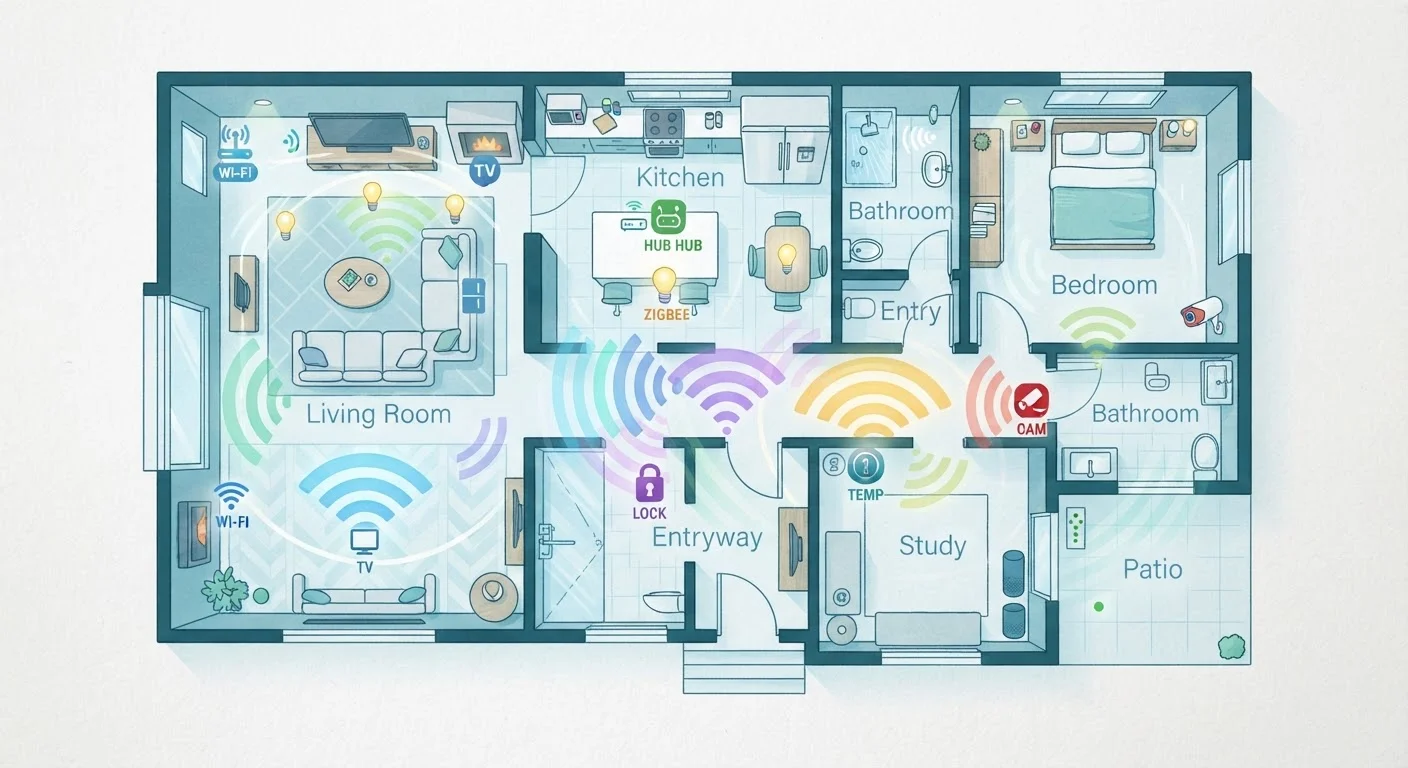
Wi-Fi is the most familiar option. Devices connect directly to your home router, require no additional hub, and generally offer the fastest response times. The trade-off is power consumption — Wi-Fi radios draw significantly more energy, making them a poor fit for battery-powered sensors or locks that need to last months between charges. Wi-Fi also adds load to your router; a home with dozens of smart devices can strain networks not designed for that density.
Zigbee operates on the 2.4 GHz band and uses a mesh network architecture, meaning devices can relay signals through one another rather than connecting directly to a central hub. This extends range and improves reliability in larger homes. Zigbee is highly power-efficient, making it well-suited to sensors, switches, and other battery-dependent devices. It does require a compatible hub or coordinator. Different manufacturers have historically implemented Zigbee in slightly incompatible ways, though the standard has matured considerably.
Z-Wave operates on a sub-gigahertz frequency (around 908 MHz in the US), which passes more easily through walls and generates less interference from other household electronics. Like Zigbee, it uses mesh networking and requires a hub. Z-Wave has a stricter certification process than Zigbee, which has historically made cross-brand compatibility more predictable. The downside is that the ecosystem of compatible devices is smaller.
Thread is the newest of the four. It is an IPv6-based mesh protocol designed from the ground up for low-power IoT devices. Thread does not replace your internet connection — it needs a Thread Border Router (often built into a smart speaker or hub) to bridge to the internet. Thread underpins Matter, the cross-industry interoperability standard backed by major platform makers, positioning it as a significant part of the smart home's future.
Mesh Network
A network topology where devices relay signals to one another rather than all connecting to a single central point. This extends range and makes the overall network more resilient to individual device failures.
Hub / Coordinator
A central device that manages communication across a Zigbee, Z-Wave, or Thread network and bridges those devices to your home internet connection.
Thread Border Router
A device — often a smart speaker or hub — that connects a Thread mesh network to the broader IP internet, acting as a gateway between the two.
Matter
An open interoperability standard developed by the Connectivity Standards Alliance that allows smart home devices from different brands to work together. Matter uses Thread and Wi-Fi as its underlying transport protocols.
IPv6
The current generation internet addressing protocol. Thread uses IPv6 to give each device a unique network address, enabling direct, standardized communication between devices.
Choosing the Right Protocol for Your Situation
There is no universally correct answer, but there are sensible patterns. Wi-Fi devices make sense when power is always available and you want to avoid adding a hub — think smart TVs, video doorbells, or appliances already near an outlet. Zigbee and Z-Wave are strong choices for battery-powered sensors, large device counts, or setups where reliability in every room matters more than raw speed. Thread is worth considering if you are starting fresh and want a setup likely to remain compatible with evolving standards over time.
Many households end up using more than one protocol — a Zigbee hub for sensors, Wi-Fi for cameras, and Thread-based devices entering the mix gradually. First-time smart home builders benefit from mapping out which protocols a chosen hub supports before buying individual devices.
Security is also relevant here — every wireless protocol introduces a potential attack surface. Smart home security principles apply regardless of which protocol your devices use. And before adding any new device to your network, it's worth running through a compatibility and setup checklist to avoid common friction points.
A Note on Network Congestion
Wi-Fi smart devices share bandwidth with your computers, phones, and streaming equipment. Homes with many Wi-Fi devices may notice slowdowns if the router cannot efficiently manage concurrent connections. Several widespread beliefs about home networks contribute to poor planning decisions here — it's worth understanding what actually affects performance before scaling up.