

| Minimum coverage type required in most U.S. states | Bodily injury & property damage liability (Insurance Information Institute) |
| States requiring Personal Injury Protection (PIP) | 12 no-fault states (plus several optional states) (Insurance Information Institute) |
| Typical liability limit format | Split limit (e.g., 25/50/25) or combined single limit (Industry standard notation) |
| Comprehensive & collision — required by law? | No — but usually required by lenders/lessors (General lending industry practice) |
The Core Coverage Types — and What Separates Them
Auto insurance policies bundle several distinct coverages under one document, and confusing them is one of the most common reasons drivers end up underprotected. Here's how the foundational types actually differ.
Liability coverage is the foundation of nearly every U.S. auto policy. It pays for other people's injuries and property damage when you are at fault in an accident. It does not pay for your own vehicle or your own medical bills. Liability limits are typically written in a split format — for example, 100/300/100 — representing maximum payouts per person injured, per accident, and for property damage respectively. For a fuller breakdown of how liability works and where gaps commonly appear, see our liability coverage explainer.
Collision coverage pays to repair or replace your vehicle after a crash with another car or a stationary object — a guardrail, a pole, or a parked car. Fault generally doesn't affect whether collision pays out, but your deductible applies.
Comprehensive coverage handles losses that aren't collision-related: theft, fire, hail, flooding, a deer strike, or a tree branch. Despite the name, it doesn't cover everything — read your policy's exclusions carefully.
Together, collision and comprehensive are often called physical damage coverage. Lenders and leasing companies typically require both when you're financing or leasing a vehicle.
| Minimum coverage type required in most U.S. states | Bodily injury & property damage liability (Insurance Information Institute) |
| States requiring Personal Injury Protection (PIP) | 12 no-fault states (plus several optional states) (Insurance Information Institute) |
| Typical liability limit format | Split limit (e.g., 25/50/25) or combined single limit (Industry standard notation) |
| Comprehensive & collision — required by law? | No — but usually required by lenders/lessors (General lending industry practice) |
Liability Limits, PIP, and Uninsured Motorist — The Details That Matter
Beyond the three core types, several additional coverages fill critical gaps that basic liability leaves open.
Personal Injury Protection (PIP) — sometimes called no-fault coverage — pays for medical expenses, lost wages, and related costs for you and your passengers after an accident, regardless of who caused it. It's mandatory in no-fault states and available as an option in others.
Medical Payments (MedPay) is a narrower version of PIP available in some states. It covers medical and funeral expenses for you and your passengers but generally not lost wages or other costs PIP may include.
Uninsured/Underinsured Motorist (UM/UIM) coverage steps in when the driver who hit you either has no insurance or doesn't carry enough to cover your damages. Given that a meaningful share of drivers on U.S. roads are uninsured at any given time, this coverage addresses a real and frequent risk.
Coverage Requirements Vary by State
Every U.S. state sets its own minimum auto insurance requirements. Most require at least some liability coverage, but the specific minimums — and whether additional coverages like personal injury protection are mandatory — differ significantly by state. Always verify your state's requirements with your state's department of insurance or a licensed agent. General information in this article does not substitute for advice tailored to your situation.
If you're building a policy from scratch or reviewing an existing one, this introduction to auto insurance for first-time policyholders offers useful context on how these pieces fit together. You can also explore optional add-ons like roadside assistance and rental reimbursement before deciding what to decline.
Key Terms That Affect What You Pay and What You Receive
Understanding coverage types is only half the equation. The financial terms built into your policy determine how much of any claim actually ends up in your pocket.
Premium
The amount you pay — typically monthly, semi-annually, or annually — to keep your auto insurance policy active. Your premium is calculated based on factors like your driving history, vehicle type, location, and chosen coverage levels.
Deductible
The out-of-pocket amount you agree to pay before your insurance covers the remainder of a claim. For example, a $500 deductible on a $2,000 repair means you pay $500 and your insurer covers $1,500.
Coverage Limit
The maximum dollar amount your insurer will pay for a covered loss. Any costs beyond this limit are your responsibility, which is why matching limits to your actual financial exposure matters.
Liability Coverage
Insurance that pays for injuries or property damage you cause to others in an accident. It does not cover your own vehicle or your own medical expenses.
Collision Coverage
Pays to repair or replace your vehicle after it's damaged in a collision with another vehicle or object, regardless of who is at fault.
Comprehensive Coverage
Covers vehicle damage from non-collision events such as theft, fire, hail, flooding, falling objects, and animal strikes. Often paired with collision coverage.
Uninsured/Underinsured Motorist
Coverage that protects you when the at-fault driver either has no insurance or insufficient coverage to pay for your damages or injuries.
Declarations Page
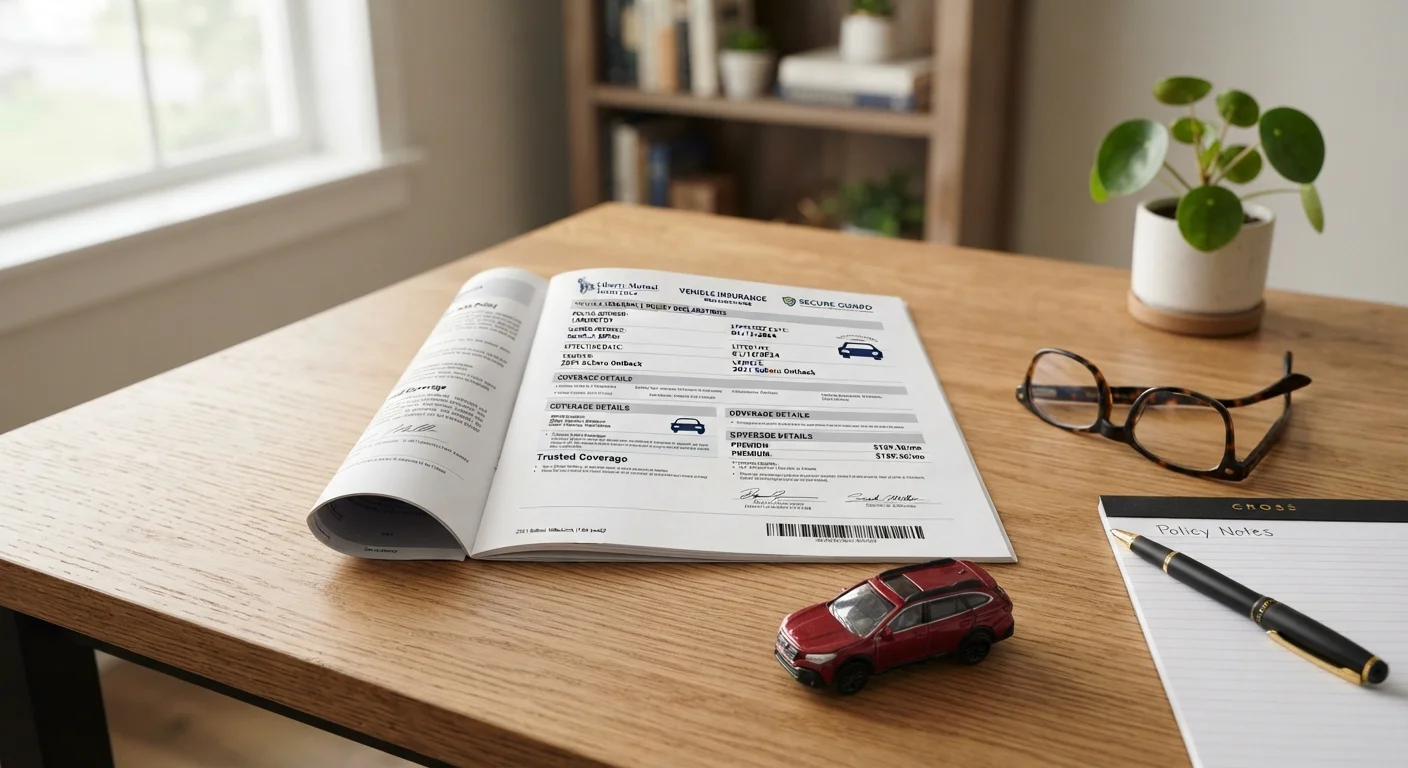
A summary page at the start of your policy listing the named insured, covered vehicles, coverage types, limits, deductibles, and policy period. It is the fastest way to review what you actually have.
Your premium is what you pay to maintain coverage; your deductible is what you pay when you make a claim. Choosing a higher deductible lowers your premium but increases your out-of-pocket cost after a loss — that trade-off is worth weighing against your savings cushion, not just the monthly payment.
Coverage limits are ceilings, not guarantees. If your liability limit is $25,000 in property damage but you total someone's vehicle worth $40,000, you may be personally responsible for the $15,000 gap. Selecting limits that reflect your actual financial exposure — rather than the state minimum — is a decision worth discussing with a licensed insurance agent.
To navigate the full language of your policy document, our declarations page guide walks through every section line by line. For broader insurance terminology beyond auto, our plain-language insurance glossary covers premiums, exclusions, riders, and more.
This article is for general informational purposes only and does not constitute personalized insurance, financial, or legal advice. Coverage requirements, terms, and availability vary by state and insurer. Consult a licensed insurance agent or your state's department of insurance for guidance specific to your situation.