

Key Takeaways
- Most car batteries last three to five years, regardless of how well the vehicle is maintained.
- Slow engine cranking is one of the earliest and most reliable signs of battery decline.
- Corrosion on battery terminals can accelerate discharge and mimic a failing battery.
- Electrical accessories behaving erratically often point to insufficient battery voltage.
- A battery load test, available at many auto parts stores, gives a definitive health reading.
Why Battery Health Deserves Your Attention
A dead battery is one of the most common reasons drivers end up stranded — and one of the most preventable. Unlike a blown tire or a cracked windshield, battery failure tends to be gradual, announcing itself through a pattern of small, easy-to-dismiss signals before it quits entirely.
Most standard lead-acid automotive batteries have a service life of roughly three to five years under normal driving conditions. Extreme heat, frequent short trips, and extended periods of inactivity can all shorten that window. Knowing what to look for means you can act before an inconvenient moment becomes a roadside emergency.
The warning signs below are worth understanding whether your battery is approaching the two-year mark or you've lost track of when it was last replaced. For a broader picture of routine upkeep, see our guide on car maintenance across the full vehicle lifespan.
Slow or laboured engine cranking
When you turn the key or press the start button, the battery delivers a surge of power to the starter motor. As a battery ages and loses capacity, that surge weakens — and the engine takes longer to turn over. You might notice the cranking sounds sluggish, lower-pitched, or drawn out before the engine catches.
This is often the first noticeable symptom and tends to be most pronounced on cold mornings, when both the battery and the engine oil are less cooperative. Don't mistake occasional slow starts for a temperamental engine — if it's happening regularly, have the battery tested.
Sluggish cranking on cold mornings is often the first reliable sign of battery decline.
Frequent need to jump-start the vehicle
Jump-starting a car once after leaving the lights on is understandable. Needing a jump two or three times in a month — without an obvious reason — is a strong indication the battery is struggling to hold a charge. A healthy battery, once recharged by the alternator during a drive, should retain enough power to start the car reliably for days or even weeks.
If jump-starts are becoming routine, the battery's internal cells may have degraded to the point where they can no longer store adequate energy.
Repeated jump-starts without a clear cause suggest a battery that can no longer hold a charge.
Electrical accessories behaving erratically
Your car's electrical system — headlights, interior lights, power windows, infotainment screen — draws power from the battery and the alternator. When battery voltage drops below normal operating levels, these systems can dim, flicker, respond slowly, or reset unexpectedly.
Headlights that appear noticeably dimmer at idle, or a radio that loses its saved settings after the car sits overnight, are worth paying attention to. These aren't necessarily isolated faults in each component — they may all share a single root cause: insufficient battery output.
Dimming headlights and resetting electronics often share a single culprit — low battery voltage.
Visible corrosion on the battery terminals
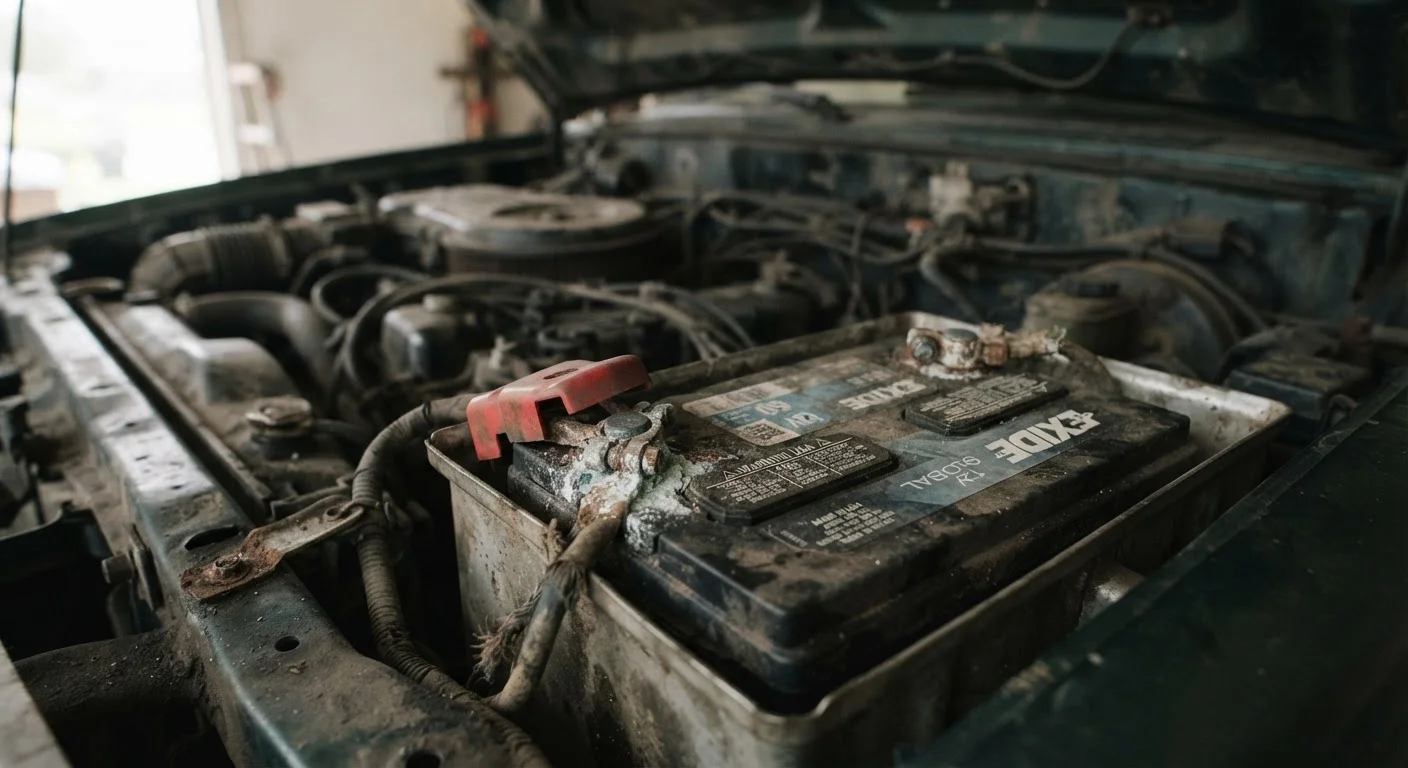
A white, blue, or greenish powder around the positive and negative battery terminals is a sign of corrosion. This buildup is caused by a chemical reaction between battery acid vapours and the metal connectors. Beyond being a visual flag, corrosion increases electrical resistance at the connection point — meaning less power gets through to start the car and less charge flows back in from the alternator.
Mild corrosion can sometimes be cleaned with a solution of baking soda and water (with the battery disconnected and proper precautions taken), but heavy or recurring corrosion may indicate the battery casing is venting excessively — a sign it's near the end of its useful life. Any work near battery terminals carries a risk of electrical shock or sparks; if you're unsure, have a technician handle it.
Corrosion at battery terminals raises electrical resistance and can mimic the symptoms of a failing battery.
The battery is three or more years old
Age alone is a meaningful data point. A battery that's three years old isn't necessarily failing, but it has entered the window where degradation accelerates. At four or five years, the likelihood of unexpected failure rises considerably — even if the battery seems to be performing normally day to day.
If you don't know when your battery was last replaced, a technician can often date it from a sticker on the battery casing. Building an annual battery check into your maintenance routine — particularly before winter — can catch problems before they strand you. The seasonal car maintenance guide outlines the ideal timing for these inspections throughout the year.
At three to five years old, even a seemingly healthy battery warrants a professional load test.
A swollen or misshapen battery case
In high-heat environments — or if a battery has been overcharged — the internal gases can cause the battery casing to swell or bulge. A swollen battery is no longer operating safely and should be treated as a failure requiring immediate professional attention. Do not attempt to charge or jump-start a visibly deformed battery.
This is a less common symptom than slow cranking or corrosion, but it's one of the clearer physical indicators that a battery has reached end of life.
A swollen battery case is a safety concern — have it inspected and replaced without delay.
When to Act — and Who Can Help
Recognising these signs early gives you options. A qualified mechanic or battery technician can perform a load test — a diagnostic check that measures how well the battery holds voltage under real operating conditions — to give you a definitive answer. Many auto parts retailers also offer free or low-cost battery testing if you prefer a quick first look.
Get a Load Test Before You're Stranded
A battery can pass a basic voltage check while still failing under real starting conditions. A load test applies a simulated electrical demand to the battery and measures how well it maintains voltage — giving a much more accurate picture of remaining capacity. Ask for a load test specifically, not just a voltage reading, when having your battery assessed.
If your dashboard battery light stays on after startup, don't dismiss it. That light can indicate a problem with the battery itself, the alternator (the component that recharges the battery while driving), or the charging circuit. Our article on what your car's warning lights are actually telling you breaks down what each symbol means and when it needs prompt attention.
Battery replacement is generally a straightforward job, but some modern vehicles — particularly those with advanced electronics or start-stop systems — require recalibration after a new battery is fitted. In those cases, professional installation is the safer choice. If you're heading into colder months, battery health deserves a dedicated pre-season check; seasonal car maintenance covers exactly what to inspect and when.
This article is for general informational purposes only. Always consult a qualified automotive technician for diagnosis, repair decisions, or any work involving your vehicle's electrical systems.