

| Typical recommended PSI range | 30–35 PSI (passenger vehicles) (Check your door-jamb sticker for your vehicle's exact specification) |
| US federal minimum tread depth | 2/32 inch (≈1.6 mm) (Federal Motor Vehicle Safety Standards) |
| Recommended replacement threshold | 4/32 inch (≈3.2 mm) (Widely recommended by safety organizations for wet-weather driving) |
| Average monthly pressure loss | 1–2 PSI (Normal permeation through tyre rubber) |
| Pressure drop per temperature change | ~1 PSI per 10°F decrease (General principle of gas behavior in sealed environments) |
| Best time to measure pressure | When tyres are cold (parked 3+ hours or driven under 1 mile) |
The Two Numbers That Determine Tyre Safety
Two measurements govern whether your tyres are keeping you safe: PSI (pounds per square inch), the pressure of air inside each tyre, and tread depth, the amount of rubber remaining between the road and your wheel. Get either wrong and you're dealing with degraded braking, reduced grip, and an increased risk of a sudden failure.
| Typical recommended PSI range | 30–35 PSI (passenger vehicles) (Check your door-jamb sticker for your vehicle's exact specification) |
| US federal minimum tread depth | 2/32 inch (≈1.6 mm) (Federal Motor Vehicle Safety Standards) |
| Recommended replacement threshold | 4/32 inch (≈3.2 mm) (Widely recommended by safety organizations for wet-weather driving) |
| Average monthly pressure loss | 1–2 PSI (Normal permeation through tyre rubber) |
| Pressure drop per temperature change | ~1 PSI per 10°F decrease (General principle of gas behavior in sealed environments) |
| Best time to measure pressure | When tyres are cold (parked 3+ hours or driven under 1 mile) |
Most passenger vehicles require tyre pressure somewhere between 30 and 35 PSI, but the only number that matters for your car is the one specified by the manufacturer — not the maximum figure moulded into the tyre sidewall, which describes the tyre's structural limit, not its recommended operating pressure. Your correct PSI is printed on a sticker inside the driver's door jamb or in your owner's manual. See how to navigate your owner's manual for help finding vehicle-specific figures.
For tread depth, the federal legal minimum in the US is 2/32 of an inch (roughly 1.6 mm). Most safety organizations recommend replacing tyres at 4/32 inch (about 3.2 mm) — especially if you drive in wet conditions — because stopping distances increase significantly below that threshold.
How to Check Both at Home
You don't need a mechanic visit to verify either measurement. Here's how to do both reliably with minimal tools.
Checking Tyre Pressure
- Use a quality gauge. Digital or dial-style gauges from any auto parts store provide accurate readings. The free gauges at petrol stations vary in reliability.
- Check when tyres are cold. Drive less than a mile before measuring, or let the vehicle sit for at least three hours. Tyre pressure rises as rubber heats up, so a hot reading will be higher than the actual cold baseline.
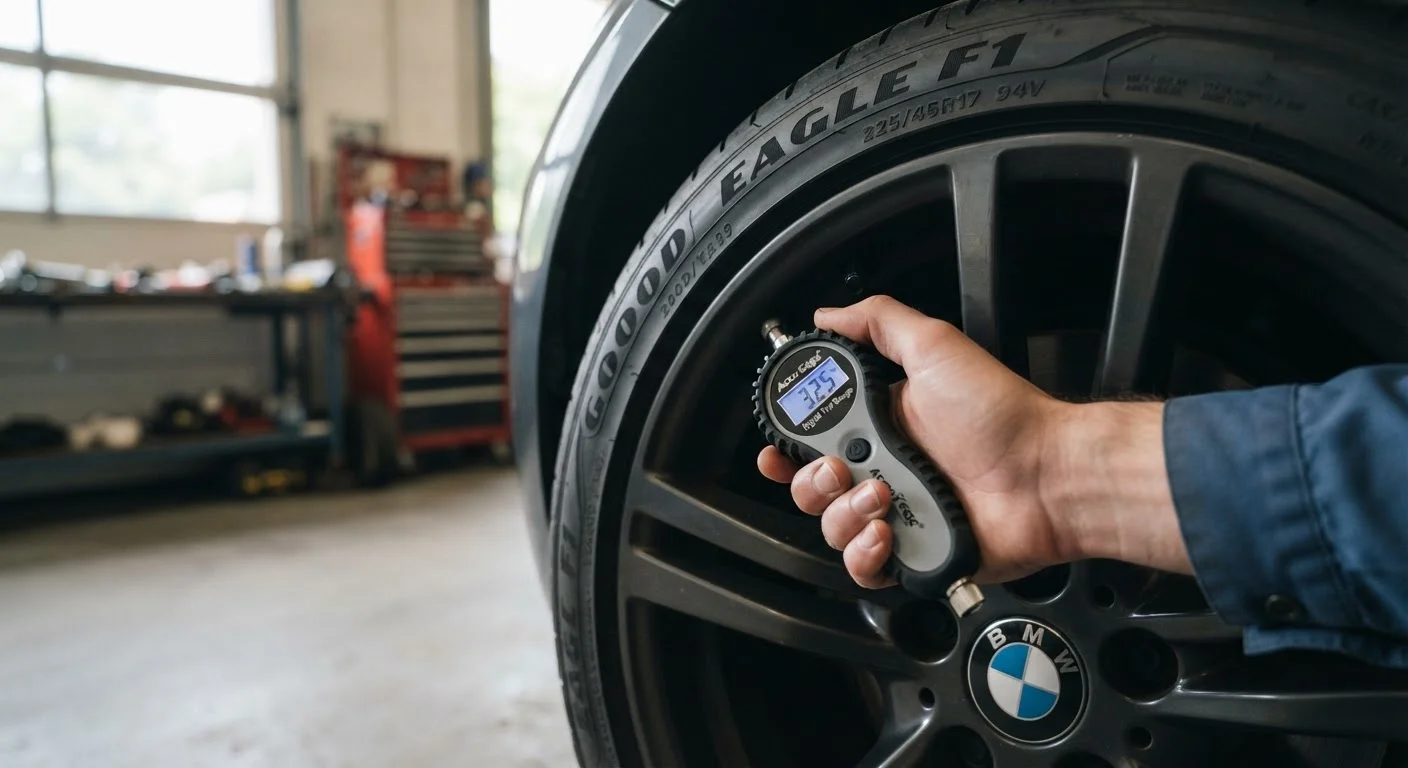
- Remove the valve cap, press the gauge firmly onto the valve stem, and read the result. Compare it to your door-jamb specification.
- Adjust as needed. Add air with a portable inflator or at a petrol station pump. Release air using the small pin inside the valve stem if over-inflated.
Checking Tread Depth
- The penny test (rough indicator). Insert a penny into a tread groove with Lincoln's head facing down. If you can see all of Lincoln's head, tread is at or below 2/32 inch — the tyre needs replacing.
- The quarter test (recommended threshold). Use a quarter the same way. If the top of Washington's head is visible, you're at or below 4/32 inch — a more practical replacement threshold for wet-weather safety.
- Tread wear indicators. Modern tyres have moulded wear bars running across the grooves. When the tread surface is flush with these bars, the tyre has reached minimum legal depth.
- Tread depth gauge. A dedicated gauge (typically under $10) gives a precise reading in 32nds of an inch for the most accurate assessment.
Uneven Wear May Signal a Deeper Problem
If one tyre consistently loses more pressure than the others, or if tread is wearing faster on one side than the other, those patterns often point to alignment, suspension, or valve issues beyond the tyre itself. A slow loss of more than 2–3 PSI per week warrants a professional inspection — don't assume it will stabilize on its own.
Check all four tyres individually — pressure and wear are rarely identical across an axle. Uneven wear patterns can also indicate alignment or suspension issues worth having a qualified mechanic inspect. For guidance on building these checks into a regular routine, see car maintenance habits for new drivers.
Why These Numbers Drift — and When to Act
Tyres lose roughly 1–2 PSI per month through normal permeation, and approximately 1 PSI for every 10°F drop in ambient temperature. That means a tyre correctly inflated in summer may be significantly under-inflated by January without ever sustaining a puncture.
Under-inflation generates excess heat and accelerates tread wear on the outer edges. Over-inflation reduces the tyre's contact patch with the road, degrading grip and making the centre of the tread wear faster than the edges. Both conditions shorten tyre lifespan and affect handling.
If you notice pressure dropping faster than expected — more than 2–3 PSI per week — you likely have a slow leak. Don't dismiss it: ignoring a slow tyre leak can lead to a blowout at highway speed. A tyre shop can perform a submersion or spray test to locate punctures or valve stem failures quickly.
A practical habit: check pressure and tread depth at least once a month and before any long trip. The pre-journey safety checklist includes both as standing items for good reason. These checks take under five minutes and are among the highest-return maintenance actions available to any driver. For a broader framework on road safety, the complete safe driving guide covers how tyre condition fits into overall vehicle readiness.