

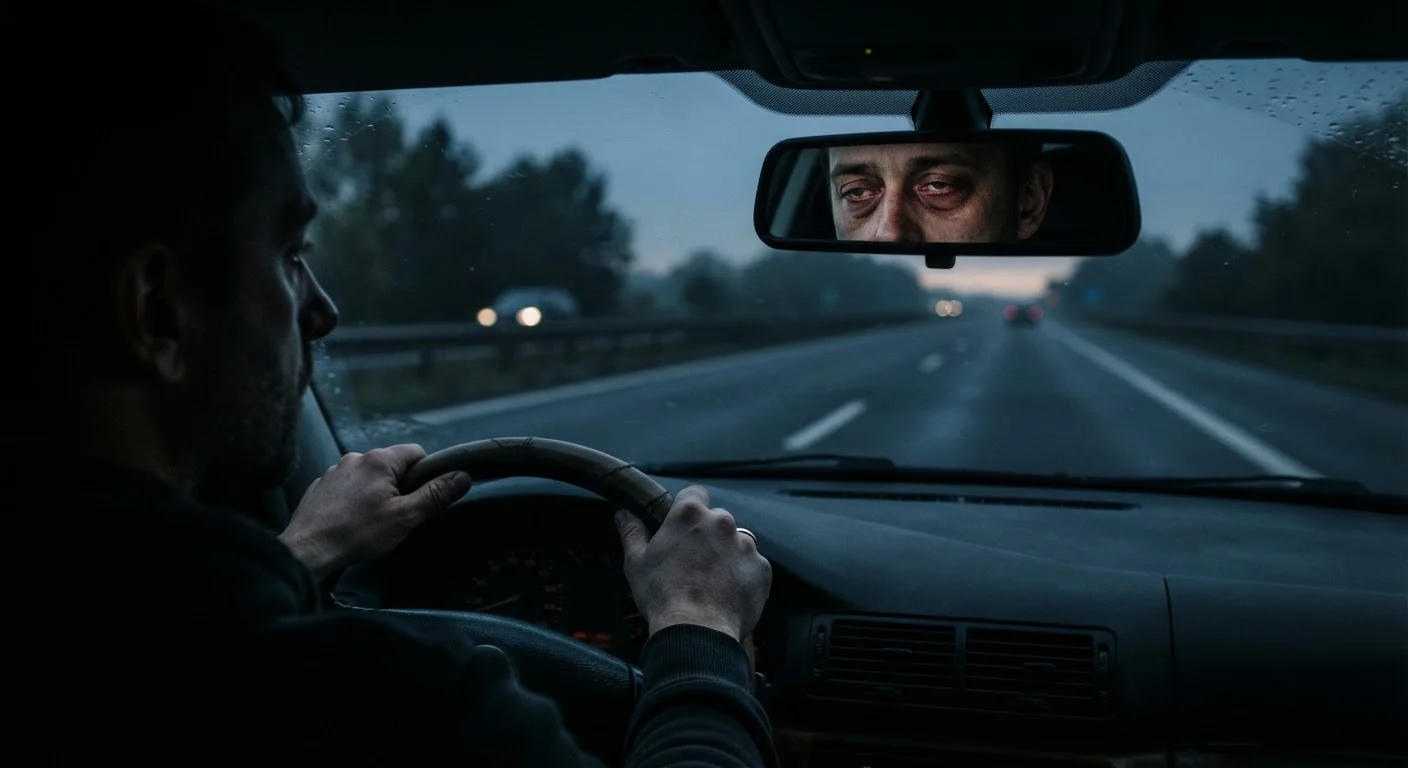
Key Takeaways
- Being awake for 18 consecutive hours produces impairment comparable to a blood alcohol concentration of 0.05%.
- Drivers frequently underestimate their own fatigue — the feeling of alertness can be misleading.
- Microsleep episodes can occur with eyes open, meaning a driver may have no memory of losing control.
- Drowsy driving risk spikes between midnight and 6 a.m. and again in the early afternoon.
- Caffeine and brief naps can help temporarily, but neither substitutes for adequate sleep before driving.
Drowsy Driving
Drowsy driving refers to operating a vehicle while fatigued or sleep-deprived to a degree that meaningfully impairs cognitive and physical performance. It slows reaction time, reduces the ability to sustain attention, and distorts judgment — often without the driver realizing how impaired they've become. Unlike obvious forms of impairment, drowsiness can creep in gradually, making it one of the more deceptive hazards on the road.
Sleep researchers use the term 'microsleep' to describe brief, involuntary episodes of unconsciousness lasting 1–30 seconds that can occur without the driver's awareness, even with eyes open.
Why Fatigue Is a Hidden Impairment
Most drivers recognize impaired driving as something involving alcohol or substances. Fatigue is different — it wears no obvious label, and the person experiencing it is often the last to know how compromised they've become. This is what makes drowsy driving particularly dangerous: the impairment undermines the very judgment needed to detect it.
The mechanisms are well-documented. Sleep deprivation degrades the prefrontal cortex's ability to regulate attention, decision-making, and impulse control — the same cognitive systems essential for safe driving. As fatigue deepens, the brain begins to compensate by entering brief, involuntary sleep episodes called microsleeps, which can last anywhere from one to thirty seconds. At highway speeds, a single two-second microsleep means traveling over 170 feet with no awareness of what's happening on the road.
What makes this harder to see than distraction or weather-related hazards is that there's no external cue. Distracted driving is often associated with a visible behavior — a glance at a phone, a conversation. Drowsy driving is invisible until it produces a consequence.
Drowsiness Isn't the Same as Feeling Sleepy
Drivers often assume they'll notice when they're too tired to drive because they'll feel overtly sleepy. In reality, the cognitive processes most affected by fatigue — sustained attention and self-assessment — are impaired before the sensation of sleepiness becomes pronounced. This means subjective alertness is an unreliable gauge of actual driving fitness when sleep-deprived.
The Data on Drowsy Driving Crashes
The NHTSA estimates that drowsy driving is responsible for tens of thousands of crashes annually in the United States, though experts widely believe these numbers are significantly underreported because fatigue is difficult to verify after a crash. Unlike blood alcohol, there is no roadside test for sleepiness.
Research from the AAA Foundation for Traffic Safety found that drivers who slept six to seven hours the night before a drive were twice as likely to be involved in a crash compared to those who slept eight hours or more. Those who slept fewer than five hours had crash rates comparable to drivers above the legal alcohol limit.
2x
Crash risk for drivers sleeping 6–7 hours vs. 8+
According to AAA Foundation for Traffic Safety research on sleep and crash involvement.
0.08%
BAC equivalent after 20+ hours without sleep
AAA Foundation research found 20 hours of wakefulness produces impairment comparable to this blood alcohol concentration.
~100,000
Estimated annual drowsy driving crashes in the U.S.
NHTSA estimates; actual figures are widely believed to be higher due to underreporting difficulties.
Crash patterns also reveal consistent timing. Drowsy driving incidents cluster in the late-night and early-morning hours, and again in the early afternoon — periods that align with natural dips in the human circadian rhythm. This means fatigue risk isn't random; it's predictable, which gives drivers an opportunity to plan around it.
Who Is Most at Risk — and Why
While any driver can be affected by fatigue, certain groups face disproportionately higher risk. Young drivers — particularly males between 16 and 25 — are overrepresented in drowsy driving crashes, partly due to irregular sleep schedules and a tendency to underestimate impairment. Shift workers, commercial truck drivers, and those with untreated sleep disorders such as sleep apnea also face elevated baseline risk.
Long-distance driving creates its own category of fatigue risk. Extended highway travel is monotonous by nature, and monotony accelerates the onset of drowsiness even when a driver isn't significantly sleep-deprived. This effect compounds with the time-of-day risk windows described above. A driver who is moderately tired at midnight on a flat interstate faces meaningfully different conditions than the same driver on a busy urban road at midday — and not just because of nighttime visibility factors.
The 'Pull Over, Not Push Through' Rule
When you notice repeated yawning, lane drift, or difficulty focusing on the road ahead, the instinct to 'push through to the next exit' is counterproductive. Pull off at the nearest safe location — a rest area, parking lot, or gas station — and take a 15–20 minute rest before continuing. Setting a phone alarm prevents oversleeping and helps you resume driving with improved alertness.
Practical Strategies for Managing Fatigue on the Road
The most effective strategy is straightforward but underused: begin any significant drive well-rested. Adults generally need seven to nine hours of sleep per night, and carrying a sleep deficit into a long drive compounds risk at every mile. Planning overnight trips or long drives during daytime hours when the body is naturally more alert also reduces exposure to the highest-risk windows.
When fatigue sets in during a drive, pulling over safely and taking a short nap of 15–20 minutes is one of the more well-supported countermeasures. Some research suggests that combining a short nap with caffeine intake immediately before the nap — sometimes called a 'caffeine nap' — may improve alertness more than either approach alone, though neither substitutes for adequate prior sleep.
Recognizing the early warning signs before they become dangerous is part of the broader skill set that situational awareness requires. A driver who can honestly assess their own state — rather than rationalizing 'just a little longer' — is exercising the same forward-thinking judgment that separates reactive driving from genuinely safe driving. For a broader framework, see the complete guide to safe driving habits.