

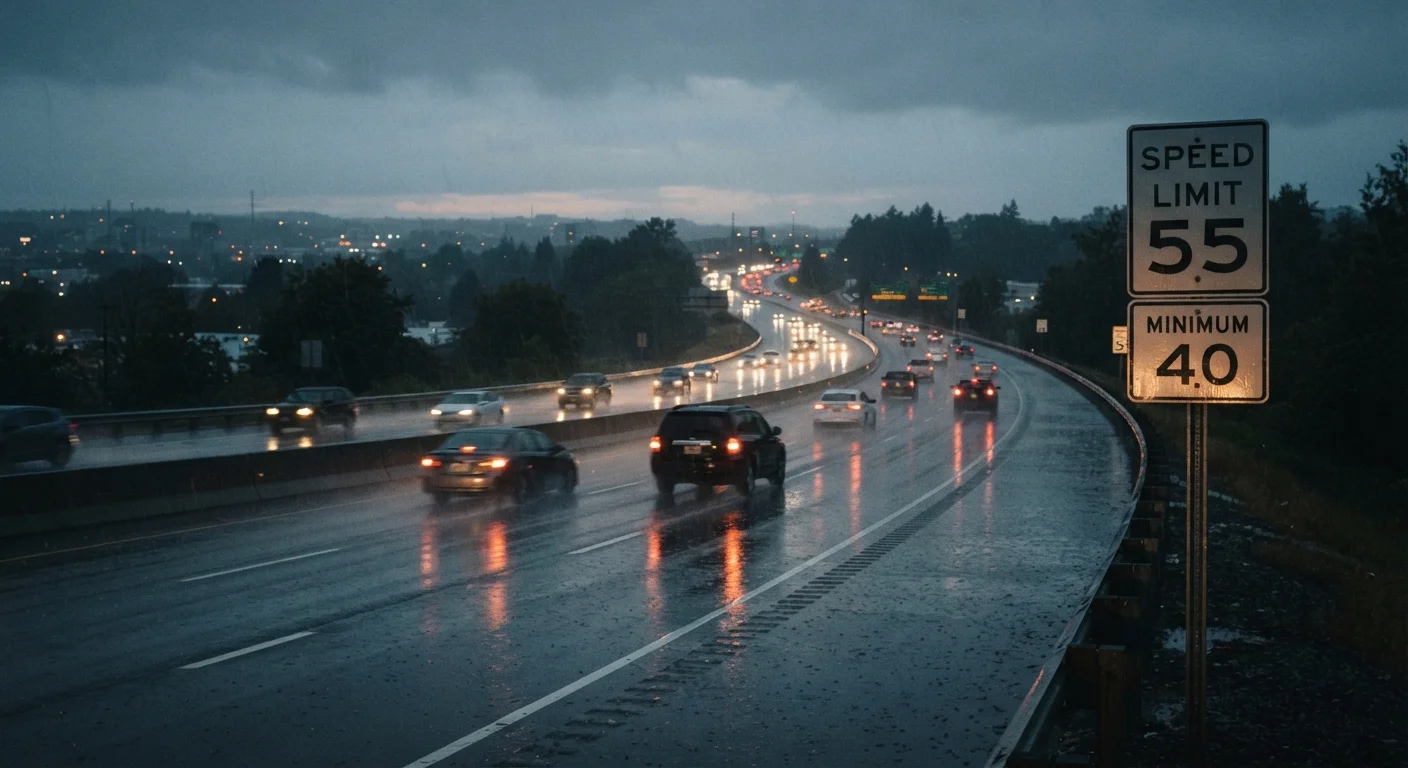
Key Takeaways
- Speed limits define what is legally permissible, not what is situationally safe.
- Limits are set for ideal road, traffic, and weather conditions — not every scenario.
- Drivers can be held liable for crashes even when traveling at or below the posted limit.
- Safe speed requires actively reading road conditions, visibility, and traffic flow.
- Slowing below the limit in poor conditions is not timid driving — it is skilled driving.
Option A
The Posted Speed Limit
The legal ceiling — set by engineers, not your conditions.
Best for: Establishing the maximum lawful speed on a given road under ideal circumstances.
Option B
Safe Speed
The contextual choice — adjusted for real-world conditions.
Best for: Protecting you, your passengers, and others when conditions fall below the ideal assumptions built into the posted limit.
If you're driving in heavy rain, fog, or snow
Safe Speed
Posted limits assume dry, clear conditions. Reduced visibility and longer stopping distances demand a lower speed regardless of what the sign says.
If you're navigating unfamiliar roads or tight curves
Safe Speed
Limits on winding or unmarked roads may still exceed what allows adequate reaction time for an unfamiliar driver. Slow down until you understand the road.
If you need to understand your legal obligation on any road
The Posted Speed Limit
The posted number is the law. Exceeding it carries legal and insurance consequences regardless of your perception of conditions.
If you're sharing the road with pedestrians, cyclists, or school zones
Safe Speed
Impact severity rises sharply with speed. Even a legally posted limit in these areas may be too fast when foot traffic is high or visibility is limited.
What Speed Limits Actually Represent
Speed limits are not calculated with any particular day or driver in mind. Traffic engineers establish posted limits using a methodology that typically considers the road's geometry, historical crash data, and observed traffic flow under ideal conditions — dry pavement, good visibility, and moderate traffic. The resulting number represents the maximum speed considered safe for that road under those baseline assumptions.
What limits do not account for: rain pooling on the surface, a frost pocket on a shaded curve, sun glare at dawn, a child stepping from between parked cars, or the specific reaction time of the driver behind the wheel. As the road safety fundamentals every driver should know makes clear, stopping distance increases exponentially with speed — and conditions can shorten your margin to zero in ways no sign can predict.
The legal limit, in other words, is a ceiling. It tells you the fastest you may go. It says nothing about the fastest you should go right now.
| Criterion | Posted Speed Limit | Safe Speed |
|---|---|---|
| Set by | Traffic engineers and regulators | The driver, in real time |
| Based on | Ideal road and weather conditions | Actual current conditions |
| Legal status | Maximum lawful speed | Not a fixed number — context-dependent |
| Changes with weather? | No — sign stays the same | Yes — always adjusted for conditions |
| Accounts for traffic density? | Partially, at time of study | Yes — driver must respond dynamically |
| Liability protection | Does not guarantee legal protection | Reduces crash risk and potential liability |
| Applies to all drivers equally? | Yes — uniform for all | No — varies by experience, vehicle, load |
When the Limit and Safety Diverge
The gap between posted speed and safe speed widens most sharply in four common scenarios:
- Adverse weather: Rain, ice, fog, and snow all reduce both grip and sight distance. A 55 mph highway limit set for clear conditions may require 35 mph or less in dense fog to maintain adequate stopping distance.
- Heavy or unpredictable traffic: When vehicles are merging, braking suddenly, or driving erratically, your following distance and reaction buffer shrink. Speed must come down to compensate. See our article on the two-second rule and why drivers keep getting it wrong for how spacing and speed interact.
- Road type transitions: Moving from a straight arterial to a tight residential street, or from a motorway to an off-ramp, often catches drivers at a speed appropriate for where they were, not where they are. How safe driving changes by road type explains why these transitions demand active speed adjustment.
- Nighttime driving: Headlights typically illuminate 200–250 feet ahead. At 60 mph, a vehicle travels roughly 88 feet per second — meaning your sight distance and stopping distance are alarmingly close even on a clear night.
2x
Stopping distance increase: 30 mph vs. 60 mph
Physics dictates that stopping distance quadruples when speed doubles — a core reason why speed management matters far beyond the posted number.
~40%
Fatal crash reduction linked to lower impact speeds
Research published by the Insurance Institute for Highway Safety indicates that meaningful reductions in travel speed correspond to significant drops in fatal crash likelihood.
3 seconds
Typical driver perception-reaction time
At 60 mph, a 3-second reaction window means a vehicle travels approximately 264 feet before braking even begins — underscoring why speed must match sight distance.
U.S. traffic law in most states includes a basic speed law: drivers must operate at a speed that is reasonable and prudent given actual conditions, even if that speed is below the posted limit. Traveling at the posted limit does not automatically shield a driver from liability if conditions clearly warranted slowing down.
How to Judge Your Own Safe Speed
Choosing a safe speed is an active, ongoing assessment — not a single decision made at the start of a trip. Experienced drivers continuously monitor four factors:
- Visibility: Can you see far enough ahead to stop within the distance you can see? If not, you're traveling too fast for conditions.
- Traction: Wet, icy, or debris-covered surfaces extend stopping distances dramatically. Reduce speed before you feel the grip change, not after.
- Traffic density: The closer surrounding vehicles are, the less room for error. Slower speed buys reaction time that increased following distance alone cannot always provide.
- Road familiarity: Unfamiliar roads may hide sharp bends, unmarked intersections, or poor sight lines. Treat them with the same caution you'd apply to adverse weather until you understand their layout.
Speed and Vehicle Load Both Matter
A fully loaded SUV or a vehicle towing a trailer requires significantly more distance to stop than an unloaded passenger car — even at identical speeds. If your vehicle's weight or configuration has changed, your mental model of safe speed needs to adjust accordingly. This is especially important on downhill grades, where braking demands increase further. Always factor your vehicle's actual stopping capability into your speed choice.
For a broader framework of these habits, the safe driving complete guide covers how experienced drivers systematically manage speed alongside other risk factors. And if you frequently drive at higher speeds, motorway driving myths that mislead new drivers addresses some deeply held misconceptions about what fast-road safety actually requires.
Driving below the posted limit when conditions demand it is not hesitancy — it is the exercise of judgment that the law explicitly expects from every licensed driver.