

Key Takeaways
- Motorways are statistically among the safer road types per mile, but high speeds mean errors have severe consequences.
- A-roads carry a disproportionate share of fatal crashes, largely due to mixed traffic and frequent junctions.
- Urban streets demand the widest scan area because hazards—pedestrians, cyclists, parked cars—appear from every direction.
- Following distance, speed management, and scan technique each need to be recalibrated for the road you're on.
- No single speed or gap setting works across all road types; context-specific adjustment is the mark of a skilled driver.
Our Verdict
No road type is inherently safe or dangerous in isolation — risk is shaped by how well a driver adapts their technique to the environment. Motorways reward smooth, predictable high-speed discipline; A-roads demand vigilance at junctions and when overtaking; urban streets require constant 360-degree awareness and low-speed patience. Recognising which mode you're in — and switching deliberately — is what separates competent driving from merely legal driving.
| Best for | Recommended |
|---|---|
| Drivers covering long distances quickly | Motorway techniques: consistent following distance, lane discipline, early mirror checks |
| Rural and mixed-traffic journeys | A-road techniques: junction anticipation, cautious overtaking assessment, speed variance awareness |
| City commuters and urban navigators | Urban street techniques: wide scanning, low speed buffer, pedestrian and cyclist priority |
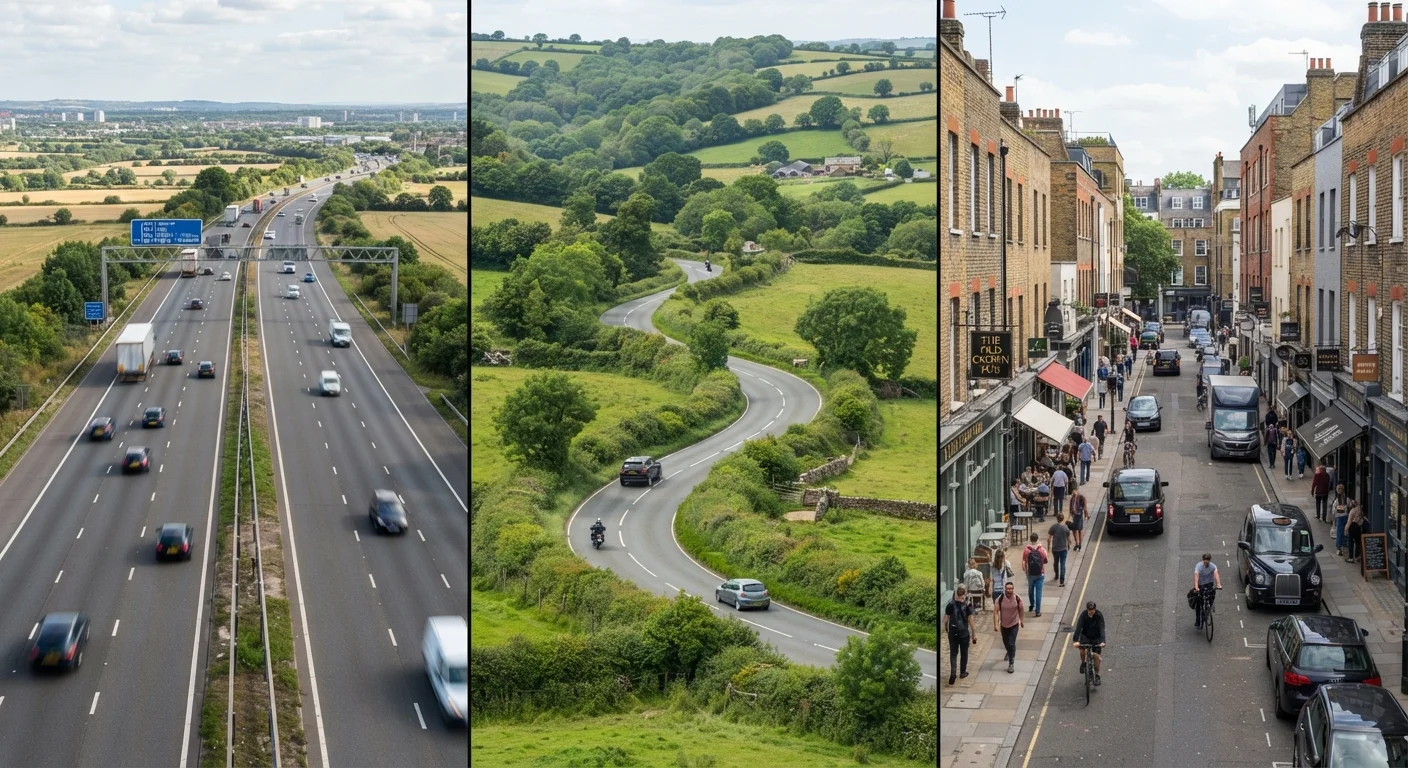
Why Road Type Changes Everything About Safe Driving
Many drivers carry a single mental model of how to drive safely and apply it regardless of whether they're merging onto a motorway or navigating a crowded high street. That one-size approach is where risk accumulates. Each road environment presents a different hazard profile, traffic mix, and required response time — meaning the habits that serve you well in one context can actively work against you in another.
This article breaks down the three core road types most US and UK drivers encounter daily — motorways (or highways), A-roads (or arterial roads), and urban streets — and explains precisely which skills and adjustments matter most on each. For a broader foundation, see our complete guide to safe driving habits and hazards.
| Motorway | A-Road | Urban Street | |
|---|---|---|---|
| Primary hazard type | High-speed error, fatigue, tailgating | Junctions, overtaking, mixed traffic | Pedestrians, cyclists, parked cars |
| Recommended following distance | 3+ seconds minimum | 2–3 seconds; more on bends | 1–2 seconds; stop-start aware |
| Key scanning technique | Far ahead, early lane changes | Junction entry points, oncoming lane | 360° including door zones and footpaths |
| Speed management focus | Maintain consistent, legal speed | Adjust for sight lines and junctions | Stay well within limit near pedestrians |
| Overtaking risk level | Low — lanes are separated | High — single carriageway gaps close fast | Generally not applicable |
| Fatigue risk | High — monotony causes micro-sleep | Moderate | Low — constant engagement |
Motorway Driving: Precision at High Speed
Motorways carry traffic at the highest sustained speeds of any road type, yet per-mile fatality rates are generally lower than rural A-roads. The reason: traffic flows in one direction, junctions are controlled, and pedestrians are absent. What makes motorways dangerous isn't their design — it's the unforgiving physics of high-speed error.
Following Distance Is Non-Negotiable
At 70 mph, a vehicle covers roughly 102 feet per second. The two-second rule that feels generous in town becomes a bare minimum on a motorway; many safety experts recommend three seconds or more in normal conditions. Tailgating at motorway speed eliminates any meaningful reaction window.
Lane Discipline and Merging
Staying in the correct lane — travelling in the left or right lane unless overtaking, depending on your country — reduces weave-and-brake patterns that cascade into rear-end collisions. When merging, match the flow of existing traffic rather than forcing a gap. For more on common misconceptions here, see motorway driving myths that catch new drivers out.
Managing Fatigue and Monotony
The steady rhythm of motorway driving is itself a hazard. Micro-sleep events are more likely on long, featureless stretches. Plan rest stops every two hours at minimum, and if drowsiness sets in, exit and rest — no destination justifies driving while impaired by fatigue.
Reset Your Driving Mode at Every Transition
Whenever you move from one road type to another, take a conscious moment to recalibrate. Check your speed against the posted limit rather than relying on feel, adjust your following distance, and shift your scanning pattern to match the new hazard profile. This deliberate reset takes seconds and meaningfully reduces transition-point risk.
A-Road Driving: The Most Overlooked Danger
A-roads — the arterial routes connecting towns and running through rural areas — account for a disproportionate share of serious and fatal crashes. Their danger stems from a combination of higher speeds, frequent junctions, opposing traffic, and a mix of vehicle types including tractors, cyclists, and heavy trucks sharing the same carriageway.
Junction Anticipation Is the Critical Skill
Unlike motorways, A-roads are punctuated with side roads, farm entrances, and roundabouts where traffic crosses or joins at speed. Scanning well ahead — not just the vehicle in front — gives you time to identify slowing traffic, turning signals, or vehicles pulling out. Assume a junction is active until you've confirmed otherwise.
Overtaking: A Decision That Cannot Be Undone
Passing a slower vehicle on a single-carriageway A-road requires a clear sight line, sufficient acceleration, and an accurate gap assessment. If any of those elements is uncertain, don't proceed. Most overtaking collisions occur not because drivers misjudged speed alone, but because they underestimated how quickly the gap would close. The posted speed limit is a ceiling, not a target — on a winding A-road in poor visibility, the appropriate speed may be well below it.
A-Road Overtaking Demands Full Commitment or None
Aborting an overtake halfway through — pulling back in behind the vehicle you were passing — is itself a collision risk if traffic has closed behind you. Only begin an overtake when you have confirmed a clear, sufficient gap for the entire manoeuvre. If doubt exists at any point before you pull out, wait for the next opportunity.
Urban Street Driving: Constant Awareness in Tight Spaces
Urban environments present the highest density of potential hazards per mile: pedestrians stepping off curbs, cyclists filtering between lanes, children near parked cars, delivery vehicles double-parked, and junctions every few hundred feet. Speed is lower, but stopping distances are short and hazards are immediate.
Scanning Wide, Not Just Forward
In town, your scan must be genuinely 360 degrees. Check mirrors frequently, watch for movement between parked cars, and anticipate that pedestrians — especially children — may not look before stepping into the road. The door zone alongside parked cars is a frequent collision point with cyclists; allow at least a metre of clearance where possible.
Speed as a Safety Margin
At 20 mph, a pedestrian struck by a vehicle has a significantly higher chance of survival than at 30 mph. Urban speed limits exist precisely because hazard density is higher and reaction time shorter. Defensive driving principles are especially applicable here: assume the unexpected will happen, and position your vehicle to give yourself options.
Condition changes compound urban risk. For how wet roads and low visibility alter the calculus further, see our guide on driving in rain, fog, and ice.
~56%
Fatal crashes occurring on rural roads
According to the NHTSA, rural roads — including A-roads and similar arterials — account for a majority of traffic fatalities in the US despite lower overall traffic volume.
~5x
Pedestrian fatality risk increase from 20 to 40 mph
Research from the AAA Foundation for Traffic Safety indicates pedestrian fatality risk rises steeply with vehicle speed, underscoring the importance of urban speed management.
Transferring Skills Across Road Types
The transition between road types is itself a moment of risk. Drivers who have spent an hour on a motorway often feel the speed drop to urban limits as unnaturally slow — a phenomenon sometimes called highway hypnosis or speed adaptation. Check your speedometer consciously when entering a new road environment rather than relying on feel.
Vehicle condition matters across all three contexts. Tyre tread, brake responsiveness, and mirror adjustment are relevant everywhere, but their failure modes differ: poor brakes are catastrophic at motorway speeds, while worn tyres become critical on a rain-slicked urban street. Regular vehicle maintenance is the unglamorous foundation beneath all safe driving technique.
Finally, risk doesn't stay constant within a road type. Time of day, weather, and traffic volume all shift the hazard profile significantly. Night driving introduces a separate layer of risk on every road type covered here — visibility, fatigue, and impaired driver prevalence all increase after dark.
This article is for general informational and educational purposes only. Always follow the traffic laws and regulations applicable in your state or jurisdiction.