

Key Takeaways
- The glycaemic index ranks foods by their blood sugar impact per 50 g of carbohydrate, not per typical serving size.
- GI ignores how much carbohydrate a food actually contains — that's where glycaemic load fills the gap.
- Cooking method, ripeness, and food combinations all shift a food's real-world GI value.
- Low-GI eating may support blood sugar management, but it is not a complete dietary framework on its own.
- Always consult a qualified healthcare or nutrition professional before making significant dietary changes.
Glycaemic Index (GI)
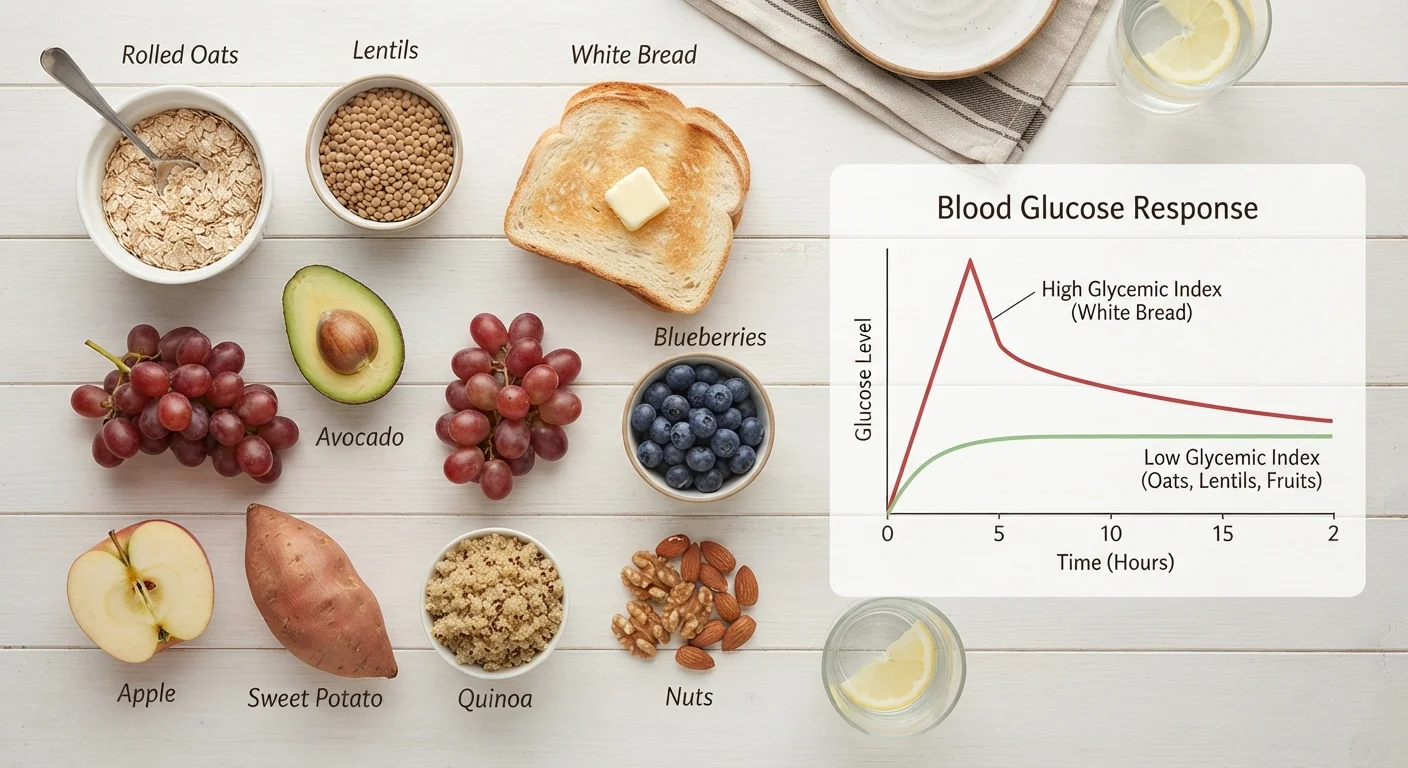
The glycaemic index is a numerical scale from 0 to 100 that ranks carbohydrate-containing foods by how quickly they raise blood glucose levels compared to pure glucose or white bread. Foods with a high GI score cause a faster, sharper blood sugar spike, while low-GI foods produce a slower, more gradual rise. The scale was developed in the early 1980s to help manage blood sugar in people with diabetes.
GI is measured under controlled laboratory conditions using a fixed 50-gram available-carbohydrate portion consumed by healthy volunteers; results can vary significantly between individuals and testing labs.
How the Glycaemic Index Is Actually Measured
To assign a GI score, researchers recruit healthy volunteers and ask them to consume a portion of food containing exactly 50 grams of available carbohydrate — the carbohydrate that is actually digested and absorbed, excluding fibre. Blood glucose is then measured at regular intervals over two hours, and the resulting curve is compared to the same person's response to a reference food, typically pure glucose or white bread, also at 50 grams.
The food's GI score is the ratio of those two curves, expressed as a percentage. A score of 70 means the test food raises blood glucose 70% as much as pure glucose. Scores are averaged across several participants to account for individual variation.
This controlled method is methodologically sound for what it sets out to measure. The problem is that what it measures is narrower than most people assume.
50 g
Carbohydrate portion used in all GI testing
Every GI measurement is standardised to a 50-gram available-carbohydrate serving, which often differs substantially from typical portion sizes.
~20 points
Typical inter-individual GI variation
Research published in the journal Cell found blood glucose responses to identical foods varied by roughly 20 GI points between different individuals.
55 or below
Threshold for a food to be classified low GI
This classification is used by major nutrition bodies worldwide, including the American Diabetes Association, as a general clinical reference point.
The Gaps GI Doesn't Fill
The most significant limitation of GI is that it says nothing about how much carbohydrate a food delivers in a real-world portion. Consider watermelon: it carries a high GI score (around 72–76), yet a standard two-cup serving contains relatively few digestible carbohydrates. The concept of glycaemic load (GL) was developed precisely to address this — it multiplies GI by the grams of carbohydrate in an actual serving and divides by 100, giving a more realistic picture of a food's blood sugar impact in practice.
GI also ignores everything else in a meal. Fat, protein, and dietary fibre all slow gastric emptying, which blunts glucose absorption. A high-GI food eaten alongside olive oil and legumes will behave very differently in the body than it does in a laboratory fasting test.
Other variables GI cannot capture include:
- Food processing and cooking: Al dente pasta has a meaningfully lower GI than overcooked pasta. Cooling cooked potatoes increases their resistant starch content, lowering GI further.
- Ripeness: A ripe banana has a higher GI than an underripe one because starches convert to sugars as fruit matures.
- Individual biology: Emerging research shows that two people eating identical meals can produce dramatically different blood glucose curves based on gut microbiome composition and other personal factors.
Use Glycaemic Load for Real-World Decisions
Rather than memorising GI scores, consider the glycaemic load of your usual portions. Freely available GL databases let you look up common foods by realistic serving sizes. Pairing any carbohydrate-rich food with protein, healthy fats, or fibre will further moderate its blood sugar impact without requiring precise calculations.
When GI Is — and Isn't — a Useful Tool
Despite its limitations, GI is not without value. Research, including reviews published in journals such as The Lancet and the American Journal of Clinical Nutrition, has associated habitual low-GI diets with modest improvements in glycaemic control and cholesterol levels, particularly in people with type 2 diabetes or insulin resistance. For clinicians managing blood sugar conditions, GI can serve as one useful data point within a broader dietary plan.
For general healthy eating guidance, however, GI works best as a rough heuristic rather than a rigid rulebook. Choosing less-refined grain products, legumes, and most vegetables over heavily processed carbohydrates will naturally tend toward lower GI — but framing those choices around whole food quality rather than scores alone is more practical and more durable.
It's also worth noting that a low GI score alone cannot make a food nutritious. Understanding how to read a nutrition label gives you far richer information about what you're actually consuming, including fibre content, added versus natural sugars, saturated fat, and sodium — none of which GI addresses.
“The glycaemic index is a useful concept, but it is a tool — not a diet. Eating patterns matter far more than the score of any single food.”
— Walter Willett, Professor of Epidemiology and Nutrition, Harvard T.H. Chan School of Public Health
This article is for general informational purposes only and does not constitute medical or nutritional advice. If you have concerns about blood sugar management or dietary needs, please consult a qualified healthcare professional.