

Key Takeaways
- Whole grains retain all three kernel layers — bran, germ, and endosperm — while milling removes the first two.
- Fibre, B vitamins, and minerals are concentrated in the bran and germ, making refined grains significantly lower in these nutrients.
- Enrichment adds back some B vitamins and iron, but does not restore fibre or all phytonutrients lost during milling.
- Diets higher in whole grains are associated with reduced risk of cardiovascular disease and type 2 diabetes in large observational studies.
- Glycaemic response tends to be lower for whole grains, though processing method, ripeness, and cooking also affect this.
- Neither category is inherently forbidden — overall dietary pattern matters more than any single food choice.
Option A
Whole Grains
The complete, minimally processed kernel.
Best for: Consumers seeking higher fibre intake, sustained energy, and a broader range of naturally occurring nutrients.
Option B
Refined Grains
The milled, streamlined starch.
Best for: Situations where texture, shelf life, or digestive ease takes priority, though enrichment partially restores some lost nutrients.
If you want to maximise fibre and micronutrient density from grain foods
Whole Grains
The intact bran and germ deliver fibre, magnesium, B vitamins, and antioxidant compounds that are largely absent from refined alternatives.
If digestive sensitivity makes high-fibre foods difficult to tolerate
Refined Grains
Lower fibre content can ease digestion for people with certain GI conditions; always discuss dietary changes with a healthcare provider.
If you're focused on long-term heart and metabolic health
Whole Grains
Consistent evidence from large cohort studies links regular whole grain consumption with lower cardiovascular disease risk and better blood glucose regulation.
If you need folate from fortified foods, such as during pregnancy planning
Refined Grains
Many refined grain products are enriched with folic acid; however, consult a healthcare professional about all prenatal nutritional needs.
What Milling Actually Does to a Grain
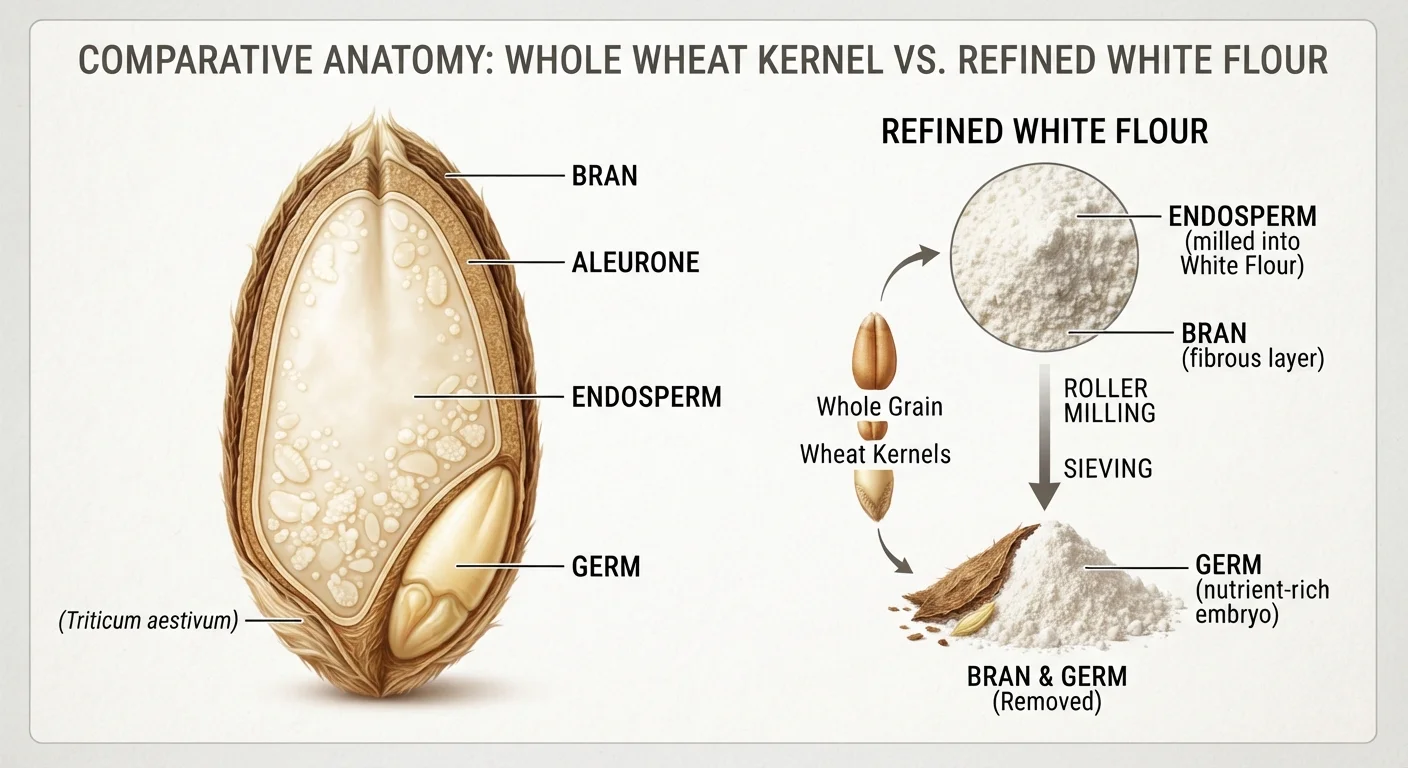
Every grain — whether wheat, oats, rice, or rye — starts as a kernel with three distinct layers. The bran is the fibrous outer coat. The germ is the embryo, rich in healthy fats, vitamin E, and B vitamins. The endosperm is the starchy interior that fuels seed germination.
Whole grain products preserve all three layers in their original proportions, either intact (think brown rice or rolled oats) or ground together so the flour reflects the full kernel's composition. Refining changes this fundamentally: industrial milling strips away the bran and germ, leaving almost pure endosperm. The result is a lighter, smoother flour with a longer shelf life — but a substantially altered nutritional profile.
The germ is removed partly because its oils can turn rancid, limiting a product's shelf life. The bran is removed for texture. Both decisions are commercially rational, but they come at a nutritional cost that enrichment only partially addresses.
| Criterion | Whole Grains | Refined Grains |
|---|---|---|
| Kernel layers retained | Bran, germ, and endosperm | Endosperm only |
| Dietary fibre | High (e.g. ~3–4g per slice of bread) | Low (e.g. ~1g per slice of white bread) |
| B vitamins | Naturally present in full range | Partially restored via enrichment |
| Glycaemic response (typical) | Lower and more gradual | Higher and faster |
| Shelf life | Shorter (oils in germ can oxidise) | Longer |
| Texture | Denser, nuttier | Lighter, smoother |
| Phytonutrients and antioxidants | Naturally present | Largely removed; not restored |
The Nutrient Gap: What the Numbers Show
The difference between whole and refined grains isn't marginal. A standard comparison of whole wheat flour versus white wheat flour illustrates the gap clearly. Fibre content falls by roughly 75% when bran is removed. Magnesium drops by about 80%. Zinc, potassium, and vitamin E follow similar trajectories. These aren't trace losses — they represent meaningful dietary contributions for people eating grains daily.
~75%
Fibre lost when wheat is refined
USDA nutrient data shows whole wheat flour contains roughly 12–13g of fibre per 100g versus 3–4g in white flour.
3x
Greater magnesium in whole wheat vs white flour
USDA FoodData Central figures show whole wheat flour provides approximately 137mg magnesium per 100g compared with around 22mg in enriched white flour.
~30%
Lower CVD risk associated with whole grain intake
A 2016 meta-analysis in BMJ found that people with the highest whole grain consumption had roughly 22–30% lower cardiovascular disease risk than those with the lowest intake.
Enrichment — the process of adding back specific B vitamins (thiamine, riboflavin, niacin, folic acid) and iron — was introduced in the US in the 1940s to address widespread nutrient deficiency. It's been effective for that goal. However, enrichment restores only a handful of the dozens of compounds lost during milling. Fibre, phytic acid, lignans, and various antioxidant phenols are not added back. To understand how these nutrients appear on packaged foods, reading a nutrition label can help you compare products side by side.
Glycaemic Response and Blood Sugar Regulation
The glycaemic index (GI) ranks foods by how quickly they raise blood glucose. Refined grains, stripped of fibre, are digested more rapidly in the small intestine, typically producing a faster and higher glucose spike compared with their whole grain counterparts. Whole grain fibre slows digestion, moderating glucose absorption and supporting a more gradual insulin response.
That said, GI is not the whole story. Cooking method, particle size, food combinations, and individual metabolic variation all influence actual blood glucose response. Finely milled whole wheat bread, for example, can behave more like white bread than coarsely ground whole grain bread. The physical structure of the grain matters as much as its technical classification.
This distinction matters for long-term health outcomes. Large-scale epidemiological studies — including data from the Nurses' Health Study and the Health Professionals Follow-Up Study — have found associations between higher whole grain intake and reduced risk of type 2 diabetes and cardiovascular disease. Observational studies cannot establish direct causation, and diet patterns are complex, but the consistency of findings across multiple populations strengthens the signal.
For a broader look at how grain-related nutrition claims hold up to scrutiny, see common nutrition myths examined.
Making Practical Choices Without All-or-Nothing Thinking
Nutrition guidance — including US Dietary Guidelines — generally recommends that at least half of grain servings come from whole grain sources. That framing is worth noting: it's a proportion, not a prohibition. Refined grains aren't categorically harmful, and context matters enormously. A diet otherwise rich in vegetables, legumes, and diverse nutrients can absorb moderate refined grain consumption without meaningful harm.
Practical strategies include swapping white rice for brown or wild rice in mixed dishes, choosing oats over instant refined cereals, and checking ingredient labels for "whole grain" or "whole wheat" as the first listed grain ingredient. When comparing products, understanding how added sugars interact with processed grain foods adds another useful layer of label literacy.
Individuals with specific health conditions — including irritable bowel syndrome, celiac disease, or blood sugar management concerns — should discuss grain choices with a qualified healthcare provider or registered dietitian rather than relying on general guidance.
This article is for general informational and educational purposes only and does not constitute medical or dietary advice. Consult a qualified healthcare professional before making significant changes to your diet, especially if you have an existing health condition.