

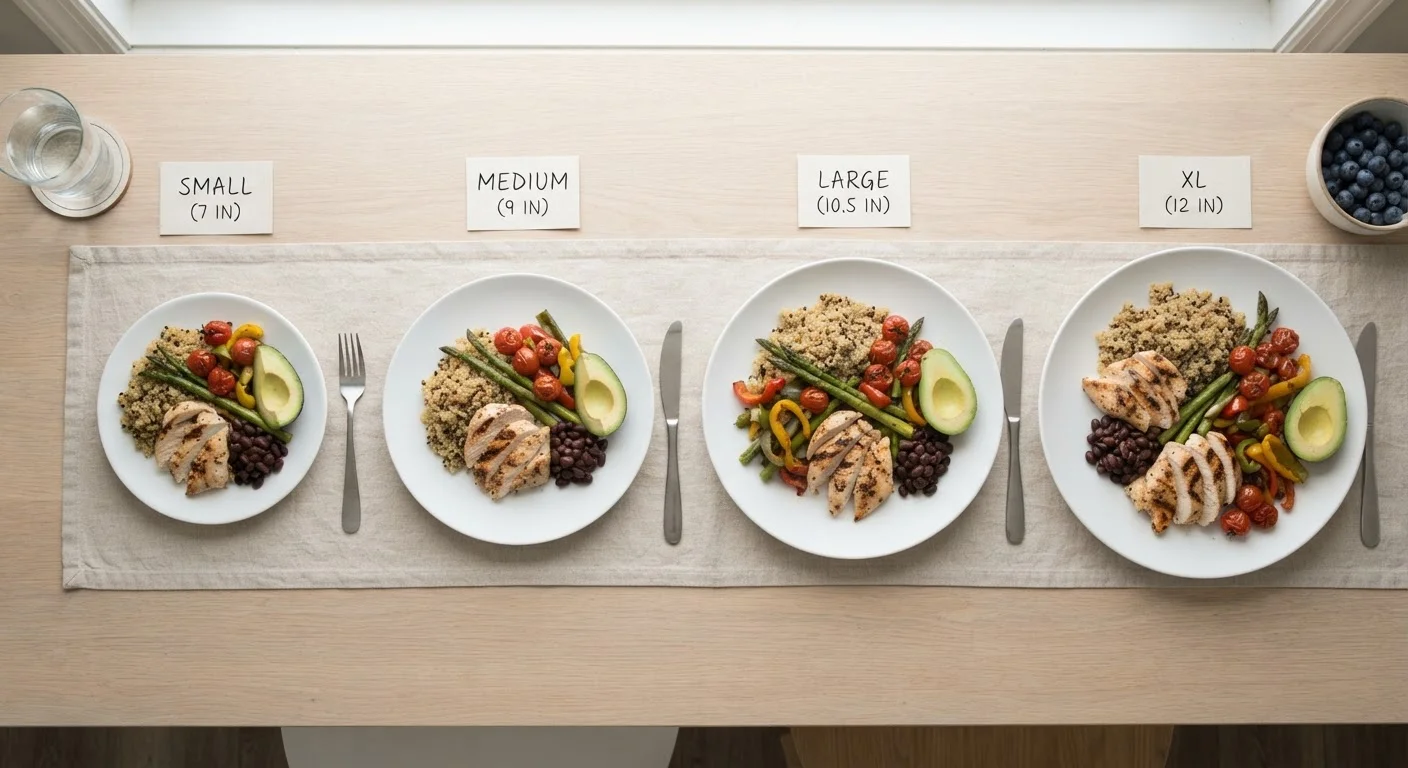
Key Takeaways
- Visual cues like plate size and container shape reliably cause people to misjudge serving sizes.
- Packaged food serving sizes are standardized by regulation, not designed to reflect how much people actually eat.
- Eating while distracted or in social settings consistently increases intake beyond what people later recall.
- Simple reference tools — like using your hand as a guide — improve portion accuracy without requiring a scale.
The Science Behind Estimation Errors
Portion estimation feels intuitive, but it draws on the same perceptual shortcuts that make optical illusions work. Research in behavioral nutrition consistently shows that people — including trained dietitians — underestimate how much they consume when environmental cues are misleading. The brain does not weigh food; it interprets it through context, shape, contrast, and memory.
This is not a character flaw or lack of discipline. It is an expected outcome of how human visual perception operates. Understanding the specific traps that skew judgment is the first step toward making more accurate assessments — and toward reading tools like nutrition labels more usefully. Our guide to reading a nutrition label without the confusion explains how serving-size figures on packaging are defined and what they actually represent.
~92%
People who underestimate calorie intake
Multiple dietary recall studies have found that self-reported food intake commonly underestimates actual consumption by 10–40%, with the gap widening at larger portion sizes.
2–3x
Typical servings per snack package
Many single-serving-looking packages of chips, beverages, and crackers legally contain two to three servings per container under FDA labeling rules.
Common Mistakes That Distort Portion Perception
The errors below are grounded in published cognitive and environmental research. Each one reflects a predictable pattern — which also means each one is correctable once recognized.
Judging quantity by container size rather than actual volume.
Why it happens: When a larger bowl or plate is used, the same amount of food looks smaller by contrast — a well-documented effect sometimes called the Delboeuf illusion. People intuitively fill vessels to a proportionally similar level regardless of total capacity.
Treating a full package as a single serving.
Why it happens: Packaging is designed around convenience and marketing, not nutritional guidance. A bag, bottle, or box feels like a natural unit, so consumers often consume it as one.
Underestimating portions when eating while distracted.
Why it happens: Attention is a limited resource. When it is occupied by screens, conversation, or work, the brain encodes less detailed memory of the eating event, leading to inaccurate recall and reduced satiety signaling.
Anchoring to restaurant or takeout portions as a "normal" serving.
Why it happens: Repeated exposure to large commercial portions shifts a person's internal reference point. What was once recognizably oversized becomes the new baseline expectation for a meal.
Consuming more in social settings without noticing.
Why it happens: Social facilitation research shows that people eat more in groups, partly because meal duration extends and partly because attention is directed outward. Mirroring the pace of others also overrides internal hunger cues.
Practical Ways to Recalibrate Your Estimates
You don't need precise lab equipment to improve accuracy. The goal is to interrupt automatic perception and replace it with deliberate reference points.
- Use your hand as a baseline. A closed fist approximates one cup; a palm (excluding fingers) approximates three ounces of protein. These travel with you everywhere.
- Pre-portion before eating. Serve food onto a plate or bowl rather than eating directly from bags or pots. This creates a visible boundary that anchors your sense of quantity.
- Check the stated serving size before opening a package. Nutrition labels list nutrients per serving, not per container. Many packages contain two, three, or more servings.
- Pause mid-meal. Distraction-driven eating removes the feedback loop that normally signals how much you've consumed. A brief pause restores awareness.
Avoid Overcorrecting Into Rigid Restriction
Improving portion awareness is a practical skill, not a mandate for constant measurement or anxiety about food. Overly rigid tracking can foster an unhealthy relationship with eating for some individuals. If you notice distress around food quantities, speak with a registered dietitian or mental health professional who specializes in eating behaviors.
This article is for general informational purposes only and is not a substitute for personalized nutrition or medical advice. If you have specific dietary needs or health conditions, consult a qualified healthcare professional or registered dietitian.