

Key Takeaways
- ACV pays what your property was worth at the time of loss — after depreciation is subtracted.
- Replacement cost coverage pays what it would cost to replace the item with a new equivalent today.
- The gap between ACV and RCV can amount to thousands of dollars on a single claim.
- RCV policies typically carry higher premiums than ACV policies.
- Understanding your policy's valuation method before a loss — not after — is critical.
- Some policies offer ACV as a base with optional RCV endorsements available for an added cost.
Option A
Actual Cash Value (ACV)
The depreciation-adjusted payout option.
Best for: Policyholders seeking lower premiums who can absorb the cost difference between depreciated value and replacing an item at today's prices.
Option B
Replacement Cost Coverage (RCV)
The full rebuild-or-replace payout option.
Best for: Homeowners and renters who want their insurer to cover the actual cost of replacing damaged property with a comparable new item, regardless of depreciation.
If you want lower monthly premiums and can self-fund any depreciation gap
Actual Cash Value (ACV)
ACV coverage keeps premium costs down and may be sufficient if you have savings set aside to cover the difference between depreciated value and replacement cost.
If you want to fully restore your home or belongings without out-of-pocket surprises
Replacement Cost Coverage (RCV)
RCV eliminates the depreciation shortfall, ensuring you can rebuild or replace property at current market prices without dipping into savings.
If you own a newer home or have recently purchased high-value contents
Replacement Cost Coverage (RCV)
New and near-new assets depreciate quickly in the early years; RCV protects their full current replacement value during that vulnerable window.
If your property is older and a full rebuild isn't your priority
Actual Cash Value (ACV)
For older structures or personal property already well-depreciated, the premium savings from ACV may outweigh the gap in claim proceeds.
What Each Term Actually Means
When you file a property insurance claim, your payout hinges on one critical question buried in your policy: how will your insurer value what was lost or damaged?
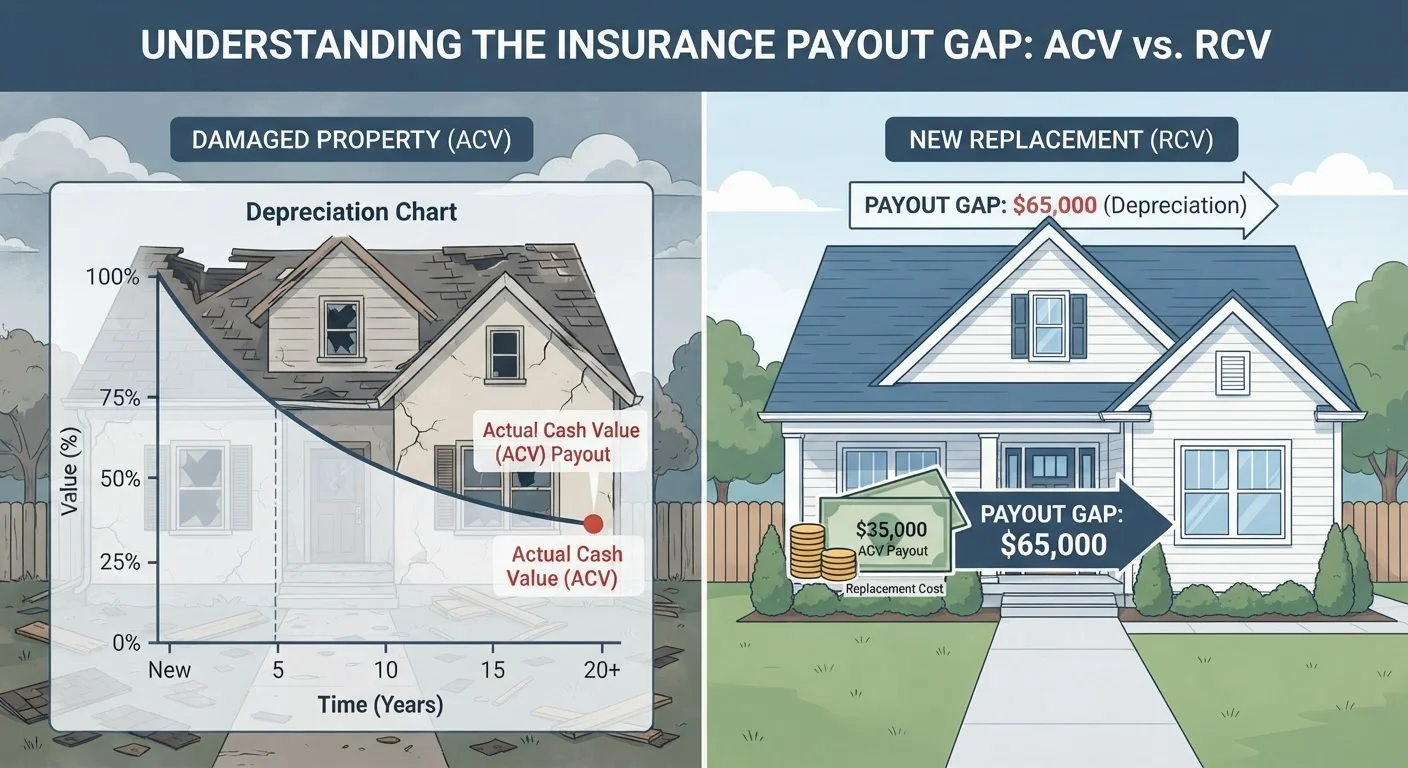
Actual Cash Value (ACV) is calculated by taking the replacement cost of an item and subtracting depreciation — the loss in value caused by age, wear, and obsolescence. If a five-year-old roof costs $20,000 to replace but has depreciated by 40%, an ACV claim pays roughly $12,000. You cover the remaining $8,000 yourself.
Replacement Cost Value (RCV) removes depreciation from the equation. Under an RCV policy, that same roof claim would pay the full $20,000 needed to restore it to a comparable condition — though most insurers release the depreciation holdback only after repairs are completed or underway.
This distinction applies across homeowners, renters, and some commercial property policies. For auto total-loss scenarios, insurers typically default to ACV; see how insurers calculate ACV after a total loss for a detailed look at that process.
| Criterion | Actual Cash Value (ACV) | Replacement Cost Value (RCV) |
|---|---|---|
| How payout is calculated | Replacement cost minus depreciation | Full cost to replace with new equivalent |
| Effect of age/wear on payout | Reduces payout significantly | No reduction for depreciation |
| Typical premium cost | Lower | Higher |
| Out-of-pocket risk after a claim | Higher — policyholder covers the gap | Lower — insurer covers replacement cost |
| Common policy structure | Default on many standard policies | Optional upgrade or endorsement |
| Best scenario for this valuation | Older property, tight budget | Newer property, risk-averse owner |
Why the Gap Can Hurt at Claim Time
Most policyholders don't discover their valuation method until they're already filing a claim — which is precisely the wrong moment. Depreciation schedules vary by item category: electronics and appliances depreciate faster than structural elements, meaning the ACV shortfall on contents can be especially steep.
~30–40%
Typical depreciation applied to a 10-year-old roof
Depreciation schedules vary by insurer and material type, but significant reductions are common on older structural components.
$10,000+
Potential ACV vs. RCV gap on a major home claim
On large structural losses, the difference between depreciated value and current replacement cost can reach or exceed five figures depending on property age and construction costs.
~60%
U.S. homes estimated to be underinsured
Industry analyses have consistently found that a majority of insured homes carry coverage limits below the actual cost to rebuild, a risk compounded when ACV rather than RCV applies.
Consider a household contents claim after a fire. A five-year-old laptop originally purchased for $1,500 might be valued at $400–$600 under ACV. Replacing it with a comparable new model could cost $1,200–$1,500. That gap — several hundred dollars on a single item — multiplies across an entire household of damaged belongings.
For structural damage, the stakes are even higher. Construction costs have risen substantially in recent years, meaning the gap between what an older home was worth on a depreciated basis and what it costs to rebuild can reach tens of thousands of dollars. Policyholders with ACV coverage who haven't reviewed their policy limits in years may find themselves significantly underinsured.
This dynamic also intersects with auto coverage decisions. Understanding how valuation methods work can clarify choices like whether gap insurance makes sense when you owe more on a vehicle than its ACV.
How to Read Your Policy and Make an Informed Choice
Your policy's declarations page or coverage summary will typically identify the valuation basis — look for language like "actual cash value," "replacement cost," or "extended replacement cost." If you're unsure, your insurer or a licensed agent can clarify before a claim arises.
A few practical considerations when evaluating your options:
- Premium difference: RCV policies generally cost more. The spread varies by insurer, property type, and coverage limits, but the added premium may be modest relative to the potential payout difference on a major loss.
- Holdback provisions: Many RCV policies pay ACV initially and release the depreciation holdback once you submit proof of repair or replacement. Understand this timing before assuming you'll have full funds upfront.
- Endorsements: Some insurers offer ACV base policies with optional RCV endorsements for specific categories — such as roof replacement or electronics — allowing targeted upgrades without a full policy switch.
- Item age and condition: For property that's already heavily depreciated, the practical difference between ACV and RCV narrows. For newer, high-value assets, the gap widens considerably.
Reviewing your coverage valuation method is one part of a broader coverage audit. Related choices — such as liability vs. full coverage or state minimum vs. recommended coverage — all interact to determine your real-world financial protection.
Check Your Policy Before You Need It
Many policyholders assume they have replacement cost coverage when their policy actually defaults to ACV. Requesting a coverage review from your agent — especially after renovations, major purchases, or rising construction costs in your area — can reveal gaps before a claim makes them costly. Policy language varies, so reading the actual document rather than relying on a summary is always advisable.
This article is for general informational purposes only and does not constitute personalized insurance, financial, or legal advice. Coverage terms, eligibility, and claim outcomes vary by policy and provider. Consult a licensed insurance professional to evaluate options suited to your specific situation.