

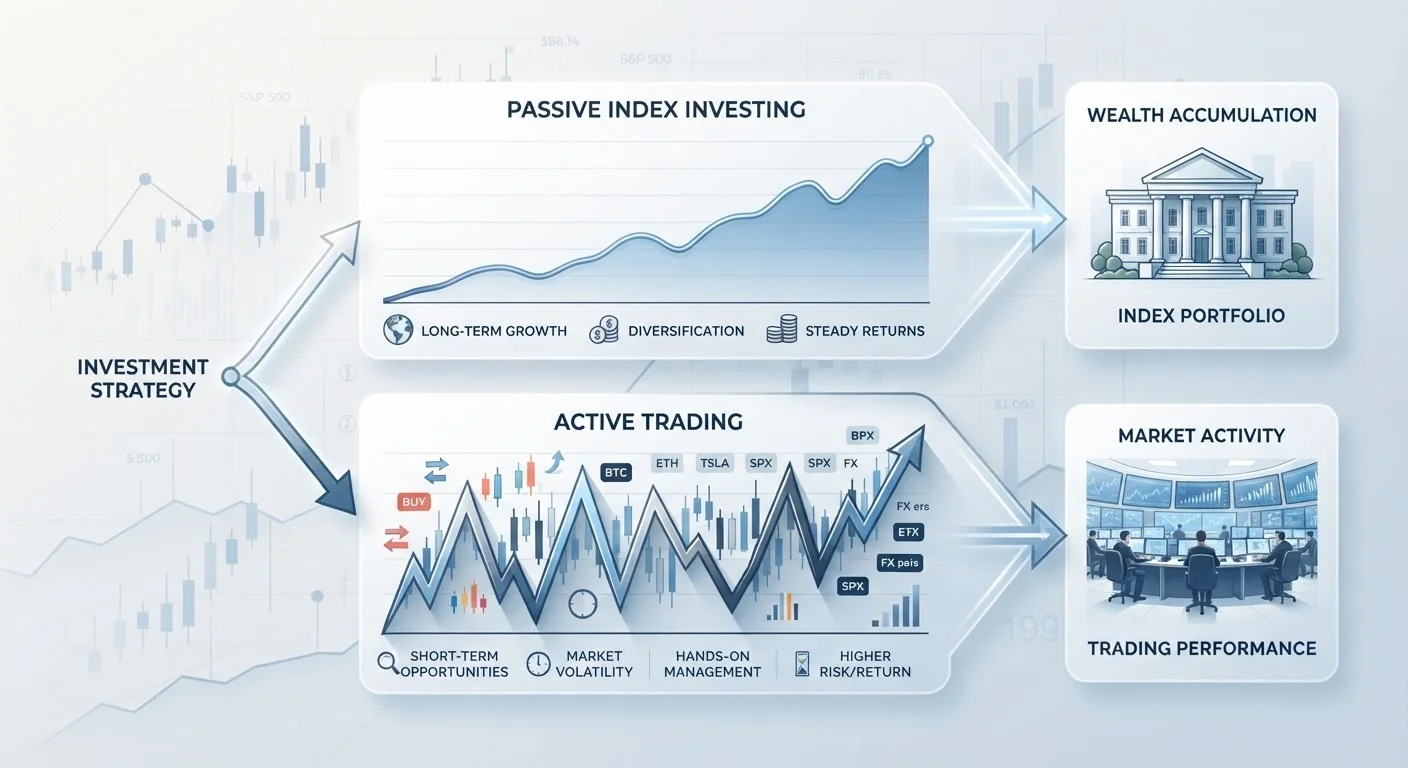
Key Takeaways
- Index funds track a market benchmark passively, while actively managed funds rely on professional managers making deliberate investment decisions.
- Actively managed funds typically carry higher expense ratios due to research and management costs.
- Research consistently shows most actively managed funds underperform their benchmark index over long time horizons.
- Neither fund type eliminates market risk; both can lose value when markets decline.
- Cost differences compound significantly over decades, making fees a critical factor for long-term investors.
Option A
Index Funds
The passive, low-cost market-tracking approach.
Best for: Investors seeking broad market exposure with minimal fees and hands-off management.
Option B
Actively Managed Funds
The professionally directed, research-driven strategy.
Best for: Investors who want a portfolio manager making deliberate stock-selection decisions on their behalf.
If you want low-cost, long-term market participation with minimal decision-making
Index Funds
Index funds offer broad diversification and consistently low fees, which can meaningfully compound to your advantage over time.
If you want a professional manager actively navigating specific market opportunities or niches
Actively Managed Funds
Active management may be worth considering for specialized market segments where skilled managers have historically added value, though higher costs and underperformance risk remain real concerns.
If you are just beginning to invest and have limited financial knowledge
Index Funds
Index funds are straightforward to understand, widely available, and require no ongoing monitoring of manager performance or strategy shifts.
What Each Fund Type Actually Does
At their core, these two fund types answer the same basic question differently: how should my money be invested across a collection of securities?
Index funds are designed to replicate the performance of a specific market index — such as the S&P 500 or the total U.S. stock market. The fund simply holds the same securities as the index, in roughly the same proportions. No manager is deciding which stocks to buy or sell beyond what the index dictates. This approach is called passive investing.
Actively managed funds take a different approach. A portfolio manager — or a team of them — analyzes economic data, company financials, and market trends to make deliberate decisions about what to buy, hold, or sell. The goal is to outperform a relevant benchmark index, not merely match it. This is called active investing.
Understanding this structural difference is the foundation for everything else — including cost, performance expectations, and how each fits into a broader financial plan. If you are also weighing whether to invest at all versus keeping money in savings, this breakdown of saving versus investing trade-offs can provide useful context.
| Criterion | Index Funds | Actively Managed Funds |
|---|---|---|
| Management style | Passive — tracks an index | Active — manager makes decisions |
| Typical expense ratio | Very low (often under 0.20%) | Higher (often 0.50%–1.00%+) |
| Goal | Match benchmark performance | Outperform benchmark |
| Portfolio turnover | Low | Typically higher |
| Diversification | Broad, built-in by design | Varies by fund strategy |
| Long-term performance vs. index | Matches index (minus small fees) | Most underperform after fees |
| Investor effort required | Minimal ongoing monitoring | Manager performance review needed |
Costs, Performance, and What the Data Generally Shows
One of the most consequential differences between these fund types is cost. Index funds carry low expense ratios — the annual fee expressed as a percentage of your investment — because their strategy requires minimal human oversight. Many broad-market index funds have expense ratios well under 0.20% annually.
Actively managed funds incur higher costs: research teams, portfolio managers, and frequent trading all add up. Expense ratios for active funds commonly range from 0.50% to over 1.00%. While that gap may sound small, compounded over 20 or 30 years, it can amount to a meaningful reduction in total returns.
~85%
Active large-cap funds underperforming S&P 500
S&P Dow Jones Indices' SPIVA reports have consistently shown roughly 80–90% of actively managed U.S. large-cap funds underperform the S&P 500 over 15-year periods after fees.
~0.03%
Lowest available index fund expense ratios
Some of the broadest U.S. market index funds have expense ratios as low as 0.03%, compared to industry averages for active funds that can exceed 0.60%.
On performance: extensive academic and industry research — including long-running reports from organizations like S&P Dow Jones Indices — has consistently found that the majority of actively managed funds underperform their benchmark index over 10- and 15-year periods, particularly after fees are accounted for. This does not mean all active funds underperform all the time, but it does mean that selecting a fund that reliably beats the market is genuinely difficult.
Diversification also matters here. Index funds are inherently diversified by design — a total market index fund may hold thousands of securities. Understanding how diversification works can help you appreciate why that breadth matters for managing risk.
Market Risk Applies to Both Fund Types
Neither index funds nor actively managed funds protect against overall market downturns. When markets fall broadly, both types of funds typically lose value. The difference lies in cost structure and management approach, not in the elimination of market risk. All investing involves the possibility of losing money, and past performance does not guarantee future results.
How to Think About This Choice as a Consumer
Neither fund type is inherently right or wrong — what matters is how each aligns with your financial goals, timeline, and risk tolerance. A few practical considerations worth reflecting on:
- Time horizon: The longer your investment horizon, the more costs compound — making low-fee index funds particularly attractive for goals measured in decades.
- Involvement preference: Index funds require virtually no ongoing research. Actively managed funds require monitoring your manager's strategy and performance over time.
- Tax efficiency: Index funds tend to generate fewer taxable events due to lower portfolio turnover, which can matter in taxable accounts.
- Specific market exposure: In some narrower or less efficient market segments, active management may offer more targeted expertise — though this varies significantly by fund and manager.
It is also worth noting that many investors hold both types across different accounts or goals. The choice is rarely all-or-nothing. For broader context on building savings foundations before investing, this comparison of savings accounts, money market accounts, and CDs explains where lower-risk options fit.
This article is for general informational and educational purposes only. It does not constitute personalized financial, investment, or tax advice. Consult a qualified, licensed financial adviser before making investment decisions based on your individual circumstances.