

Key Takeaways
- Dogs pull on the lead because forward movement rewards the behaviour — not because they want to dominate you.
- The behaviour is almost always learned and reinforced gradually over many walks.
- Understanding the root cause helps owners choose training methods that actually address the problem.
- Consistency matters far more than equipment when it comes to lasting change.
- Positive reinforcement-based techniques are supported by current animal behaviour science.
Leash Pulling in Dogs
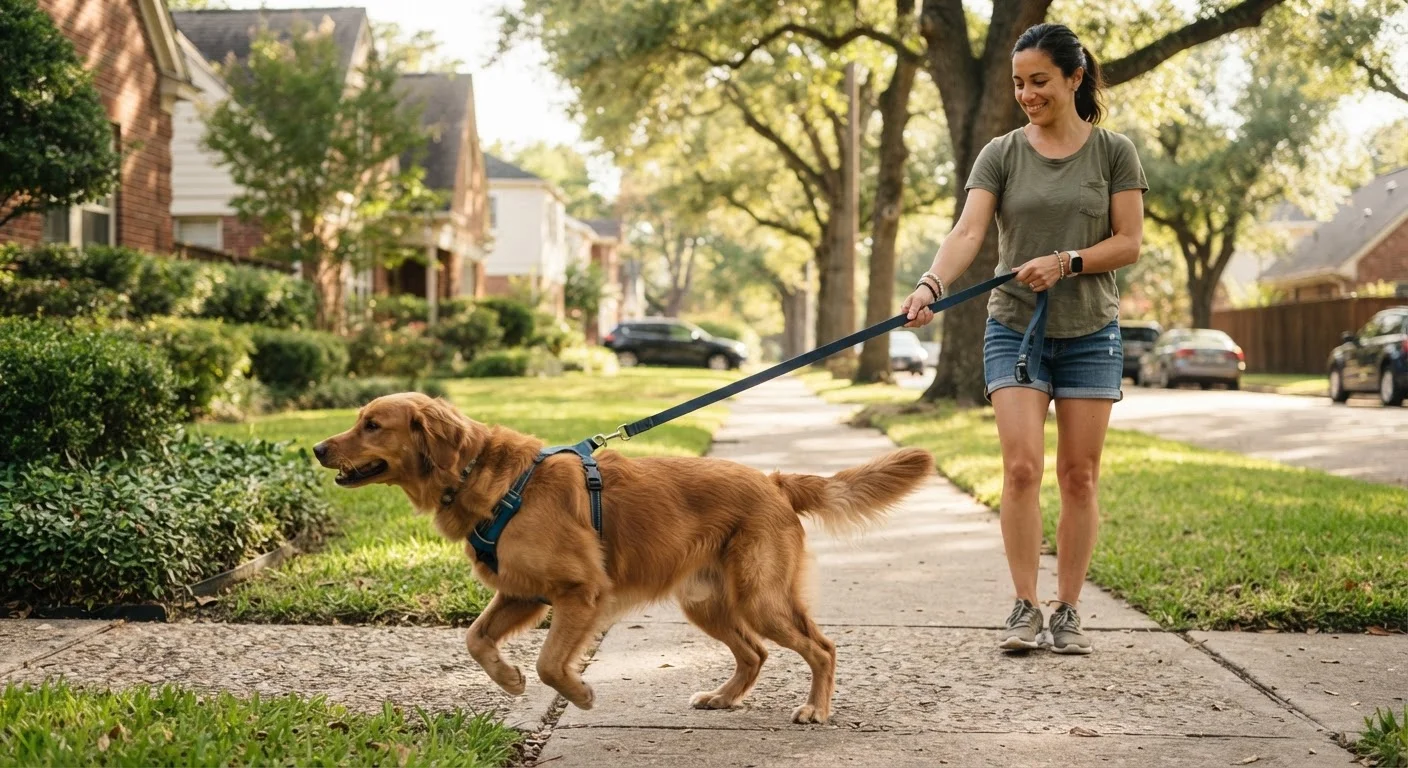
Leash pulling is when a dog consistently moves ahead of or away from its owner during a walk, creating tension on the lead. It's not a sign of dominance or stubbornness — it's a learned behaviour rooted in natural canine instincts and reinforced, often unintentionally, by the walk itself. Dogs pull because moving forward when they pull has worked for them before.
In behavioural terms, leash pulling is maintained primarily through negative reinforcement — the dog learns that pulling moves them closer to something they want, which strengthens the behaviour over time.
The Real Reason Dogs Pull
Ask most dog owners why their dog pulls, and you'll hear words like "stubborn," "dominant," or "excited." The truth is both simpler and more useful: dogs pull on the lead because pulling has worked. Every time a dog lunged toward a lamp post and got there, every time forward pressure on the leash was followed by forward movement — the behaviour was quietly reinforced.
This is the core insight from learning theory. As our article on how dogs learn explains, dogs form habits through the consequences of their actions. When pulling consistently leads somewhere rewarding, the brain files it away as a successful strategy.
It's also worth noting that walking at a human pace, in a straight line, past countless interesting smells without stopping — is genuinely unnatural for a dog. Their sensory world is rich with information at nose-level. Pulling isn't defiance; it's an animal trying to engage with its environment in the way that feels most natural to it.
“Dogs repeat what works. If pulling has reliably gotten them to the bush, the squirrel, or the other dog, that's the behaviour they'll bring to every walk. The question isn't how to stop the dog — it's how to change what works.”
— Dr. Karen Overall, Board-certified veterinary behaviourist and author on applied animal behaviour
How the Behaviour Gets Reinforced Over Time
Most leash pulling doesn't start dramatic. A puppy trots ahead, the owner follows. A young dog strains toward a squirrel, the owner lets the lead stretch. Each small repetition teaches the dog: tension on the leash predicts reaching the destination.
#1
Most reported dog behaviour problem by owners
Leash pulling consistently ranks as the most common complaint in surveys of dog owners conducted by veterinary behaviour organisations.
~80%
Dogs that pull have owners who inadvertently reinforce it
Behaviour specialists commonly observe that most pulling cases involve owners who have unknowingly rewarded the behaviour by continuing to walk when the lead is tight.
Over weeks and months, this pattern consolidates. The dog isn't plotting to take charge of the walk — it has simply learned the most efficient way to get where it wants to go. This is also why punishment-based corrections rarely solve the underlying problem: they may suppress the pulling in the moment without changing what the dog has learned about how walks work.
The myths that surround pet behaviour often lead owners toward corrections that address the symptom while leaving the cause untouched. Understanding the reinforcement history helps you see why a change in approach — rather than more pressure — tends to produce better results.
What Actually Helps: Training the Walk
Addressing leash pulling means teaching the dog a new rule: a loose lead is what earns forward movement. This is sometimes called "loose-leash walking," and the principle is straightforward — when the lead goes tight, the walk stops or reverses; when the lead is loose, the walk continues and good things happen.
Start Simple: The Stop-and-Wait Method
When your dog pulls, stop completely and wait calmly. The moment they release tension on the lead — even slightly — resume walking. Keep early training sessions short and in low-distraction environments. Your dog is learning a new rule, and that takes repetition before it sticks in busier, more tempting settings.
In practice, this requires patience and enormous consistency. Every person who walks the dog needs to apply the same approach, because inconsistency simply re-teaches the old pattern. Short, frequent training sessions during low-distraction walks tend to be more effective than trying to tackle a busy park immediately.
It's also helpful to ask whether your dog is getting enough physical and mental stimulation overall. A dog that arrives at the lead bursting with pent-up energy is going to find impulse control much harder. Structured enrichment — puzzle feeders, sniff-focused walks, training sessions — can reduce the intensity of the pull before you've even clipped the lead on. Regular activity also plays a role in overall health, another reason consistent, calm walks are worth working toward.
When to Seek Extra Support
For most dogs, consistent positive training will produce steady improvement in leash manners. But some dogs pull with an intensity that makes walks genuinely unmanageable, or the pulling is paired with reactivity — lunging, barking, or snapping at other dogs or people. In those cases, working with a certified professional trainer or veterinary behaviourist is worth considering.
A qualified trainer can observe your specific dog, identify what's driving the behaviour, and tailor a plan accordingly. This is particularly true if the dog has any history of anxiety, as fearful or anxious dogs sometimes pull as an avoidance response rather than a forward-seeking one. Our piece on separation anxiety in dogs touches on how stress can show up in unexpected behaviours — leash reactivity can sometimes be part of the same picture.
This article is for general informational purposes only. For concerns about your dog's behaviour or health, please consult a qualified veterinary or animal behaviour professional.