

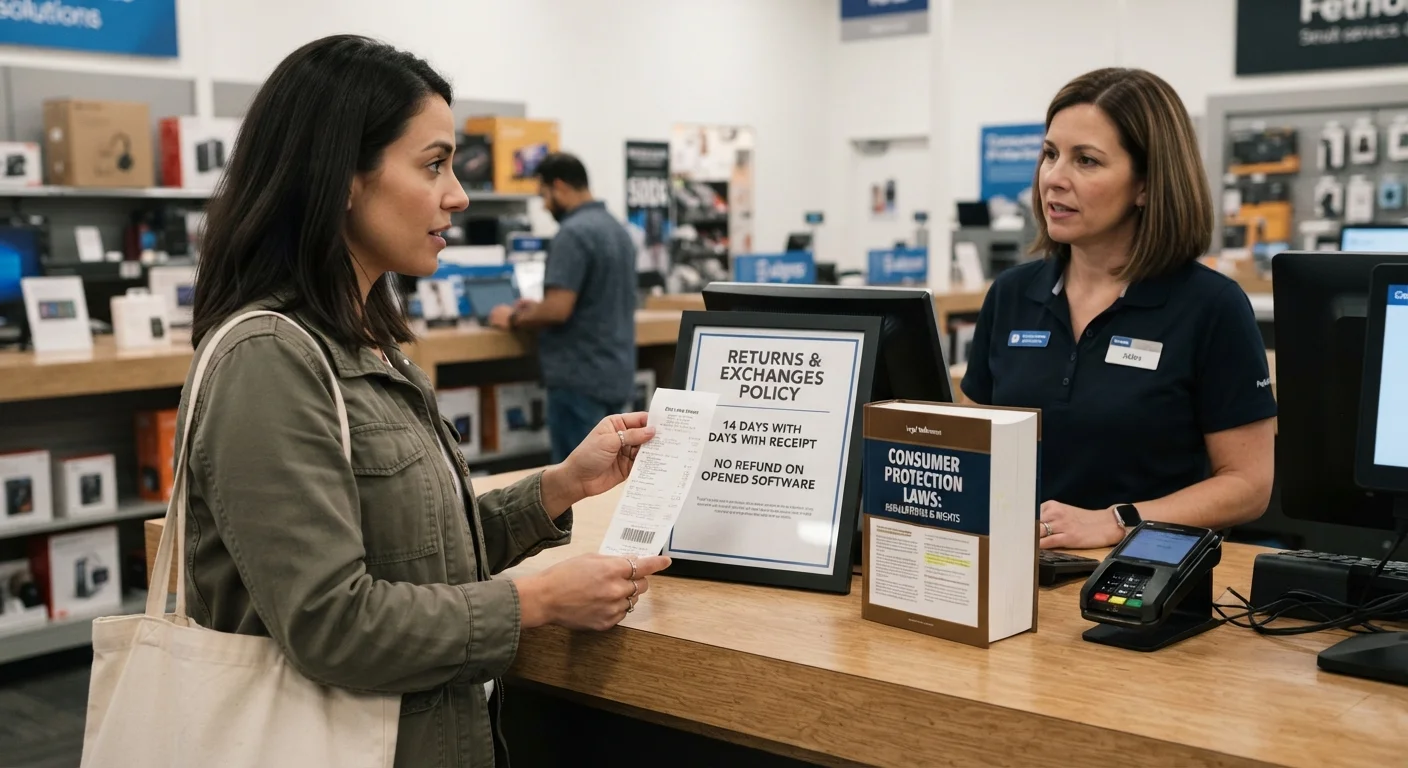
Key Takeaways
- Statutory rights are set by law and cannot be removed by any retailer's store policy.
- Store policies can offer more generous terms than the law but can never offer less.
- A faulty or misdescribed product triggers legal protections regardless of return window signs.
- Change-of-mind returns have no federal legal requirement — they depend entirely on store policy.
- Knowing which protection applies helps you argue your case more effectively at the counter.
Option A
Statutory Rights
The legal baseline every consumer holds by default.
Best for: Situations where a product is faulty, misdescribed, or unfit for purpose — regardless of what the store's policy says.
Option B
Store Policy
The retailer's own rules, which may be more — or less — generous than the law.
Best for: Straightforward change-of-mind returns, exchanges, and goodwill gestures where no legal fault exists.
If your product arrived faulty or broke within a short time of normal use
Statutory Rights
The law entitles you to a remedy — repair, replacement, or refund — independent of what any posted store policy says.
If you simply changed your mind about a purchase
Store Policy
No federal statute mandates change-of-mind returns for in-store purchases, so the retailer's posted policy is the operative rule here.
If the product didn't match its advertised description or listing
Statutory Rights
Consumer protection law covers misdescription, meaning you have a legal claim even if the store's return window has closed.
If you want an exchange or gift receipt swap beyond the legal fault window
Store Policy
Exchanges for non-faulty goods are a courtesy, so the retailer's stated terms govern what's available to you.
Two Different Layers of Protection
When a purchase goes wrong, shoppers often hear two conflicting things: what the store's customer service rep says the policy allows, and a vague sense that the law says something different. Both can be true at once — because statutory rights and store policies operate on separate layers.
Statutory rights are protections built into law. In the United States, these include protections under the Magnuson-Moss Warranty Act (which governs written warranties on consumer products), the implied warranty of merchantability under the Uniform Commercial Code (as adopted by most states), and various state-level consumer protection statutes. These rights attach automatically to a transaction — you don't need to register for them or ask for them.
Store policy is the retailer's own set of rules: the 30-day return window, the requirement for original packaging, the no-receipt, no-return rule. These are voluntary commitments by the business, and they vary widely. See our common misconceptions about return policies for a breakdown of which shopper assumptions actually hold up.
The critical principle: a store policy can be more generous than your legal rights, but it cannot legally strip those rights away.
| Criterion | Statutory Rights | Store Policy |
|---|---|---|
| Source | Federal and state law | Retailer's internal rules |
| Can be waived by the store? | No — legally binding | Yes — set and changed at will |
| Applies to faulty goods? | Yes — core protection | Varies; may exclude final-sale items |
| Applies to change-of-mind returns? | Generally no federal requirement | Yes — if policy allows it |
| Time limit for claims | Varies by state and warranty type | Set by retailer (e.g. 14–90 days) |
| Requires a receipt? | Not always — proof of purchase may suffice | Often yes, per store rules |
| Remedy available | Repair, replacement, or refund | Exchange, store credit, or refund (policy-dependent) |
When the Law Steps In — and When It Doesn't
Statutory protections are strongest when something is objectively wrong with the product. If an item is faulty at the point of sale, fails within a reasonable period under normal use, or was materially misdescribed, most state consumer protection laws and implied warranty doctrines give you a route to a remedy — repair, replacement, or refund — regardless of posted policy. A sign that says "All Sales Final" does not override implied warranty obligations for defective goods in most U.S. jurisdictions.
50+
State consumer protection statutes in the U.S.
Every U.S. state has its own consumer protection law, meaning statutory rights can vary significantly depending on where you made your purchase.
~4 years
Typical UCC implied warranty claim window
Under the Uniform Commercial Code as adopted in most states, buyers generally have up to four years to bring a breach of implied warranty claim, though specifics vary by jurisdiction.
Where the law is largely silent is the change-of-mind scenario. There is no federal statute requiring retailers to accept returns on non-defective products from in-store purchases. In that situation, the store's posted policy is your operative protection — or limitation. This is why reading return terms before purchase matters, especially for high-value or non-standard items.
Online purchases introduce a separate layer. Distance-selling considerations and credit card dispute rights can apply. For a detailed look, see how your rights differ online versus in-store.
Credit Card Dispute Rights Add a Third Layer
If you paid by credit card, the Fair Credit Billing Act gives you the right to dispute charges for goods that were not delivered as described or that were defective. This is separate from both statutory rights and store policy, and it applies even when a retailer has declined your return request. Time limits apply — typically 60 days from the statement date — so act promptly if needed.
Using This Knowledge at the Counter
Understanding which protection applies changes how you approach a dispute. If a product is defective, you're not asking for a favor — you're asserting a legal right. Calmly referencing implied warranty protections or your state's consumer protection statute shifts the conversation. Escalating to a manager, filing a complaint with your state attorney general's consumer protection office, or disputing the charge with your card issuer are all legitimate next steps when a retailer refuses a valid statutory claim.
If you're seeking a return for a non-faulty item, the store policy is the framework — and being familiar with its exact terms before you get to the counter is your strongest tool. For a broader view of rights across the full purchase lifecycle, the full picture of consumer rights from purchase to resolution covers warranties, complaints, and dispute resolution in one place.
The bottom line: neither layer exists in isolation. Knowing which one governs your specific situation is what lets you advocate for yourself effectively — without confusion or confrontation getting in the way.
This article provides general consumer information for educational purposes only and does not constitute legal advice. Laws vary by state and circumstance. Consult a qualified legal professional or your state attorney general's office for guidance specific to your situation.