

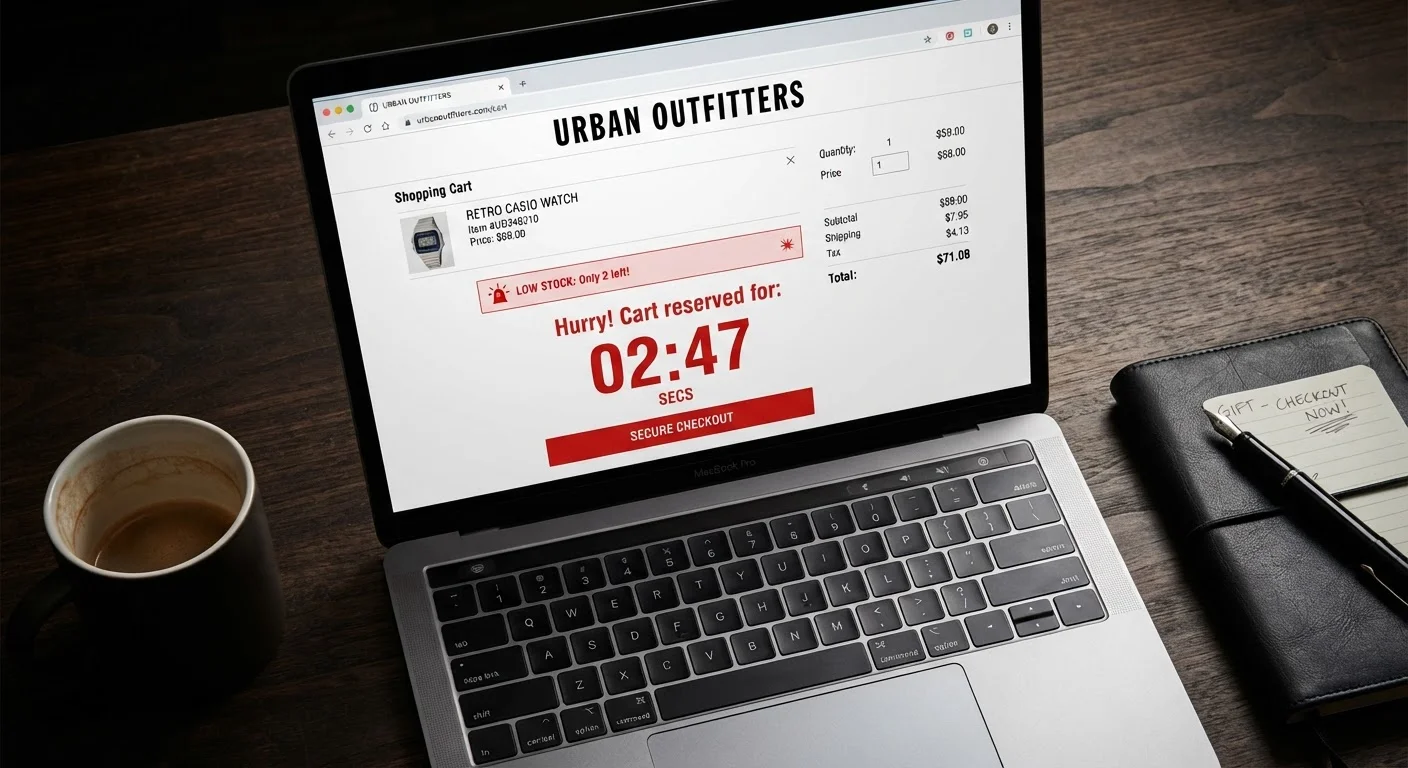
Key Takeaways
- Low-stock and countdown warnings can be real signals or purely automated marketing tactics.
- Retailers are legally permitted to reset countdown timers indefinitely in most US jurisdictions.
- Checking price history before acting on urgency signals reveals whether a deal is genuinely time-limited.
- Feeling rushed to decide is itself a sign to pause, not accelerate, a purchase.
- Consumer protection frameworks address deceptive practices, but enforcement is uneven and complaint-driven.
How Scarcity and Urgency Signals Work
Online retailers rely on a well-documented principle from behavioral economics: people assign higher value to things that appear scarce and make faster decisions when they believe an opportunity is about to disappear. Low-stock labels, countdown timers, and real-time viewer counts are all applications of the same underlying mechanism. None of these elements are inherently dishonest — genuine stock limits and time-bound promotions do exist. The problem arises when the signals are decoupled from any real constraint and used purely as conversion tools.
Understanding the mechanics behind these displays is the first step toward neutralizing their effect on your own judgment. The sections below address the most persistent myths shoppers carry about what these signals actually mean.
Myth
"Only 3 left in stock" means the retailer is nearly out of that product.
Fact
Low-stock labels are often triggered by automated thresholds, not actual near-depletion. A retailer may show this message whenever inventory drops below a set number — even if that number is replenished daily.
Many e-commerce platforms allow merchants to configure a threshold — commonly between 5 and 10 units — at which a low-stock label automatically appears. The message is accurate in a narrow technical sense (that many units are currently allocated to the display pool), but it does not mean the warehouse is empty or the product is being discontinued. Seasonal staples and high-volume basics frequently trigger these labels as a permanent state. Before treating the warning as a reason to act, check whether the item has consistent reviews dating back months or years — a strong indicator of ongoing availability.
Myth
A countdown timer on a sale price means the discount expires when the clock hits zero.
Fact
Countdown timers are display elements that retailers can reset, extend, or recycle without any technical or legal barrier in most US states.
Unlike an auction deadline, a retail countdown timer carries no binding commitment. Merchants using major e-commerce platforms can manually extend a promotion or configure timers to loop. Consumer reporters and watchdog groups have documented examples of the same "24-hour" sale running for weeks with a timer that resets nightly. The Federal Trade Commission's general deception standards could theoretically apply to timers that are demonstrably false, but enforcement actions specifically targeting countdown clocks remain rare. The practical test: note when the timer expires, revisit the page, and observe whether the price or the timer has changed. Price history tools are a more reliable signal than any displayed clock.
Myth
Real-time viewer counts like "47 people are looking at this right now" reflect genuine live competition for the item.
Fact
Viewer-count figures displayed on product pages are frequently generated by scripts with no direct connection to actual simultaneous user sessions.
Some platforms do surface real session data, but many third-party urgency plugins generate plausible-looking numbers algorithmically rather than by counting live visitors. There is no standard disclosure requirement for how these figures are calculated. Even when the number is technically real-time, seeing 47 concurrent viewers does not mean 47 people are about to check out — browsing behavior and purchase intent are very different. Treat these figures as unverified and factor them out of your decision process entirely.
Myth
Flash sales and limited-time offers always represent genuine price reductions from a regular price.
Fact
"Regular" or "original" prices used as reference points for flash sales are sometimes set artificially high to make the sale price appear more dramatic.
This practice, often called reference price inflation or fictitious pricing, has been the subject of class-action litigation and FTC guidance in the US. A product listed at $120 "marked down" to $60 may have rarely or never sold at $120 in the relevant market. Anchor pricing tactics exploit the human tendency to judge value relative to a reference number rather than absolute worth. Checking a price-history extension before a flash sale ends will show whether the "original" price is a real baseline or a constructed one. See also: how "up to X% off" language works in practice.
Myth
If a retailer uses scarcity tactics, the entire transaction is probably a scam.
Fact
Scarcity and urgency signals are used by legitimate retailers and fraudulent ones alike — the presence of the tactic does not indicate fraud, only that scrutiny is warranted.
Major, well-established e-commerce platforms routinely use low-stock labels, timers, and viewer counts as standard merchandising tools. The risk is not necessarily fraud but rather a nudged decision that may not reflect your actual priorities or the item's true value. The appropriate response is verification, not blanket distrust. Review the seller's return policy, check independent price data, and consider whether you would still want the item if the urgency element were absent. For guidance on your rights if a purchase goes wrong, the Consumer Rights hub covers returns, warranties, and dispute processes. Separately, urgency-driven purchases are one of the most common patterns behind spending regret.
What You Can Actually Do About It
Awareness alone reduces — but does not eliminate — the psychological pull of urgency cues. A few practical habits add a reliable filter between the stimulus and the decision.
Timers That Reset Are Not Rare Exceptions
Browser tests and consumer watchdog investigations have repeatedly documented countdown clocks that restart as soon as they reach zero, or reset when a page is refreshed. If a deal is still available after the timer expires, the urgency framing was not tied to any real constraint. Note the expiry time, navigate away, and return — the result tells you what the timer does not.
Verify price history before acting. Free browser extensions surface historical price data for major retail platforms. A price that has held steady for six months is not a flash sale regardless of what the timer says. Price tracking tools make this check quick and concrete.
Apply a cooling-off window. Add the item to a wishlist rather than the cart, wait 24 hours, and revisit. If the "limited" price has expired and the item is gone, you have real data. If the same deal is still running, the urgency framing was artificial.
Separate the product question from the timing question. Ask whether you would buy this item at this price without any urgency signal. If the honest answer is no, the scarcity label is doing work that price and product quality alone cannot.
Urgency Is Designed to Bypass Judgment
Scarcity and countdown mechanisms are backed by decades of behavioral research showing they trigger faster, less analytical decision-making. Recognizing the tactic does not make you immune — it simply creates the pause you need to verify the claim before committing.
For context on how retailer pricing structures create the illusion of deals more broadly, see how bundle pricing can obscure true value using similar framing mechanics.
This article is for general informational and educational purposes only. It does not constitute legal, financial, or consumer-legal advice. Specific rights and remedies vary by state; consult a qualified professional or relevant consumer protection agency for guidance specific to your situation.