
Personal Fragrance Basics: How Scent Works on Skin and Why It Smells Different on Everyone

Key Takeaways
- Fragrance smells different on everyone because skin chemistry, pH, and oils all alter how scent molecules behave.
- Body heat amplifies fragrance projection — pulse points work because skin is warmest there.
- Perfume unfolds in layers called top, middle, and base notes, each revealing itself at a different time.
- Moisturized skin holds fragrance longer than dry skin.
- Testing a fragrance on your wrist and waiting 20–30 minutes gives the most accurate impression.
Fragrance on Skin
When you apply a perfume or cologne, the scent doesn't just sit on your skin — it interacts with your body heat, natural oils, and skin chemistry to create something unique to you. This is why the same fragrance can smell dramatically different from person to person. Understanding this process helps explain why sampling a scent on your own skin is always more informative than smelling it from a blotter or bottle.
Fragrance molecules are volatile organic compounds that evaporate at different rates, producing what perfumers call top, middle, and base notes — a structured sequence of scent impressions that unfolds over time.
The Three-Layer Structure of Any Fragrance
Every perfume or cologne is built around a concept called the fragrance pyramid — a layered structure of scent that unfolds over time as different molecules evaporate at different rates.
- Top notes are what you smell immediately after application. They're typically light, fresh, or citrusy, and they evaporate within the first 15–30 minutes. These create the first impression but don't represent the full scent.
- Middle notes (also called heart notes) emerge as the top notes fade. They form the core character of the fragrance and can last several hours. Common heart notes include florals, spices, and herbs.
- Base notes are the foundation — deep, rich materials like woods, musks, and resins that anchor the scent and provide lasting power. They become most noticeable after an hour or more and are what linger on skin throughout the day.
This is why a fragrance that smells sharp and citrusy in the bottle may dry down to something warm and woody on skin an hour later. Evaluating a scent during its top notes alone gives an incomplete picture.
Test on Skin, Not Just Paper
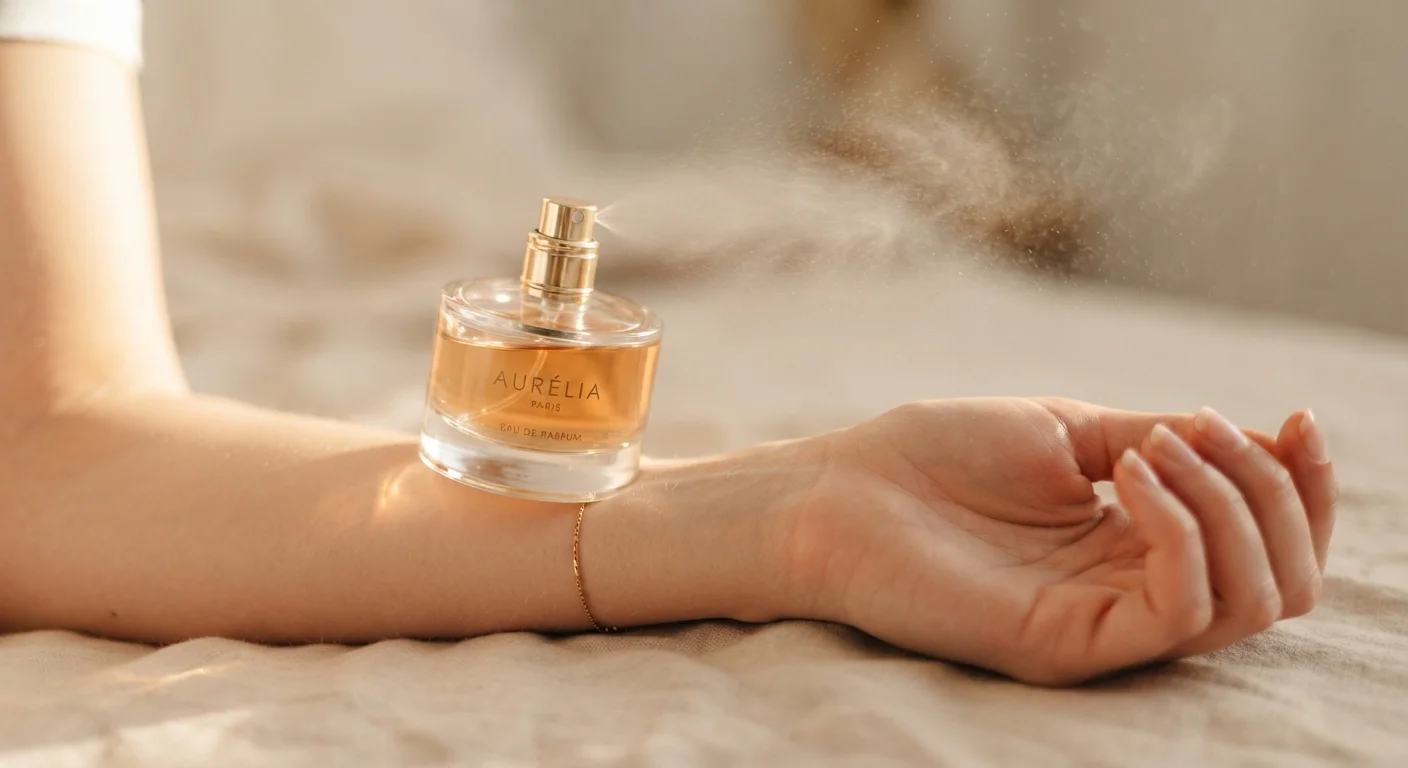
Fragrance blotters give a rough preview, but they can't replicate how a scent will develop with your body heat and chemistry. Always apply a small amount to your inner wrist and wait at least 20–30 minutes before deciding. What you smell at the end of that window is far closer to what you'll actually wear.
Why Skin Chemistry Changes Everything
No two people's skin is chemically identical. Your skin's natural pH, sebum (oil) production, hydration level, and even the bacteria that make up your skin microbiome all influence how fragrance molecules interact with your body.
Oilier skin tends to hold fragrance longer because the oils provide a medium for scent molecules to cling to. Drier skin absorbs the fragrance more readily, which can cause it to fade faster. Your skin's pH — which hovers around 4.5–5.5 in a healthy range but varies from person to person — affects how certain aromatic compounds open up or recede.
Hormones also play a role. They influence sebum production and skin chemistry, which is part of why the same fragrance may seem to shift in character across different phases of the menstrual cycle or as the body changes with age. For more on how skin itself evolves over time, see how skin type shifts with age and hormones.
Fragrance and Skin Sensitivity
Some fragrance ingredients — particularly certain synthetic musks, aldehydes, or botanical extracts — can cause irritation or allergic reactions in sensitive individuals. If you have reactive or easily irritated skin, it's worth patch-testing a new fragrance on a small area before full application. Fragrance-free alternatives exist for many personal care products if skin sensitivity is a concern.
Heat, Moisture, and Application Technique
Body heat is one of the most powerful factors in how a fragrance projects. Warmth encourages volatile molecules to lift off the skin and diffuse into the air around you — which is exactly why fragrance is traditionally applied to pulse points, areas where blood vessels run close to the skin surface and generate more warmth.
Common pulse points include the inner wrists, the sides of the neck, behind the ears, the inside of the elbows, and the back of the knees. You don't need to apply fragrance to all of them — even one or two well-chosen spots will work effectively.
Skin hydration matters too. A light layer of unscented moisturizer applied before fragrance gives the scent molecules something to bind to, noticeably extending wear time. This matters more for eau de toilette concentrations, which are lighter and fade faster than eau de parfum formulas.
As for technique: spray or dab — don't rub. Rubbing wrists together is a common habit, but it generates friction that speeds up evaporation of top notes and can distort the scent's natural development. Let the fragrance settle on its own.
Understanding skin-level basics like this sits alongside the broader logic of a personal care routine. If you're building yours from scratch, what each skincare step actually does is a useful companion read.
~78%
Fragrance concentration in parfum (extrait) formulas
Parfum or extrait de parfum typically contains 20–30% aromatic compounds, compared to 5–15% in eau de parfum and 5–10% in eau de toilette, according to general industry standards.
20–30 min
Time for heart notes to fully emerge on skin
Perfumers generally recommend evaluating a fragrance after this window, once the top notes have evaporated and the true character of the scent becomes apparent.
How to Test a Fragrance More Accurately
Paper blotters in stores give a general impression of a scent's character, but they can't replicate how it will develop on your skin. For any fragrance you're seriously considering, always test it directly on your wrist or inner arm and wait.
Give it at least 20–30 minutes before making a judgment — long enough for the top notes to fade and the heart of the fragrance to emerge. If possible, wear it for a full day to understand how the base notes settle and how long the overall projection lasts on your particular skin.
A few other practical pointers: avoid testing more than two or three fragrances on skin at once, as the scents will overlap and become difficult to distinguish. And be aware that environment matters — a fragrance can smell different in warm, humid weather versus cold, dry air, because heat amplifies projection while cold air suppresses it.
If you're interested in how the ingredients in personal care products more broadly interact with your skin, understanding common personal care ingredients offers useful context.