

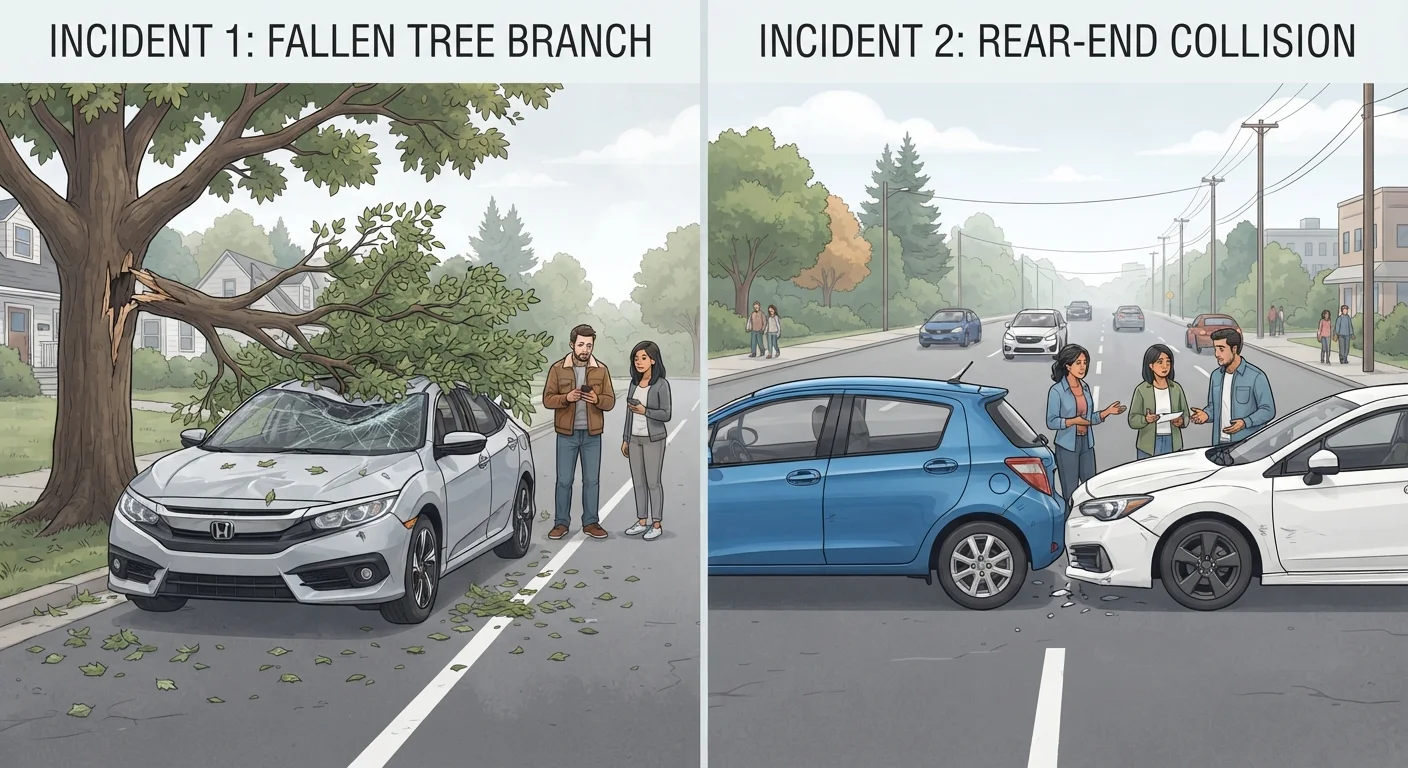
Key Takeaways
- Comprehensive covers damage from events like weather, theft, and animal strikes — not crashes.
- Collision covers damage to your vehicle from impact with another car or object, regardless of fault.
- Both coverages are subject to a deductible you choose when you set up your policy.
- Lenders typically require both coverages on financed or leased vehicles.
- Neither coverage pays for injuries or damage you cause to another driver's vehicle — that's liability.
- Your vehicle's actual cash value sets the ceiling on what either coverage will pay out.
Option A
Comprehensive Coverage
Protection against events outside your control.
Best for: Drivers who want coverage for theft, weather damage, animal strikes, and other non-collision incidents.
Option B
Collision Coverage
Protection for impact-related vehicle damage.
Best for: Drivers who want their insurer to pay for repairs after hitting another vehicle or a stationary object.
If you drive in areas prone to severe weather, hail, or wildfires
Comprehensive Coverage
Comprehensive responds to weather-related damage that collision coverage simply won't touch. It's the only protection for events like hailstorms, flooding, or falling debris.
If you frequently drive in heavy traffic or have a long daily commute
Collision Coverage
More miles in congested conditions raises the statistical likelihood of an at-fault or partial-fault accident. Collision ensures your own repairs are covered regardless of who caused the crash.
If you have a financed or leased vehicle
Both Coverages
Most lenders and lessors contractually require both comprehensive and collision. Dropping either typically violates your financing agreement.
If your car's market value is low relative to your deductible
Neither may be cost-effective
When a vehicle's actual cash value is close to or below your combined deductibles, the net payout after a claim may be minimal. Weigh annual premiums against realistic recovery amounts.
If you park in high-theft or urban areas
Comprehensive Coverage
Theft and vandalism are covered under comprehensive — collision coverage provides no protection if your car is stolen or broken into.
The Core Difference: What Triggered the Damage?
The clearest way to separate these two coverages is by asking one question: what caused the damage? If your vehicle was struck by another car, you drove into a guardrail, or you hit a pothole hard enough to damage your wheel — that's a collision scenario. If a deer ran into your car, a hailstorm dented the hood, or someone stole your vehicle overnight — that falls under comprehensive.
Insurers use the term comprehensive deliberately. It's designed to cover the broad range of incidents that aren't crashes: fire, flood, falling objects, vandalism, civil disturbance, and contact with animals. Collision, by contrast, is narrowly scoped to physical impact between your vehicle and another object or vehicle.
For a deeper look at how these coverages fit into your overall policy, see our plain-language guide to auto insurance terms.
| Criterion | Comprehensive Coverage | Collision Coverage |
|---|---|---|
| What triggers a claim | Non-collision events (weather, theft, animals, fire) | Impact with another vehicle or object |
| Fault relevance | Not applicable — no fault involved | Pays regardless of fault |
| Typical deductible range | $100–$500 (often lower) | $250–$1,500 (often higher) |
| Required by lenders? | Yes, typically required | Yes, typically required |
| Covers theft? | Yes | No |
| Covers hitting a deer? | Yes | No |
| Covers hitting a guardrail? | No | Yes |
| Payout ceiling | Actual cash value of vehicle | Actual cash value of vehicle |
How Deductibles Work for Each
Both comprehensive and collision are deductible-based coverages. A deductible is the amount you agree to pay out of pocket before your insurer covers the remainder of a claim. You set this figure when you purchase the policy — common amounts range from $250 to $1,500, though higher deductibles are available.
Comprehensive deductibles are typically set lower than collision deductibles, because comprehensive claims (such as minor windshield chips or small hail dents) tend to occur more frequently and for smaller amounts. Collision repairs — especially after a significant impact — usually run higher, so many drivers opt for a higher collision deductible to reduce their monthly premium.
One practical implication: if your vehicle suffers damage under both coverages in separate incidents, each deductible applies independently. A flood that damages your engine (comprehensive) and a parking lot fender-bender (collision) in the same policy period would trigger two separate deductibles.
~75%
Insured drivers carrying collision coverage
According to the Insurance Information Institute, roughly three-quarters of insured U.S. drivers carry collision coverage as part of their auto policy.
~80%
Insured drivers carrying comprehensive coverage
The Insurance Information Institute reports comprehensive coverage is slightly more common than collision among insured drivers, partly due to its lower cost relative to the breadth of protection.
$500
Most common collision deductible chosen
Industry data consistently shows $500 as the most frequently selected collision deductible, reflecting a balance between manageable out-of-pocket costs and lower premiums.
What Neither Coverage Pays For
Understanding the boundaries of these coverages is just as important as knowing what they include. Neither comprehensive nor collision covers:
- Injuries — to you, your passengers, or anyone else involved. Medical costs are addressed by separate coverages such as medical payments (MedPay) or personal injury protection (PIP).
- Damage to another person's vehicle — that's the job of property damage liability coverage.
- Mechanical breakdown — worn brakes, a failing transmission, or engine failure from neglect are not covered by either type.
- Custom equipment — aftermarket modifications may require a separate endorsement.
It's also worth noting that both coverages pay based on your vehicle's actual cash value (ACV) — what the car is worth on the market at the time of the loss, not what you originally paid or what you still owe. If you're carrying a loan balance that exceeds your car's ACV, gap insurance may be worth considering to cover that difference.
For a full picture of how ACV is calculated after a total loss, see how insurers determine actual cash value.
Windshield Claims and Comprehensive
Windshield damage is one of the most common comprehensive claims. In some states, insurers are required to waive the deductible for glass-only claims, meaning a cracked windshield may be repaired or replaced at no cost to you. Check your state's rules and your specific policy language, as this varies significantly by insurer and location.
When You May Need One, Both, or Neither
Whether to carry one or both coverages depends on several factors: your vehicle's age and market value, your financial cushion to absorb an out-of-pocket loss, and any contractual requirements from a lender or lessor.
As a general principle, the more your car is worth and the less you could comfortably pay out of pocket for major repairs, the stronger the case for maintaining both coverages. Conversely, on an older vehicle with a low market value, the math sometimes works against paying annual premiums for coverage that could only return a modest payout. This is a personal financial calculation — not a universal rule — and the right answer varies by situation.
Drivers who want a broader view of how these decisions play out in practice can read about coverage gaps that catch drivers off guard and how they compare within a liability vs. full coverage framework.
This article provides general educational information about auto insurance coverage types and is not personalized insurance, financial, or legal advice. Coverage terms, exclusions, and availability vary by insurer and state. Always read your policy documents carefully and consult a licensed insurance agent for guidance specific to your situation.