

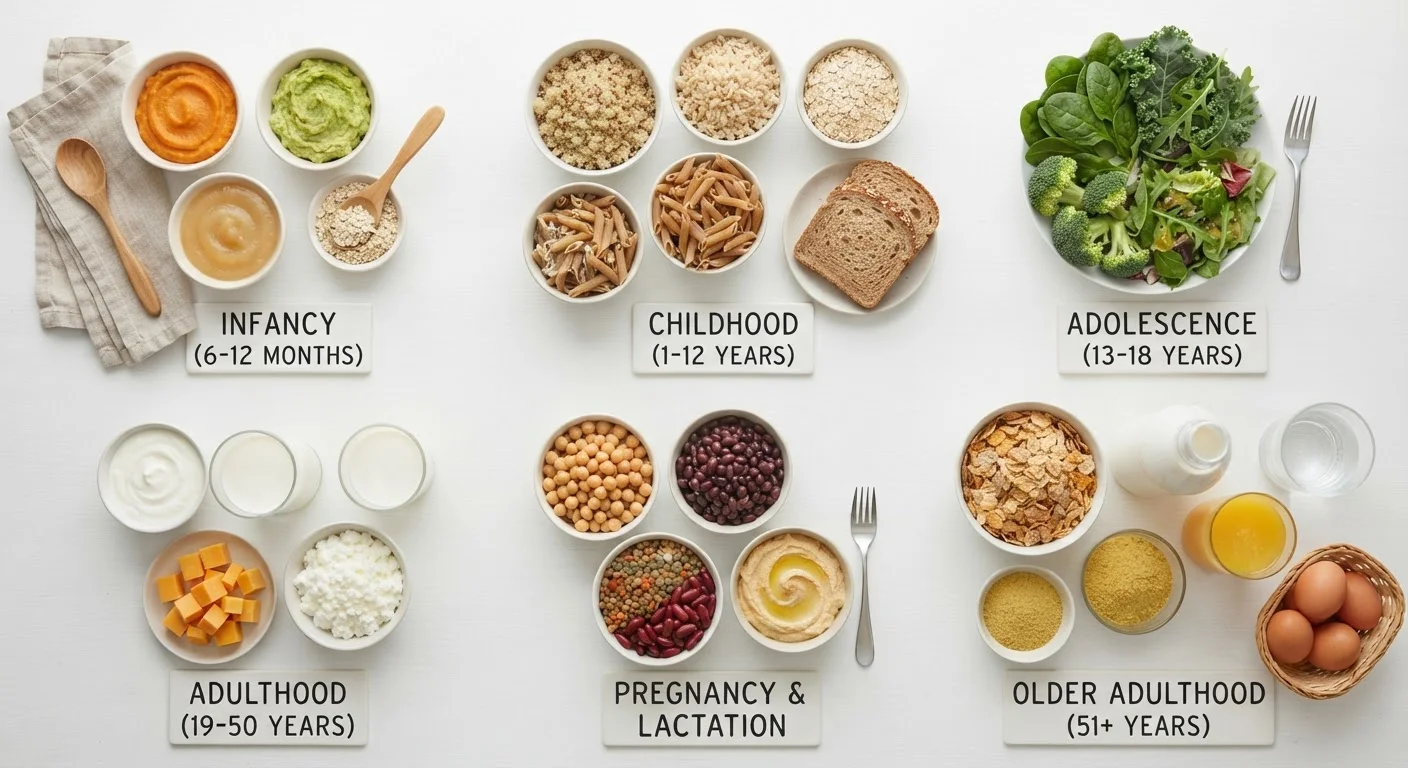
Key Takeaways
- Calorie needs fluctuate across life stages, but micronutrient requirements often remain high or increase independently of calories.
- Iron, calcium, vitamin D, and protein are among the nutrients with the most significant life-stage variability.
- Absorption efficiency declines with age, meaning older adults may need more of certain nutrients even with adequate intake.
- Pregnancy and adolescence are two periods of particularly elevated nutritional demand.
- A registered dietitian can provide guidance tailored to your specific life stage and health status.
Why Nutritional Needs Change Over a Lifetime
The human body is not a static system. From the rapid cell division of infancy to the gradual metabolic shifts of older adulthood, biology continuously changes what we need from food. Metabolism, hormone levels, organ function, gut absorption capacity, and lean muscle mass all evolve — and so do the nutrients required to support them.
Understanding these shifts is not about following a rigid eating plan. It is about recognizing that the diet that served you well at 25 may need thoughtful adjustment at 55 — and that general awareness of these patterns can help you make more confident food choices at any age. For personalized guidance, always consult a registered dietitian or qualified healthcare provider.
~60%
Brain size reached by end of infancy
According to developmental neuroscience literature, the brain reaches approximately 60% of adult volume by age one, underscoring the critical role of dietary fat and micronutrients in early life.
1,300 mg
Daily calcium target for adolescents (ages 9–18)
The National Academies of Sciences, Engineering, and Medicine set this as the recommended dietary allowance for calcium during peak bone-building years.
~1–2%
Annual muscle mass loss starting in midlife
Research in exercise physiology indicates adults can lose roughly 1–2% of skeletal muscle mass per year from the fourth decade onward if physical activity and protein intake are insufficient.
Infancy and Early Childhood: Building the Foundation
No period of life places higher nutritional demands relative to body size than infancy. In the first year, a baby roughly triples its birth weight, and the brain grows to approximately 60% of its adult size. Human breast milk, when available, provides a dynamic blend of fats, antibodies, and bioavailable nutrients calibrated to these needs. Where formula is used, current formulations are designed to approximate this profile.
By six months, most infants begin transitioning to solid foods. Iron becomes a critical focus at this point — breast milk alone no longer meets demands as stored iron from birth depletes. Iron-rich foods such as pureed meats, lentils, and iron-fortified cereals are commonly introduced first for this reason.
Introduce Iron-Rich Foods Early
When starting solids around six months, offering iron-containing foods alongside vitamin C-rich foods can support absorption. Combining, for example, pureed lentils with a small amount of pureed tomato is a practical approach. Always follow your pediatrician's guidance on introducing solids.
Early childhood (ages one through five) is characterized by slower but still significant growth. Adequate calcium and vitamin D support bone mineralization during this window. The micronutrient reference guide offers a useful overview of these nutrients and their food sources.
Parents and caregivers of infants and young children should always consult a pediatrician or registered dietitian for feeding guidance specific to the child's development and health history.
Adolescence: Growth, Hormones, and Higher Demands
Adolescence triggers a second major growth surge, and nutritional needs spike accordingly. Calcium requirements reach their lifetime peak during the teenage years, when bone density is being actively laid down — a process that largely concludes by the early twenties. Inadequate calcium intake during this window cannot be fully compensated for later in life.
Iron demands also increase sharply, particularly for adolescent girls after the onset of menstruation. Zinc, folate, and overall caloric intake all rise to support muscle development, reproductive maturation, and neurological growth.
During adolescence, focus on food variety rather than nutrient restriction. Eliminating entire food groups without a medical reason can create gaps in calcium, iron, or zinc that are difficult to close at this growth stage.
Restrictive eating patterns adopted during growth spurts have been associated with lower bone density and micronutrient insufficiencies that may persist into early adulthood.
For older adults who eat smaller meals, prioritize protein-dense options at each eating occasion rather than saving protein for one large meal — the body's ability to synthesize muscle protein from a single bolus has limits.
Research in protein metabolism suggests distributing protein intake across meals optimizes muscle protein synthesis in older adults more effectively than consuming it predominantly at dinner.
This life stage also introduces behavioral influences on nutrition — peer pressure, irregular meal timing, and the early adoption of dietary patterns that may persist into adulthood. Building a broad and varied diet during adolescence, rather than an overly restrictive one, supports both physical and psychological health. For those curious about plant-forward eating patterns, a grounded introduction to plant-based eating explores how to meet nutrient needs within those frameworks.
Adulthood: Maintaining Balance and Preventing Decline
Through the twenties and thirties, most people's nutritional goals shift from building to maintaining. Caloric needs often begin to decline gradually as metabolic rate slows, particularly after the mid-twenties when lean muscle mass begins its slow decline if not actively maintained through resistance activity. Protein remains essential — not just for muscle, but for immune function, enzyme production, and tissue repair.
For women, pregnancy and lactation are periods of dramatically elevated need. Folate (vitamin B9) is critical before and during early pregnancy for fetal neural tube development. Iron, iodine, choline, and omega-3 fatty acids are among the nutrients that require additional attention during these periods. Women who are pregnant or planning to become pregnant should seek individualized guidance from a healthcare provider.
“Good nutrition is not about perfection at any single meal — it is the pattern built across weeks, months, and years that determines long-term health outcomes.”
— Walter Willett, Professor of Epidemiology and Nutrition, Harvard T.H. Chan School of Public Health
Pairing nutritional attention with regular physical activity forms a mutually reinforcing foundation. The Fitness & Movement hub covers accessible approaches to staying active throughout adult life.
Older Adulthood: Absorbing Less, Needing More Precision
After roughly age 65, several physiological changes converge to make nutrition both more important and more challenging. Gastric acid production often decreases, impairing absorption of vitamin B12, calcium, iron, and magnesium even when dietary intake appears adequate. Vitamin D synthesis in the skin becomes less efficient with age, while kidney conversion of vitamin D to its active form also declines.
Protein needs, contrary to a common assumption, do not decrease in older adults — evidence suggests they may actually increase to help preserve muscle mass (a condition called sarcopenia, meaning age-related muscle loss). Fiber intake supports gut motility and cardiovascular health, yet surveys consistently show older adults consume well below recommended amounts.
B12 Deficiency Risk Is Underrecognized in Older Adults
Vitamin B12 deficiency is more common in adults over 65 than is widely appreciated, in part because declining stomach acid impairs absorption of food-bound B12. Early deficiency can be subtle, presenting as fatigue or mild cognitive changes. Routine monitoring through blood work is worth discussing with a healthcare provider, particularly for those following plant-predominant diets or taking medications that affect stomach acid.
Social factors also matter: isolation, reduced appetite, dental difficulties, and fixed incomes can all affect dietary quality. Recognizing these barriers is part of understanding why older adults benefit from professional nutritional assessment, not simply a modified general eating guide.
Key Nutrients That Shift Most Across the Lifespan
While every nutrient plays a role, several stand out for their variability across life stages:
- Calcium: Peaks in adolescence, remains important through midlife for bone maintenance, and continues to matter in older adulthood when absorption is less efficient.
- Iron: Critical in infancy, elevated through adolescence (especially for menstruating individuals), and requires monitoring in older adults who may absorb it less effectively.
- Vitamin D: Needed throughout life for bone health and immune function; synthesis capacity declines with age and varies by latitude and sun exposure.
- Protein: Essential at every stage; evidence suggests requirements per unit of body weight may actually rise in older adults to counteract muscle loss.
- Folate/B12: Folate is particularly critical during reproductive years; B12 absorption declines with age due to reduced stomach acid.
For a detailed look at specific vitamins and minerals — including their roles and food sources — the micronutrient reference guide is a useful companion. To put these principles into practice at the plate level, see building a nutritionally complete meal for practical frameworks.
Micronutrient Reference: Essential Vitamins and Minerals at a Glance
A lookup guide to key vitamins and minerals — their roles, food sources, and signs associated with deficiency. A practical companion to life-stage nutrition awareness.
Building a Nutritionally Complete Meal Without a Dietitian on Speed Dial
Practical plate-model frameworks and food-group guidance for structuring meals that cover major nutrient bases at any life stage.
Plant-Based Eating: A Grounded Introduction for Curious Beginners
Covers the spectrum from flexitarian to vegan and highlights which nutrients need extra attention — relevant across multiple life stages.
Fitness & Movement Hub
Accessible approaches to staying active and building physical strength — a natural complement to life-stage nutrition strategies.
This article is for general informational and educational purposes only and does not constitute medical or dietary advice. Nutritional needs vary widely by individual health status, genetics, and circumstance. Consult a registered dietitian or qualified healthcare provider for guidance tailored to your situation.