

Key Takeaways
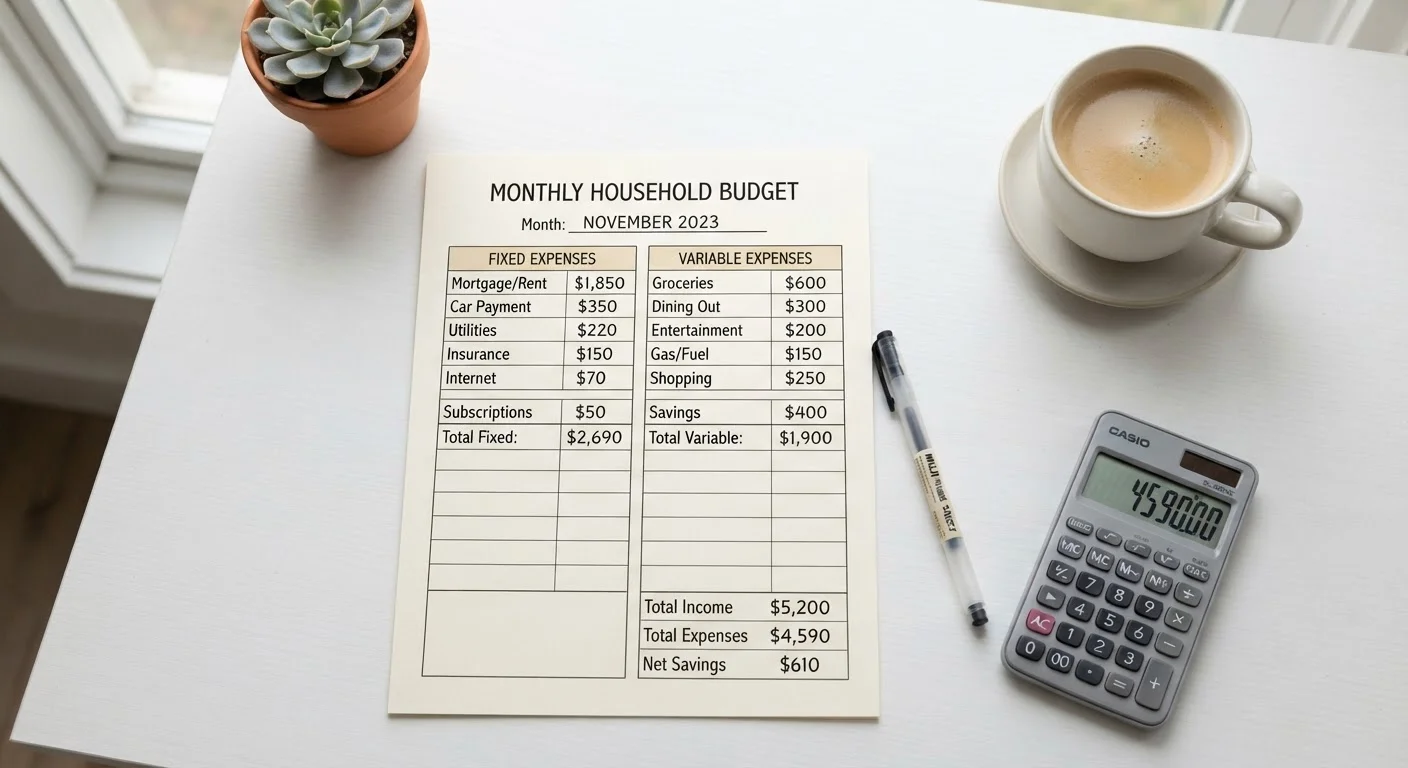
- Fixed costs stay the same each month regardless of your behavior or usage.
- Variable expenses fluctuate and offer the most opportunity to adjust your spending.
- Identifying both types helps you build a more realistic and responsive budget.
- Some expenses — like utilities — blend fixed and variable traits and require careful categorization.
- Understanding this distinction is essential before choosing any formal budgeting method.
Option A
Fixed Costs
The predictable, non-negotiable baseline of your budget.
Best for: Establishing a reliable spending floor so you always know the minimum amount needed each month.
Option B
Variable Expenses
The flexible, adjustable portion of your spending.
Best for: Finding room to cut back or redirect money when income dips or savings goals shift.
If you want to know your financial floor each month
Fixed Costs
Mapping your fixed costs first tells you the minimum income you need before anything else — a critical starting point for any budget.
If you're looking for places to trim spending
Variable Expenses
Variable expenses are where behavioral changes have the most immediate impact, since amounts aren't locked in by contracts or agreements.
If your income is irregular or unpredictable
Fixed Costs
In lean months, knowing exactly what fixed obligations must be covered lets you prioritize those first and manage shortfalls more calmly.
If you're building a savings plan
Variable Expenses
Reducing discretionary variable spending is typically the most practical lever for freeing up money to redirect toward savings goals.
What Are Fixed Costs?
Fixed costs are expenses that remain the same from one month to the next, regardless of how much you use a service or how your behavior changes. Common examples include rent or mortgage payments, car loan installments, insurance premiums, and subscription services billed at a flat rate.
The defining characteristic of a fixed cost is predictability. You can enter the amount into your budget with confidence, knowing it won't surprise you mid-month. This makes fixed costs the easiest category to plan around — but also the hardest to reduce quickly, since they're typically governed by contracts or legal obligations.
Fixed costs form what budgeting professionals often call your spending floor: the non-negotiable minimum you must cover each month before making any other financial decisions. For a deeper look at how this fits into the broader concept of a spending plan, see what a budget actually is.
What Are Variable Expenses?
Variable expenses are costs that change month to month based on usage, behavior, or circumstance. Groceries, dining out, gas, clothing, entertainment, and personal care all fall into this category. Unlike fixed costs, these amounts aren't locked in — they respond directly to your choices.
This flexibility is a double-edged feature. Variable expenses are where most people have the greatest opportunity to reduce spending when needed. They're also where spending tends to creep upward unnoticed. A grocery run that expands with an extra item here and there, or streaming services used sporadically, can quietly erode a budget.
Variable expenses are sometimes subdivided into needs (like groceries and gas) and wants (like dining out or leisure). This distinction matters because it highlights that not all variable spending is discretionary — some of it is genuinely necessary, just not fixed in amount. For definitions of terms like discretionary spending and more, see our budgeting terms glossary.
~33%
Average share of income spent on housing
The U.S. Bureau of Labor Statistics Consumer Expenditure Survey consistently finds housing — a primary fixed cost — accounts for roughly one-third of average household spending.
~13%
Average share spent on food
The same BLS survey places food at around 13% of household spending, split between groceries and dining out — both classic variable expenses.
Side-by-Side: How They Compare
Placing fixed and variable expenses next to each other makes the structural difference immediately clear. Neither type is inherently better — they serve different roles in a budget and require different management strategies.
| Criterion | Fixed Costs | Variable Expenses |
|---|---|---|
| Amount each month | Stays the same | Changes based on usage or behavior |
| Predictability | High — easy to plan around | Low to moderate — requires monitoring |
| Examples | Rent, car loan, insurance premiums | Groceries, gas, dining, clothing |
| Ease of reducing | Difficult — often contract-bound | Easier — responds to behavioral changes |
| Role in budgeting | Sets your spending floor | Reveals room for adjustment |
| Tracking effort | Minimal — amounts are known | Ongoing — amounts shift month to month |
One common source of confusion is the semi-variable expense — a cost that has a fixed base but varies beyond it. A utility bill with a flat monthly access fee plus usage-based charges is a classic example. For budgeting purposes, it often helps to estimate a reasonable average and treat it as variable, revisiting the figure seasonally.
When a Cost Is Hard to Categorize
Some expenses don't fall neatly into either bucket. Utilities, for example, often carry a fixed service fee plus a usage-based charge. Irregular but recurring costs — like annual insurance renewals or car registration — are sometimes called periodic fixed expenses. A useful practice is to divide the annual total by 12 and set aside that amount monthly, smoothing out the lump-sum impact.
How This Distinction Shapes Your Budget
Once you can separate fixed from variable, your budget gains a structure it would otherwise lack. Start by listing every fixed cost and summing them — this is your minimum monthly obligation. Subtract that total from your take-home income. What remains is the pool from which variable expenses and savings are funded.
This framework becomes especially important when income is uneven. Freelancers, gig workers, and anyone with irregular paychecks benefit from knowing precisely where the hard floor is. Our guide on budgeting with irregular income explores practical methods for managing those fluctuations.
For couples managing shared finances, the fixed-versus-variable distinction also clarifies which joint obligations are non-negotiable and which can be adjusted by mutual agreement. See budgeting as a couple for frameworks suited to shared money management.
Once you're comfortable with this foundation, the natural next step is choosing a formal budgeting method. Different systems — such as zero-based budgeting or the 50/30/20 rule — handle fixed and variable categories in distinct ways. Compare them in our zero-based vs. 50/30/20 breakdown. And when your variable expenses are consistently under control, you may find yourself ready to explore saving and investing as the next financial priority.
This article is for general informational and educational purposes only and does not constitute personalized financial advice. Consult a qualified financial professional for guidance specific to your situation.