

| Primary communication channel | Body posture and tail position |
| Tail-up greeting | Signals friendliness and confidence |
| Slow blink meaning | Trust and relaxation |
| Flattened ears signal | Fear, defensiveness, or aggression |
| Dilated pupils (in normal light) | Excitement, fear, or high arousal |
| Exposed belly | Trust — not always an invitation to pet |
Why Cat Body Language Is Worth Learning
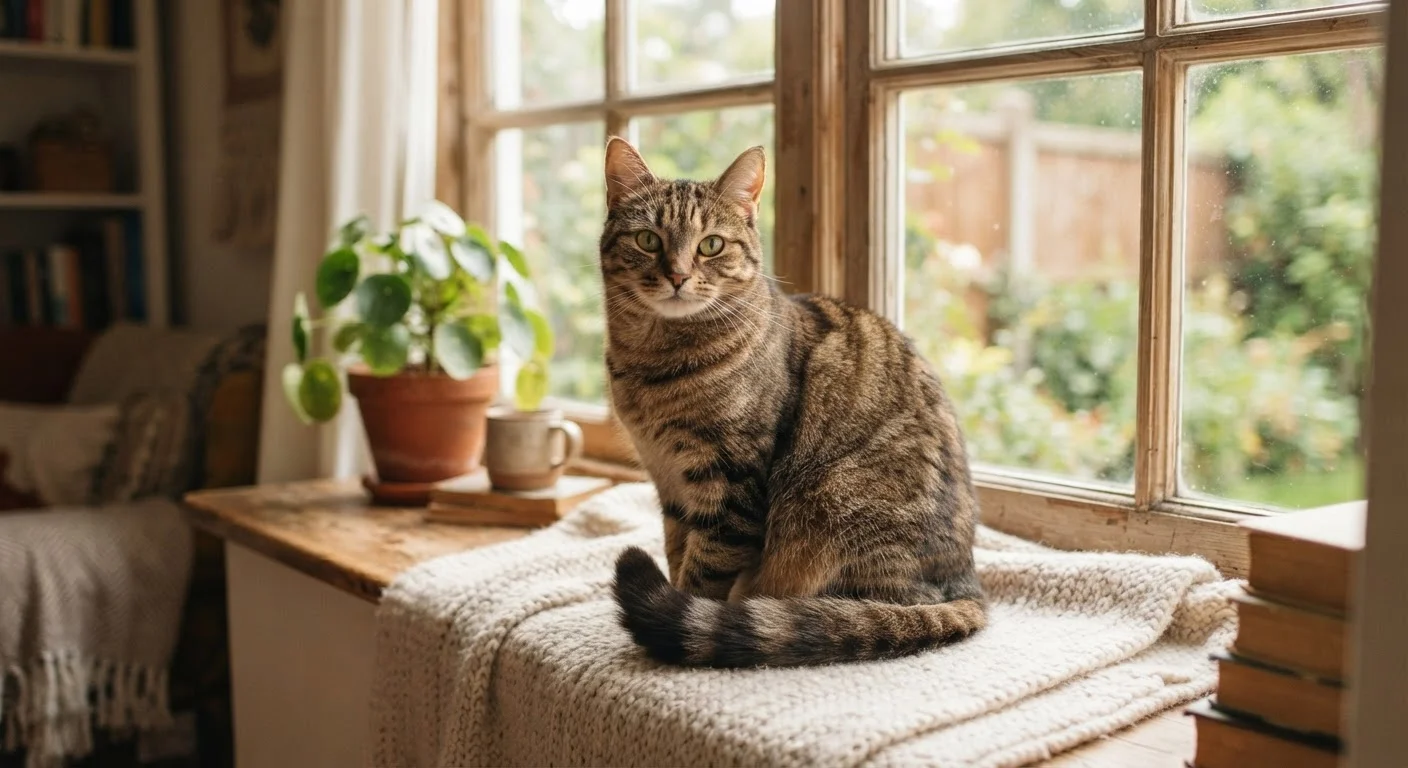
Cats communicate constantly — they just don't do it the way dogs do. Where a dog might bark or jump, a cat shifts a tail angle, changes an ear position, or offers a long, deliberate blink. These signals are easy to miss, but once you know what to look for, the conversation becomes remarkably clear.
Understanding your cat's body language isn't just a curiosity — it's a practical tool. It helps you recognize when your cat is relaxed enough for interaction, when they need space, and when something might be wrong. The ability to read these cues is also foundational to effective, positive training. See how this connects in our overview of training approaches that work for cats.
| Primary communication channel | Body posture and tail position |
| Tail-up greeting | Signals friendliness and confidence |
| Slow blink meaning | Trust and relaxation |
| Flattened ears signal | Fear, defensiveness, or aggression |
| Dilated pupils (in normal light) | Excitement, fear, or high arousal |
| Exposed belly | Trust — not always an invitation to pet |
The Tail, Ears, and Eyes: Your Cheat Sheet
Three body parts carry the most reliable signals in feline communication.
Tail
- Held high, tip slightly curved: Confident, friendly greeting. A tail quiver at the top intensifies the welcome.
- Puffed and low or tucked: Fear or defensive aggression — give your cat room.
- Lashing side to side rapidly: Irritation or high arousal. Stop whatever interaction is happening.
- Slow, gentle sway: Focus and mild interest — common when watching birds or a moving toy.
Ears
- Forward and slightly outward: Alert and engaged.
- Swiveling independently: Tracking sounds; neutral state.
- Flattened sideways ("airplane ears"): Fear or building aggression — back off.
- Pinned flat to the head: Defensive or actively aggressive.
Eyes
- Slow blink: A calm signal of trust. You can offer one back.
- Half-closed, soft gaze: Contentment and relaxation.
- Wide, fully dilated in normal light: High arousal — could be playful excitement or fear.
- Hard, unblinking stare: A threat or challenge display.
Body Language and Pain Can Overlap
Some signals — withdrawn posture, half-closed eyes, reduced activity — can indicate both contentment and discomfort depending on context. If you notice a sudden change in your cat's usual patterns, consult a veterinarian rather than assuming it's a mood. See our guide on signs your pet may be hiding pain for more detail.
Posture, Touch, and Vocalization
Whole-body posture rounds out what the face and tail are telling you.
- Loaf position (paws tucked, eyes half-closed): Comfortable and settled.
- Rolling to expose belly: Deep trust — but this isn't always an invitation to stroke. Many cats find direct belly contact overstimulating. Read the full context before reaching in.
- Arched back with piloerection: Classic fear-defense display. The cat is trying to look larger.
- Bunting (rubbing head on you): A clear social affiliation signal.
Vocalization adds another layer. Trills and chirps are generally friendly. A chattering sound near windows usually signals predatory frustration. Growling or hissing are unambiguous — distance is needed immediately.
As cats age, their communication style can shift. Older cats may become more vocal due to disorientation or physical discomfort. Our article on how senior pets' health needs change covers what to watch for at different life stages.
Slow blink
A deliberate, unhurried closing and opening of the eyes that cats use to signal trust and comfort. Returning a slow blink to your cat is widely considered a way to communicate safety and affection.
Piloerection
The involuntary raising of fur along the spine and tail, sometimes called 'puffing up.' It occurs when a cat feels threatened or highly aroused and is meant to make the animal appear larger.
Bunting
The behavior of rubbing the head, cheeks, or chin against a person or object. Cats use bunting to deposit scent from facial glands, marking something as safe and familiar.
Tail quiver
A rapid, upright tail vibration directed at a person or object. This is generally a greeting signal expressing excitement and positive recognition — distinct from an agitated lashing tail.
Displacement behavior
An out-of-context action — such as suddenly grooming mid-play — that signals a cat is conflicted or mildly stressed. It functions as a tension-release mechanism.
Trill
A short, rolling vocalization cats typically use when greeting familiar people or other cats. It often accompanies an upright tail and is considered a friendly, affiliative sound.
Responding in Ways That Build Trust
Reading body language is only useful if your responses match what you're observing. A few practical principles help:
- Match your cat's pace. If your cat approaches tentatively, let them close the distance rather than reaching toward them.
- Respect stop signals. A flicking tail or skin ripple mid-petting means the session is over. Stopping promptly teaches your cat that they can trust you to listen.
- Offer slow blinks intentionally. Softening your own gaze and blinking slowly during calm moments can reinforce feelings of safety over time.
- Use marker-based training. Once you can read when your cat is calm and receptive, short training sessions become far more productive. Clicker and verbal marker methods are particularly well-suited to cats because they communicate precisely without pressure.
- Track changes over time. A consistent shift in body language — less bunting, more hiding, altered posture — warrants a conversation with your vet. A strong relationship with your veterinarian makes these check-ins easier; see our guidance on building a relationship with your vet.
This article is for general informational purposes only and does not constitute veterinary advice. If you have concerns about your cat's behavior or health, please consult a licensed veterinarian.