

Key Takeaways
- Cats are trainable using the same positive reinforcement principles that work for dogs — but the delivery matters.
- Cats are motivated by autonomy; sessions must be short, voluntary, and rewarding to hold their interest.
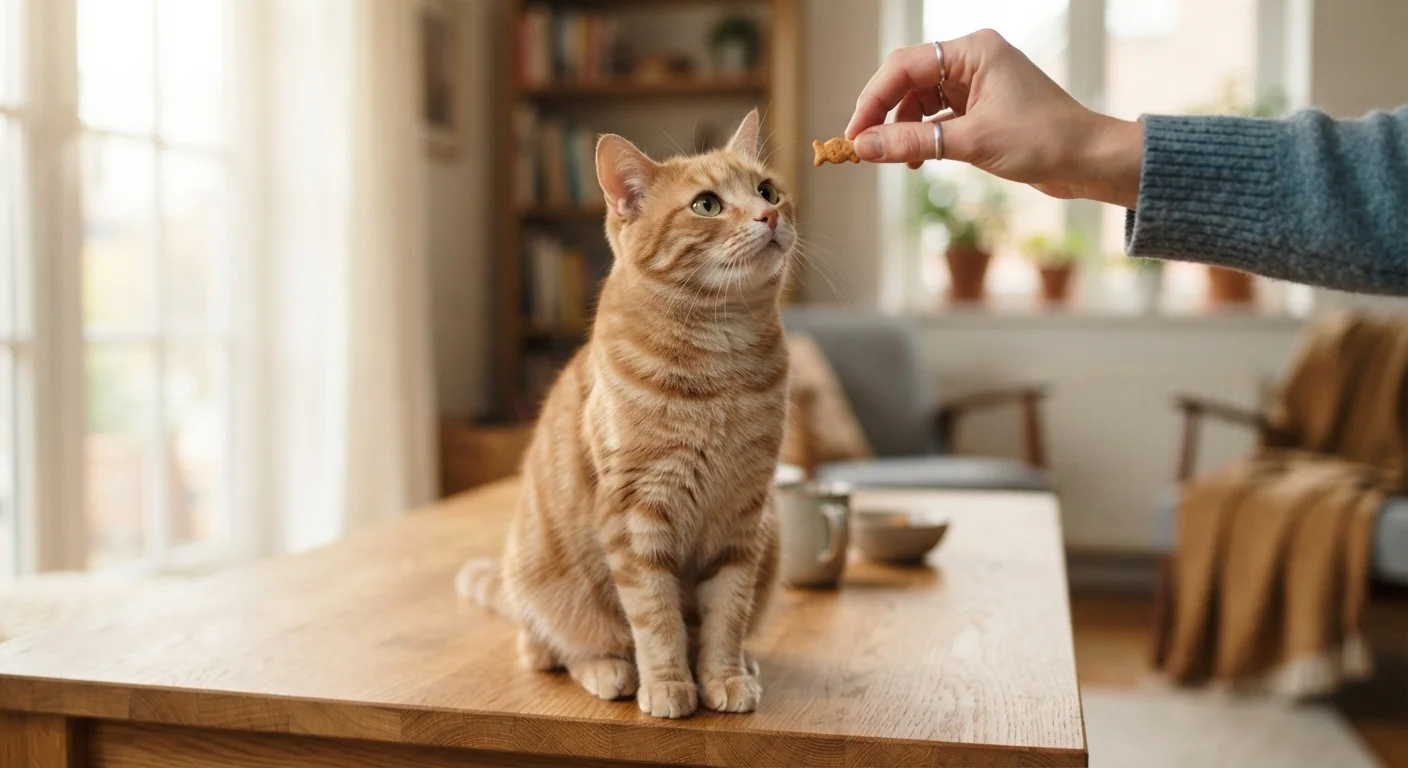
- Food treats are generally the most reliable reward for cats, though play and affection work for some individuals.
- Unlike dogs, cats rarely generalize cues across locations — practicing in multiple contexts is essential.
- Punishment-based methods are especially counterproductive with cats and can damage your relationship.
Our Verdict
Both cats and dogs respond to positive reinforcement, but cats require a lighter touch: shorter sessions, higher-value rewards, and greater respect for their choice to engage. Understanding these differences turns frustration into genuine connection.
| Best for | Recommended |
|---|---|
| Owners new to cat training | Clicker-and-treat shaping in short daily sessions |
| Cats with low food motivation | Play-based rewards paired with a verbal marker |
| Owners transitioning from dog training | Adapting dog-training timing principles with cat-specific session limits |
Why Cat Training Feels Different
Many people assume cats simply can't be trained. The reality is more nuanced: cats can learn, and they do so through the same psychological mechanisms as dogs — operant and classical conditioning. What changes is the context those mechanisms operate in. For a deeper look at how these learning principles play out in another species, see how dogs form habits through conditioning and consider how those principles translate.
Dogs evolved alongside humans as cooperative workers; their default is to orient toward people, seek approval, and repeat behaviors that earn a social reward. Cats domesticated on their own terms. They retain strong independent instincts, and their motivation to engage with training is contingent — meaning they decide, session by session, whether participation is worth their while. Respecting that contingency isn't a workaround; it's the foundation of effective cat training.
Start With Something Your Cat Already Does
The fastest way into cat training is to capture a behavior your cat performs naturally — sitting, stretching, or touching an object with their nose. Mark and reward it the moment it happens. This builds the association between the marker signal and the reward before you ever ask for anything specific, laying a foundation that makes later teaching much smoother.
Cats vs. Dogs: Key Training Differences
Understanding where the two species diverge helps owners stop applying dog logic to cat behavior — a mismatch that leads to frustration on both sides.
| Cats | Dogs | |
|---|---|---|
| Ideal session length | 2–5 minutes | 10–15 minutes |
| Social approval as reward | Rarely sufficient alone | Often effective |
| Motivation to please humans | Conditional and individual | Generally strong |
| Cue generalization across locations | Poor without explicit practice | Better natural transfer |
| Tolerance of repetition in a session | Low — disengage quickly | Higher tolerance |
| Response to punishment | Fear, avoidance, aggression | Generally more resilient, but still discouraged |
One of the most practically important differences is session length. Dog training sessions can productively run 10–15 minutes. Cats typically disengage after 2–5 minutes, and pushing past that threshold produces avoidance rather than learning. Ending while your cat is still curious is always preferable to finishing when they've walked away.
Location specificity is another common sticking point. A cat that reliably sits on cue in the kitchen may ignore the same cue in the living room — this isn't defiance, it's how feline memory works. Practicing cues in varied settings, gradually and without pressure, is the reliable fix. For guidance on building that kind of consistent structure, a structured training routine offers practical session-building strategies.
What Actually Motivates Cats
Reward selection is where cat training most visibly diverges from dog training. Dogs are often satisfied with praise alone; cats generally require a more tangible payoff. High-value food treats — small, soft, and aromatic — work for most cats. The key word is high-value: a piece of dry kibble won't compete with the distraction of a passing sound, but a tiny bit of cooked chicken or a commercial meat-based treat often will.
For cats with lower food drive, wand toys used immediately after a correct behavior can serve as an effective reward. A small number of cats are genuinely motivated by brief petting or verbal praise, but this varies significantly by individual. The trade-offs of using food rewards in training explores when treats help and when they complicate the picture — worth reading as you calibrate your approach.
Marker signals — a click or a consistent short word — help bridge the gap between the behavior and the reward, giving cats clear information about what they did right. Clicker training vs. verbal markers breaks down both options if you're deciding which fits your situation.
Reading the Room: Body Language and Consent
Successful cat training depends on your ability to read whether your cat is actually ready to engage. A cat with a slowly swishing tail, flattened ears, or dilated pupils is not in a learning state — initiating a session in those conditions is likely to produce frustration for both of you. Reading your cat's body language is an invaluable companion to any training effort, translating the subtle signals cats send into actionable information.
Avoid Punishment-Based Methods Entirely
Spray bottles, loud noises, or physical correction don't teach cats what to do — they teach cats to fear the environment or the person delivering the punishment. With cats in particular, aversive methods tend to produce hiding, aggression, and lasting wariness toward the owner. Positive reinforcement is not just kinder; it's measurably more effective for this species.
The concept of consent-based training — allowing the animal to opt in and opt out freely — is especially important with cats. If your cat approaches, engages, then turns away, that's a clean signal to stop. Cats trained with this level of respect tend to initiate sessions themselves over time, a reliable indicator that the process is genuinely rewarding for them.
Training cues should be delivered calmly and once. Repeating a cue multiple times before the cat responds teaches them that the first repetition doesn't require attention — a pattern that's hard to undo. For clarity on the precise language of cues and how to use them effectively, the language of pet training explained offers a useful reference.