

Key Takeaways
- Unit price compares products by a standard measure regardless of package size.
- Larger packages are not always cheaper per unit — verify before assuming.
- Retailers are not required to display unit prices in all US states, so knowing the math matters.
- Sale prices can still be more expensive per unit than a competing product at full price.
- Rounding errors and inconsistent base units are common obstacles to accurate comparisons.
What you will need
Why Unit Pricing Is the Most Underused Tool at the Shelf
Supermarket shelves are engineered to draw your eye toward large package sizes, promotional stickers, and bold numerals. What they rarely spotlight is the unit price — the figure that actually tells you how much you're paying for what you're getting. Unit pricing expresses the cost of a product in a standardized measure (per ounce, per liter, per 100 sheets) so that a 12 oz bottle and a 32 oz bottle can be compared on equal terms.
The gap between a product's sticker price and its true per-unit cost is where many seemingly obvious savings dissolve. Buying a bulk-size package feels economical by default, but the unit price sometimes tells a different story — smaller sizes go on sale more frequently, store brands use different fill weights, and promotional bundles can quietly inflate what you pay per unit. These are examples of the kind of shopping habits that seem thrifty but quietly inflate spending.
Unit pricing is a consumer protection tool as much as a savings tool. Understanding it also connects to a wider skill: reading the full information a retail price tag communicates. For context on other figures that appear on shelf labels, see what retail price tag numbers actually mean.
Unit Price Laws Vary by State
Not all US retailers are legally required to display unit prices. Federal law does not mandate unit pricing nationally; requirements depend on individual state statutes and sometimes local ordinances. If a shelf label lacks a unit price, you may need to calculate it yourself using the steps in this guide.
How to Read and Compare Unit Prices Step by Step
The following steps walk through the practical process of finding, calculating, and using unit prices at the shelf. You don't need any special equipment — just the label information and basic arithmetic.
What you will need
Smartphone calculator
Performs the simple division needed to calculate unit price from total price and package quantity.
Notes app or small notepad
Records unit prices across multiple products so you can compare without holding everything in memory.
Locate the unit price on the shelf label
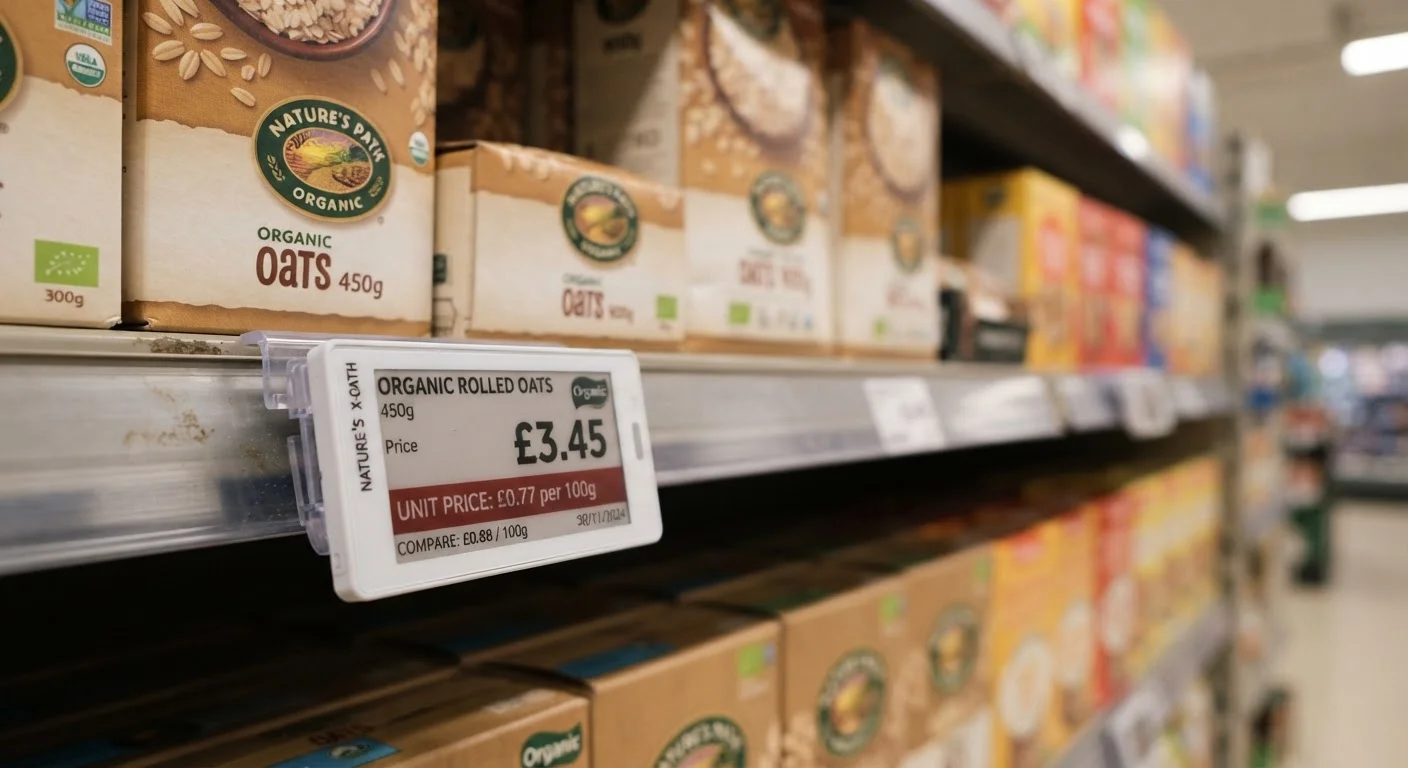
Most shelf-edge labels in larger US grocery chains display a unit price — usually in smaller print beneath or beside the total price. It typically appears as a dollar amount followed by a per-measure indicator such as per oz, per 100g, per sheet, or per fl oz. Look for this figure first before reaching for the package itself.
Confirm both products use the same base unit
Before comparing two unit prices, verify that both labels express the price in the same unit of measure. A label showing $0.18/oz cannot be directly compared to one showing $2.80/lb without first converting — there are 16 ounces in a pound, so divide the per-pound price by 16 to get the per-ounce equivalent ($2.80 ÷ 16 = $0.175/oz).
Calculate the unit price manually if no label exists
If no unit price is displayed, find the total price and the net weight or count printed on the package. Divide the price by the quantity:
Unit Price = Total Price ÷ Quantity
Example: a 28 oz jar priced at $3.49 works out to $3.49 ÷ 28 = $0.1246 per oz. Round to four decimal places for accuracy when comparing close figures.
Factor in sale prices accurately
When an item is on promotion, use the sale price — not the original price — in your unit price calculation. A sale tag that says "2 for $5" means each unit is $2.50; divide that by the package quantity to get the unit price. Do not assume the sale item automatically wins the comparison; a full-price product on the same shelf may still cost less per unit.
Account for quality and usability differences
Unit price identifies the lower cost-per-measure option, but it does not capture everything relevant to value. A paper towel with better absorbency may require fewer sheets per task, making a higher unit price the more economical practical choice. Once you have the unit price data, weigh it against your actual usage patterns. For a broader framework on this, see evaluating spending decisions by genuine utility.
Keep a Calculator Within Reach
Your smartphone calculator is all you need for shelf-side math. Divide the total price by the number of units (ounces, grams, sheets, etc.) to get the unit price instantly. Many shoppers avoid this step simply because it feels inconvenient — but it takes under 30 seconds.
Inconsistent Base Units Can Mislead
Retailers sometimes display one product's unit price per ounce and a nearby competitor's per pound, making direct comparison impossible without converting first. Always confirm both labels use the same unit before concluding which is cheaper.
Once you're comfortable calculating unit prices, the next step is integrating this data point into a fuller picture of product value. Sticker price and unit price are both proxies — neither alone determines whether something is worth buying. Our guide on why neither the cheapest nor the costliest option is reliably correct explores that broader question.