

| Who issues UL certification | UL Solutions (formerly Underwriters Laboratories) — an independent safety science company (UL Solutions organizational documentation) |
| ENERGY STAR administered by | U.S. Environmental Protection Agency (EPA) (EPA ENERGY STAR program overview) |
| USDA Organic minimum content threshold | 95% organically produced ingredients to carry the full USDA Organic seal (USDA Agricultural Marketing Service) |
| CE Mark jurisdiction | Required for many product categories sold within the European Economic Area (EEA) (European Commission regulatory framework) |
| NSF International focus | Public health and safety standards for food, water, and consumer products (NSF International program descriptions) |
| Fair Trade certification scope | Covers labor standards, pricing fairness, and community development for agricultural and manufactured goods (Fair Trade USA and Fairtrade International documentation) |
Why Certifications Exist — and Why They Vary So Much
Product certifications exist to solve a fundamental consumer problem: you generally cannot assess whether a product is safe, efficient, or honestly labeled just by looking at it. A certification is meant to transfer that verification burden to a qualified third party. The catch is that not all certifications are created equal — they differ by issuing body, testing rigor, scope, and enforcement.
Some certifications are federally mandated. Others are voluntary industry programs. A few are little more than marketing constructs with no independent oversight. Understanding the difference matters because labels influence purchasing decisions, and a misleading label is a form of misinformation.
The practice of making vague environmental claims without substantiation — often called greenwashing — is a particularly common problem. Terms like 'natural,' 'eco-friendly,' or 'clean' carry no regulatory definition in most product categories, which means any manufacturer can use them freely. Contrast that with a certification backed by a recognized accreditation body: there, a defined standard exists, testing methodology is documented, and ongoing compliance may be required. See our guide to independent testing vs. endorsements for context on how to weigh different credibility signals.
Third-party certification
Verification conducted by an independent organization that has no financial stake in the product's outcome. Third-party testing is generally more credible than manufacturer self-reporting.
Accreditation body
An organization that formally recognizes certification bodies as competent to test specific products or services against defined standards. In the U.S., ANAB and A2LA are prominent examples.
Self-certification
A claim made by a manufacturer based on its own internal testing, without independent verification. These claims may be accurate but cannot be externally confirmed.
Mark of conformity
A label or logo indicating that a product meets a specific standard or regulation. The UL Mark and CE Mark are common examples consumers encounter.
Greenwashing
The practice of making vague or unsubstantiated environmental claims on packaging or marketing materials. Terms like 'eco-friendly' or 'natural' without supporting certification are common examples.
USDA Organic
A federally regulated certification indicating that agricultural products meet U.S. Department of Agriculture standards for organic farming practices, including restrictions on synthetic pesticides and GMOs.
Common Certifications by Category: What They Actually Test
Knowing what a certification covers — and what it does not — is the most practical way to use it as a shopping signal.
| Who issues UL certification | UL Solutions (formerly Underwriters Laboratories) — an independent safety science company (UL Solutions organizational documentation) |
| ENERGY STAR administered by | U.S. Environmental Protection Agency (EPA) (EPA ENERGY STAR program overview) |
| USDA Organic minimum content threshold | 95% organically produced ingredients to carry the full USDA Organic seal (USDA Agricultural Marketing Service) |
| CE Mark jurisdiction | Required for many product categories sold within the European Economic Area (EEA) (European Commission regulatory framework) |
| NSF International focus | Public health and safety standards for food, water, and consumer products (NSF International program descriptions) |
| Fair Trade certification scope | Covers labor standards, pricing fairness, and community development for agricultural and manufactured goods (Fair Trade USA and Fairtrade International documentation) |
Safety (Electrical & Fire)
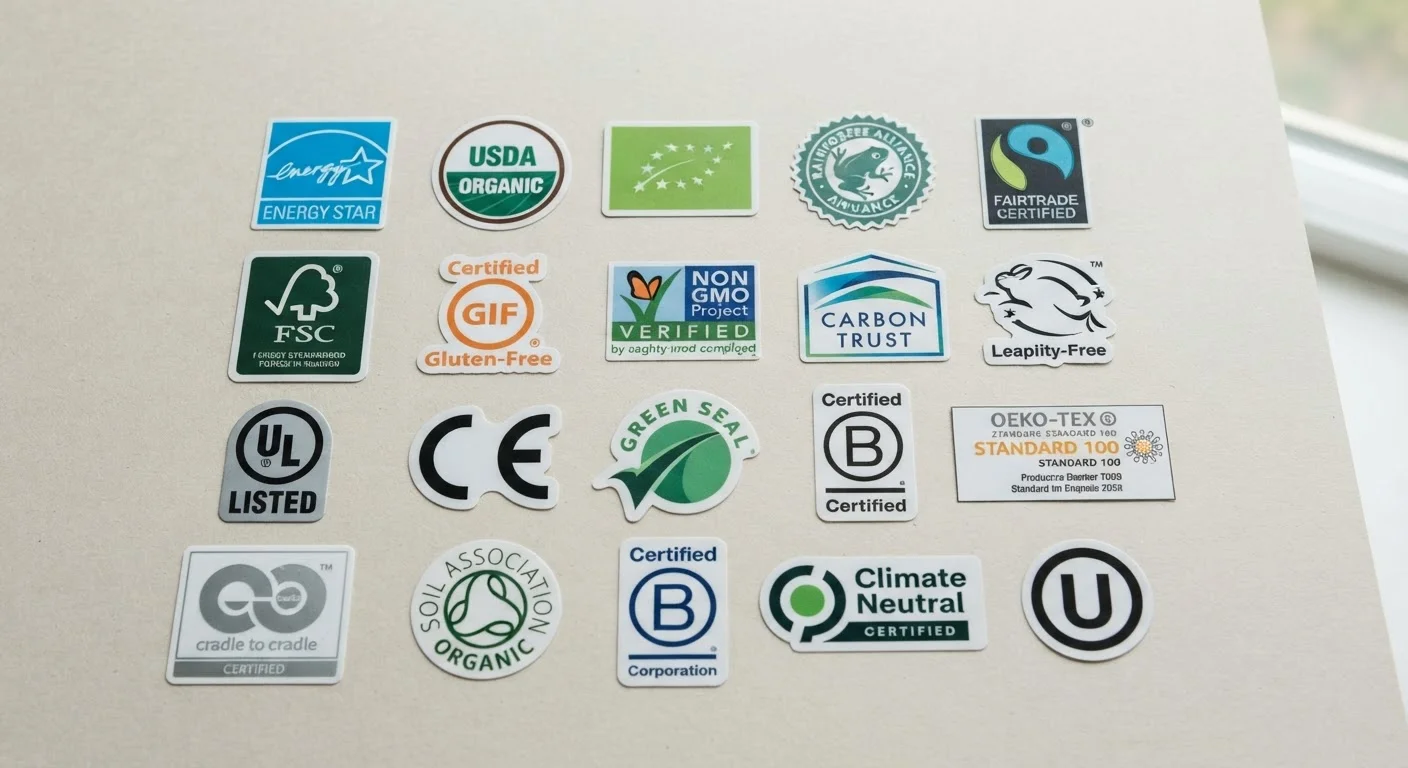
UL (UL Solutions): Tests electrical products for shock, fire, and related hazards. The UL Mark indicates a product was tested against published safety standards. Products can be verified in UL's public database.
ETL Listed (Intertek): An alternative to UL, recognized by the same authorities (OSHA's NRTL program). Functionally equivalent for most product categories.
Energy Efficiency
ENERGY STAR (EPA): A voluntary program indicating a product meets EPA energy efficiency guidelines. Particularly relevant for appliances, HVAC systems, and electronics. Does not evaluate safety or durability.
Food & Agriculture
USDA Organic: Federally regulated. Products must be certified by a USDA-accredited certifier. The seal requires at least 95% organically produced ingredients. For more on how to interpret food labels, see reading a nutrition label without the confusion.
Non-GMO Project Verified: A third-party standard, not a federal regulation. Tests for genetically modified organism (GMO) content using defined thresholds. Does not address pesticide use, farming practices, or nutritional quality.
Fair Trade: Addresses supply chain labor and pricing conditions, not product safety or nutritional content. Relevant primarily for commodities like coffee, chocolate, and apparel.
Supplements & Personal Care
NSF International / NSF Certified for Sport: Tests dietary supplements for label accuracy and contaminants. The 'Certified for Sport' variant specifically screens for substances banned in athletic competition.
USP Verified: The U.S. Pharmacopeia's verification program confirms that supplement ingredients match label claims and meet purity standards.
For pet food label standards, which follow a similar but distinct framework, see reading pet food labels without the jargon.
Self-Certification vs. Independent Verification
Not every label on a product reflects independent testing. Some claims — like 'dermatologist-tested' or 'clinically proven' — may be based on manufacturer-funded studies or internal assessments rather than third-party audits. When in doubt, look for the name of a recognized certification body and verify it on their official website.
Label Placement Doesn't Equal Endorsement
A certification mark on packaging confirms only that the product met a specific standard at a specific time under defined conditions. It does not guarantee ongoing compliance or broader product quality beyond what was tested. Some certifications require annual re-testing; others do not.
How to Evaluate a Certification You Don't Recognize
Encountering an unfamiliar seal shouldn't cause confusion — it should trigger a short verification process. A reliable certification can answer three questions clearly: Who issues it? What standard does it test against? Is that standard publicly documented?
If a label's issuing body is not easily searchable, has no published testing methodology, or is operated by the manufacturer itself, treat it as a self-certification — potentially accurate, but unverified. The same logic applies to awards and ratings that appear on packaging without naming an independent evaluator.
Over 70
Countries recognizing ENERGY STAR or equivalent programs
According to the EPA's ENERGY STAR program, similar efficiency labeling frameworks have been adopted in numerous countries, reflecting broad international alignment.
95%
Organic ingredient threshold for USDA Organic seal
Products containing 95% or more certified organic ingredients may display the USDA Organic seal, per USDA Agricultural Marketing Service rules.
1894
Year UL was founded
UL Solutions has been testing products for electrical and fire safety for well over a century, making it one of the longest-standing independent safety testing organizations in the U.S.
When researching less familiar certifications, start with the issuing organization's official site and cross-reference against recognized accreditation bodies such as ANAB (ANSI National Accreditation Board) or A2LA (American Association for Laboratory Accreditation). These bodies maintain public directories of accredited certification organizations.
Our guide to credible product research sources outlines which types of databases and testing organizations tend to produce reliable information. You can also use the pre-purchase evaluation checklist to build certification verification into your standard shopping process.
Understanding certifications is part of a broader set of consumer rights. For a grounding in the legal protections that apply when products fail to meet stated claims, see your consumer rights, explained.
This article is for general informational purposes only. It does not constitute legal, financial, medical, or professional advice. Certification programs, standards, and regulatory requirements are subject to change; always verify current information directly with the issuing organization.