

| Governing body for U.S. pet food standards | AAFCO (Association of American Feed Control Officials) (AAFCO publishes model regulations adopted by individual states) |
| "95% rule" threshold | Single named ingredient must be ≥95% of product weight (AAFCO ingredient-naming guidelines) |
| "Dinner/Entrée/Formula" threshold | Named ingredient must be ≥25% of product weight (AAFCO ingredient-naming guidelines) |
| "With [ingredient]" threshold | Named ingredient must be ≥3% of product weight (AAFCO ingredient-naming guidelines) |
| Guaranteed analysis measures | Crude protein (min), crude fat (min), crude fiber (max), moisture (max) |
| Regulatory status of "holistic" or "premium" | No standardized definition in U.S. pet food regulations |
Why Pet Food Labels Are Worth a Closer Look
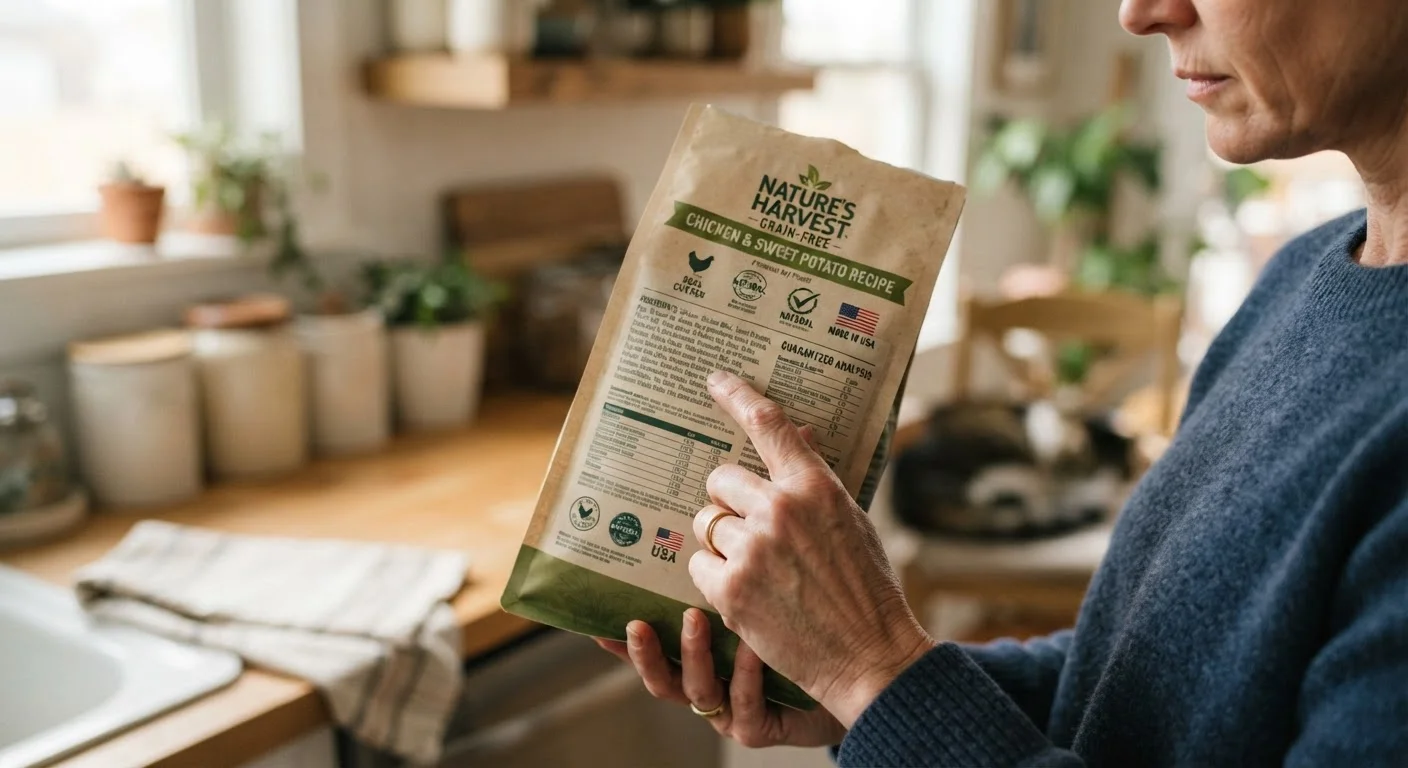
Standing in the pet food aisle — or scrolling through an online shop — it's easy to feel overwhelmed. Words like "holistic," "premium," and "natural" appear on nearly every bag, yet they carry no regulated definition in U.S. pet food law. Meanwhile, the information that actually matters is often printed in small type on the side or back panel.
The good news: once you know which sections of a label do the real work, reading them becomes much faster. The label on every commercially sold U.S. pet food must include specific information governed by the AAFCO and enforced at the state level. Understanding that framework gives you a reliable filter for the marketing language.
For a parallel look at how label literacy applies to your own food choices, see Reading a Nutrition Label Without the Confusion.
| Governing body for U.S. pet food standards | AAFCO (Association of American Feed Control Officials) (AAFCO publishes model regulations adopted by individual states) |
| "95% rule" threshold | Single named ingredient must be ≥95% of product weight (AAFCO ingredient-naming guidelines) |
| "Dinner/Entrée/Formula" threshold | Named ingredient must be ≥25% of product weight (AAFCO ingredient-naming guidelines) |
| "With [ingredient]" threshold | Named ingredient must be ≥3% of product weight (AAFCO ingredient-naming guidelines) |
| Guaranteed analysis measures | Crude protein (min), crude fat (min), crude fiber (max), moisture (max) |
| Regulatory status of "holistic" or "premium" | No standardized definition in U.S. pet food regulations |
The Five Parts of a Pet Food Label That Actually Matter
1. The Product Name
AAFCO's ingredient-naming rules dictate how prominently an ingredient can appear in a product name. If a food is called "Salmon for Cats," salmon must make up at least 95% of the total product weight (excluding water). Add the word "dinner," "entrée," or "formula," and that threshold drops to just 25%. A label reading "with salmon" means the product needs only 3% salmon. These aren't arbitrary marketing quirks — they're enforceable naming rules worth remembering.
2. The Ingredient List
Ingredients are listed in descending order by pre-cooking weight, not nutritional contribution. This means a whole meat listed first may shrink significantly after moisture is cooked out, while a meal (e.g., "chicken meal") is already concentrated and may contribute more protein per pound. Neither is inherently better — context matters. Wet Food vs. Dry Food explores how format affects these dynamics further.
3. The Guaranteed Analysis
This panel lists minimum percentages of crude protein and crude fat, and maximum percentages of crude fiber and moisture. "Crude" refers to the measurement method, not quality. Comparing a wet and a dry food directly using these numbers is tricky because moisture content differs dramatically — a dry-matter basis calculation is needed for an apples-to-apples comparison.
4. The AAFCO Nutritional Adequacy Statement
This single sentence is arguably the most important line on the label. It tells you whether the food is "complete and balanced" for a specific life stage (adult maintenance, growth, or all life stages), and whether that claim was verified through feeding trials or by meeting a nutrient profile. Foods labeled "for supplemental feeding only" are not nutritionally complete on their own.
5. Feeding Guidelines
These are starting-point estimates based on average animals, not prescriptions for your specific pet. Body weight, activity level, age, and health status all affect actual needs. Treat these figures as a baseline and monitor your pet's body condition over time. Your veterinarian is the right person to help fine-tune portion sizes.
AAFCO
The Association of American Feed Control Officials, a voluntary membership organization that develops model regulations for animal feed and pet food. U.S. states adopt and enforce these standards individually.
Guaranteed Analysis
The panel on a pet food label showing minimum crude protein, minimum crude fat, maximum crude fiber, and maximum moisture. "Crude" refers to the lab method used to measure these nutrients, not their quality.
Nutritional Adequacy Statement
A required label sentence stating whether a food is complete and balanced for a given life stage. It also indicates whether the claim is based on AAFCO nutrient profiles or actual animal feeding trials.
Dry-Matter Basis
A calculation method that removes moisture from the equation, allowing fair comparison of nutrient levels between wet and dry pet foods.
Ingredient Meal (e.g., Chicken Meal)
A rendered, dried form of an ingredient with most moisture removed. Meals are more concentrated by weight than their whole-ingredient counterparts and often contribute more protein per pound.
Life Stage
A category used in pet food labeling — typically growth (puppies/kittens), adult maintenance, or all life stages — indicating which animals the food is formulated to support nutritionally.
Marketing Claims vs. Regulated Terms
Some label claims have regulatory meaning; many do not. "Natural" has a loose AAFCO definition (no synthetic ingredients, with some exceptions), but "holistic," "human-grade," and "premium" have no standardized meaning in pet food regulations. Similarly, "grain-free" simply describes what's absent — it doesn't indicate superior nutrition.
For a broader look at how certifications and product claims work across consumer categories, Certifications, Standards, and Labels: A Consumer's Reference Guide provides useful context.
One area generating ongoing research and discussion is the relationship between grain-free diets and dilated cardiomyopathy (DCM) in dogs. The FDA has investigated a potential link, though a causal relationship has not been conclusively established. If you have concerns about your dog's diet and heart health, a conversation with your veterinarian is the appropriate next step.
Raw diet claims are another area where marketing often outpaces evidence. For a balanced look at what the research does and doesn't support, see Common Misconceptions About Raw Diets for Pets.
≥95%
Ingredient content required when it leads the product name
Under AAFCO's "95% rule," a food named simply "Chicken for Dogs" must contain at least 95% chicken by weight, excluding added water.
3%
Minimum required when "with" precedes an ingredient name
AAFCO's "with" rule means a label saying "with tuna" only guarantees 3% tuna content — a significant difference from a front-of-bag impression.
2 types
Ways AAFCO complete-and-balanced claims can be substantiated
A food can meet the nutritional adequacy standard either by matching AAFCO nutrient profiles in lab testing or by passing actual feeding trials with live animals.
This article is for general informational purposes only and is not a substitute for professional veterinary nutrition advice. Always consult your veterinarian about your pet's specific dietary needs.