

| U.S. Care Label Requirement | Mandated by the FTC for most garments sold domestically (Federal Trade Commission Care Labeling Rule) |
| International Standard | ISO 3758 governs care symbols globally (International Organization for Standardization) |
| Symbol Categories | 5: Washing, Bleaching, Drying, Ironing, Dry Cleaning |
| Temperature Units on Labels | Celsius (°C) — even on U.S. garments |
| Underlines on Wash Symbol | Indicate reduced agitation: 1 line = permanent press, 2 lines = delicate |
| Dot System | Used for both irons and dryers: 1 dot = low heat, 3 dots = high heat |
Why Care Labels Exist — and Why They Matter
That small sewn-in tag you cut off the moment you buy a garment? It carries precise instructions that can determine whether a piece lasts years or shrinks beyond recognition after one wash. Care labels in the U.S. follow guidelines set by the Federal Trade Commission (FTC), which requires most clothing sold domestically to carry permanent care instructions. Internationally, the symbols are governed by ISO 3758, a standard adopted by most of the world's apparel industry.
Understanding these symbols removes the guesswork — and the cost of ruined clothes. Whether you're dealing with a delicate silk blouse or a structured wool coat, the label tells you exactly what the fabric can withstand. This guide breaks down each category of symbol so you can read any label with confidence. For a broader look at how consumer labeling works across product categories, see our consumer labels reference guide.
| U.S. Care Label Requirement | Mandated by the FTC for most garments sold domestically (Federal Trade Commission Care Labeling Rule) |
| International Standard | ISO 3758 governs care symbols globally (International Organization for Standardization) |
| Symbol Categories | 5: Washing, Bleaching, Drying, Ironing, Dry Cleaning |
| Temperature Units on Labels | Celsius (°C) — even on U.S. garments |
| Underlines on Wash Symbol | Indicate reduced agitation: 1 line = permanent press, 2 lines = delicate |
| Dot System | Used for both irons and dryers: 1 dot = low heat, 3 dots = high heat |
The Five Symbol Categories Explained
Washing
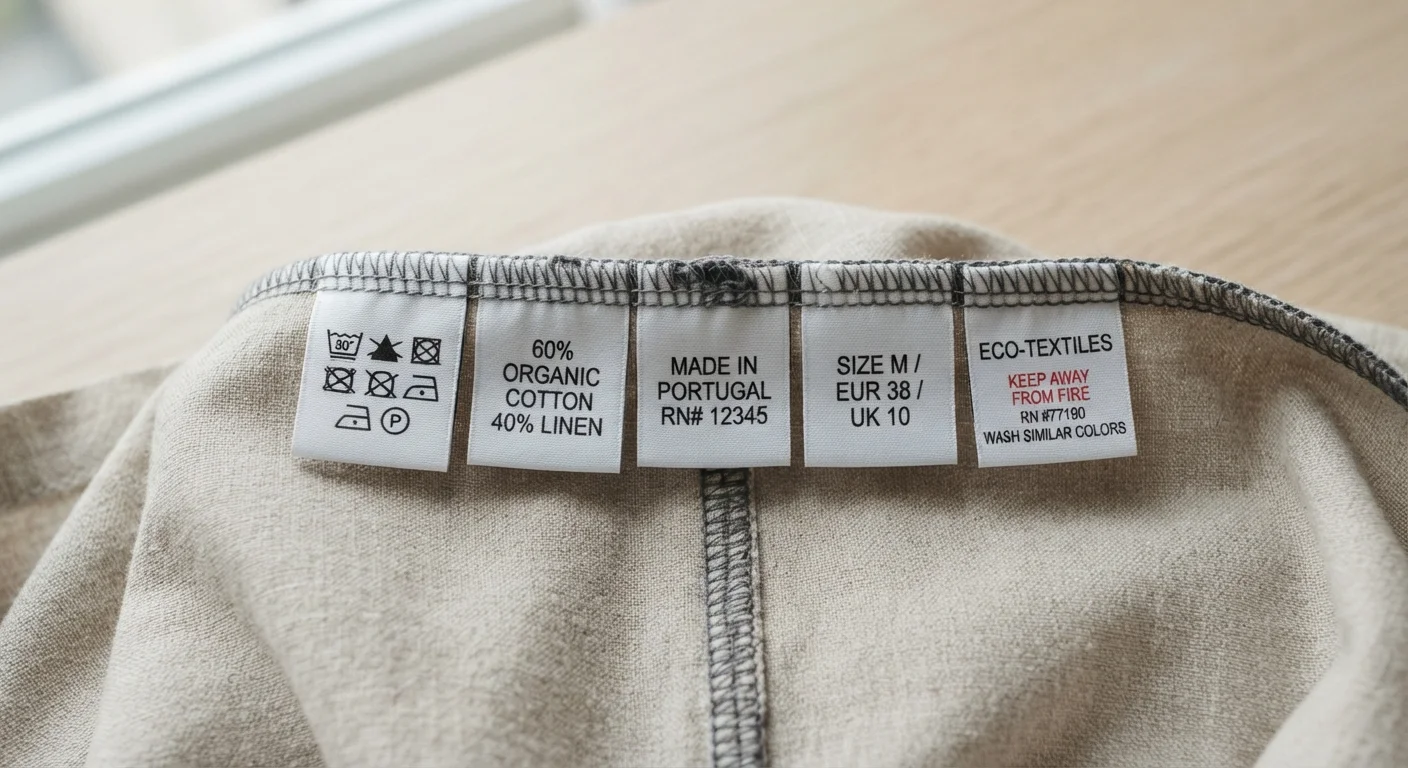
The washtub symbol (a bucket-shaped outline) is the first and most common icon. A plain washtub means machine wash is safe. A number inside indicates the maximum water temperature in Celsius (30°C, 40°C, 60°C, etc.). A hand dipping into the washtub signals hand wash only. A washtub with an X through it means do not wash with water at all.
Underlines beneath the washtub signal a gentler machine cycle: one line = permanent press; two lines = delicate or gentle. The more lines, the less agitation the fabric can tolerate.
Bleaching
A triangle governs bleach use. An empty triangle means any bleach is safe. A triangle with two diagonal lines inside restricts use to non-chlorine (oxygen) bleach only. A filled or crossed-out triangle means no bleach under any circumstances — common on bright-colored or structured fabrics.
Drying
A square is the base symbol for drying instructions. A circle inside the square means tumble dry is safe; dots inside that circle indicate heat level — one dot for low, two for medium, three for high. No dots with a circle means tumble dry with no heat. A crossed-out circle-in-square means do not tumble dry.
Squares without a circle describe flat drying methods: a horizontal line means dry flat; diagonal lines in the corner indicate drip dry; vertical lines mean hang to dry. These distinctions matter most for knits and fabrics prone to stretching.
Ironing
An iron silhouette indicates pressing instructions. Like dryer symbols, dots represent heat: one dot is low (synthetics), two dots is medium (wool, polyester blends), three dots is high (cotton and linen). An iron with an X through it means do not iron. An iron with lines beneath the sole plate means steam is permitted; an X over those lines prohibits steam pressing.
Dry Cleaning
A circle on its own — without a surrounding square — is the dry-cleaning symbol. A letter inside (A, F, P, W) directs the cleaner to a specific solvent or process; these are professional instructions rather than consumer ones. An X through the circle means dry cleaning is not appropriate for that item.
ISO 3758
The international standard that defines textile care labeling symbols, adopted by most global apparel manufacturers to ensure consistent care instructions across countries.
Permanent Press
A machine wash setting using slower spin speeds and a cool-down rinse to reduce wrinkles in synthetic or blended fabrics. Indicated by one underline beneath the washtub symbol.
Delicate / Gentle Cycle
The lowest agitation setting on a washing machine, designed for fragile fabrics and loose weaves. Shown as two underlines beneath the washtub symbol.
Oxygen (Non-Chlorine) Bleach
A gentler bleach alternative that uses hydrogen peroxide or sodium percarbonate. Safer for colors and delicate fibers than chlorine bleach.
Dry Flat
A drying method where a wet garment is laid horizontally on a surface to retain its shape as it dries — critical for knits that would stretch if hung.
Solvent Code
A letter (A, F, P, or W) inside the dry-cleaning circle that instructs professional cleaners which solvent process is safe to use on that garment.
Common Mistakes and How to Avoid Them
One of the most frequent errors is ignoring the temperature indicator on the washtub symbol. Washing at 60°C when the label shows 30°C can permanently set shrinkage into natural fibers like cotton and wool. Similarly, tumble-drying a garment marked with a crossed-out dryer symbol — even on a low setting — can cause irreversible damage to delicate weaves and structured fabrics.
Another common misread: confusing the dry-clean circle with the tumble-dry circle-in-square. The standalone circle always means professional dry cleaning; the circle inside a square is always about the home dryer.
When a Label Says 'Dry Clean Only'
This instruction is a manufacturer's recommendation, not always a legal prohibition on home washing. Some garments labeled 'dry clean only' can be hand-washed carefully in cold water — but doing so is at your own risk and may void any warranty or return policy. When in doubt on higher-value or structured pieces, defer to professional cleaning.
Dressing well starts with caring for what you already own. If you're also thinking about how garments fit into different social contexts, our dress codes guide covers how to interpret and meet various attire expectations with confidence.