

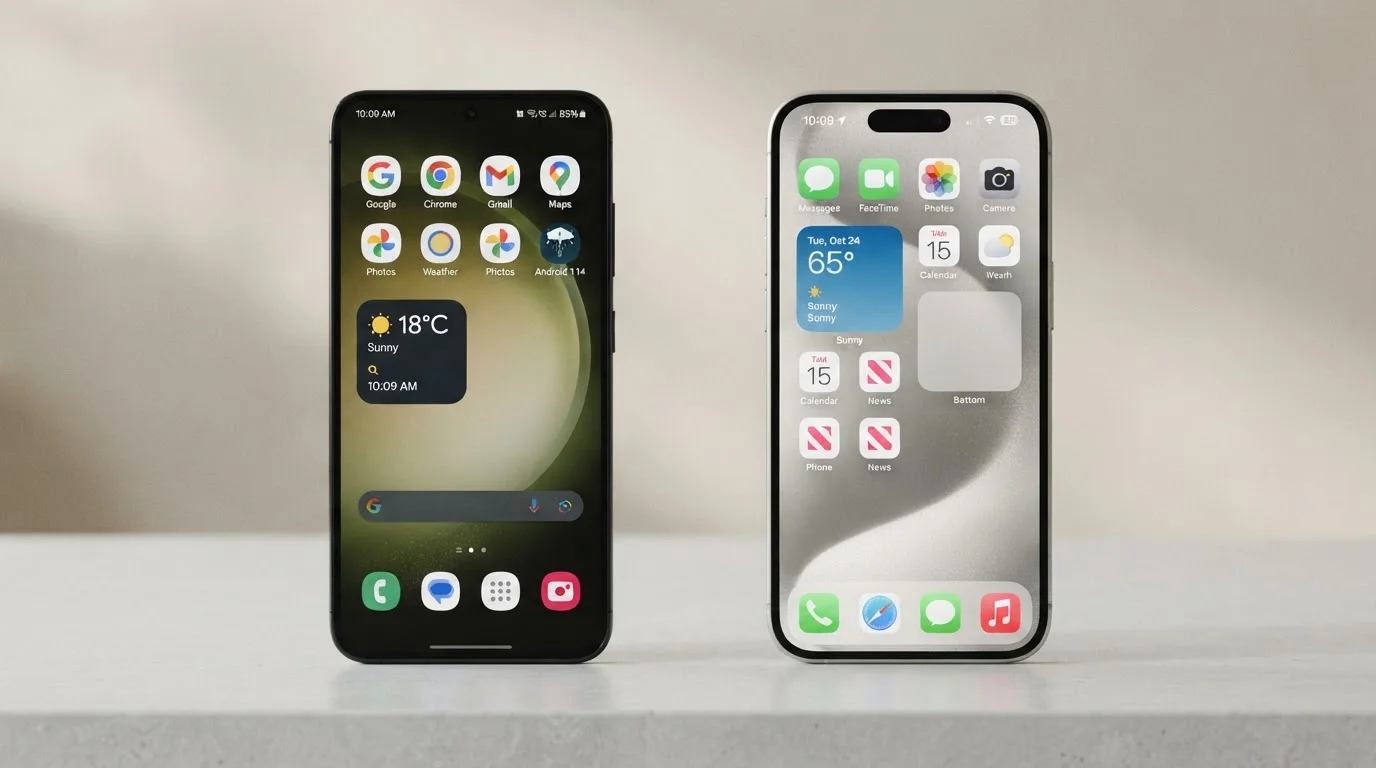
Key Takeaways
- Android prioritises flexibility and customisation; iOS prioritises consistency and simplicity.
- iOS tends to receive longer, more uniform software updates across supported devices.
- Android offers more hardware variety and often allows expandable storage options.
- Both platforms have strong security features, but they approach privacy differently.
- Switching between platforms involves real trade-offs, especially around purchased apps and services.
Our Verdict
Neither Android nor iOS is objectively superior — each reflects a coherent set of priorities. Android rewards users who want control, variety, and openness, while iOS rewards those who value a streamlined, tightly integrated experience. The right choice depends on how you use your device and which ecosystem you're already invested in.
| Best for | Recommended |
|---|---|
| Users who want deep customisation and hardware choice | Android |
| Users who prioritise software longevity and ecosystem integration | iOS |
| Those already using Apple devices like Mac or iPad | iOS |
| Those who prefer flexible file management or sideloading apps | Android |
Two Philosophies, One Purpose
Android and iOS are both mobile operating systems — the software layer that makes a smartphone usable — but they were built on very different assumptions about what users want. Understanding those assumptions makes it much easier to evaluate which platform fits your life.
Android, developed by Google, is open-source at its core. That means device manufacturers can modify it, and users have more latitude to change how the system looks and behaves. iOS, developed by Apple, is a closed system — it runs only on Apple hardware and is designed to work in a highly controlled, consistent way. Neither approach is wrong; they're just different bets on what matters most. For plain definitions of terms like operating system or open-source, see the Mobile Glossary for clear explanations.
Where Android Has the Edge
Android's biggest advantage is flexibility. You can set third-party apps as defaults for nearly anything — your browser, email client, or keyboard — and rearrange your home screen far beyond what iOS permits. On many Android devices, you can also expand storage using a microSD card, a feature iOS devices don't support.
Hardware variety is another strength. Android runs on phones across a wide price range and from dozens of manufacturers, meaning consumers can choose based on screen size, camera capability, battery life, or budget without being locked into one form factor. If you're deciding between a phone and a larger device, our smartphone vs tablet guide walks through those trade-offs clearly.
Android also tends to be more permissive about where apps can come from, which experienced users may find useful — though this does require more caution about security.
| Android | iOS | |
|---|---|---|
| Customisation | Highly flexible; deep system changes allowed | Limited; consistent, curated experience |
| Hardware options | Many manufacturers, price points, form factors | Apple devices only |
| Software update longevity | Varies by manufacturer; often 3–5 years | Typically 6+ years on supported devices |
| Expandable storage | Available on many devices via microSD | Not supported |
| Ecosystem integration | Strong with Google services | Seamless across Apple devices |
| App flexibility | Third-party app installs possible | App Store only (with limited exceptions) |
| Privacy model | Expanding controls; ad-driven business model | Strong on-device processing; stricter tracking limits |
Where iOS Has the Edge
iOS's greatest strength is software consistency. Because Apple controls both the hardware and the software, updates are delivered simultaneously to all supported devices, and those devices tend to receive updates for a longer period — often six or more years. On Android, update availability varies widely depending on the manufacturer and carrier.
The Apple ecosystem integration is also genuinely powerful. Features like Handoff (picking up a task on one Apple device where you left it on another), AirDrop, and iMessage work smoothly across iPhone, iPad, and Mac in ways that have no direct Android equivalent. If you already own other Apple hardware, iOS adds meaningful convenience.
App quality and consistency are also frequently cited as iOS strengths. Developers often release or update iOS apps first, and Apple's review process — while stricter — tends to result in more uniform experiences.
Test Before You Commit
If you're genuinely undecided, visit a retail store and spend time with both platforms hands-on. Notice whether the navigation feels intuitive to you and whether the default apps meet your needs. What feels natural varies from person to person, and no spec sheet captures that.
Privacy, Security, and Updates
Both platforms take security seriously, but their models differ. Apple emphasises on-device processing for features like facial recognition and Siri requests, and offers strong app tracking transparency controls that let you limit how advertisers follow you across apps. Google, whose business model relies more on data-driven advertising, has expanded its privacy tools in recent years but approaches data differently at a foundational level.
On both platforms, keeping your software updated is one of the most effective security habits you can maintain. For practical guidance, see habits that reduce smartphone security risk.
~72%
Global smartphone OS market share held by Android
According to StatCounter's global mobile OS data, Android consistently holds the majority of worldwide market share, though iOS dominates in markets like the US.
6+ years
Typical iOS software support window
Apple has historically provided major iOS updates for devices up to six or more years old, a benchmark most Android manufacturers have not consistently matched.
The Real Cost of Switching
One factor many people underestimate is ecosystem lock-in. Apps purchased on one platform don't transfer to the other. If you've built a library of iOS apps, switching to Android means repurchasing them. Messaging habits also matter — moving away from iMessage, for example, affects group chats with other Apple users.
Cloud storage is another consideration. Both platforms have native cloud services (iCloud for Apple, Google One for Android), but your data may not migrate cleanly. Understanding how RAM, internal storage, and cloud space work can help you plan before making any switch.
Switching is possible and many people do it successfully — but going in clear-eyed about what you'll leave behind makes the transition smoother. The platform you choose is less about which is objectively better and more about which set of trade-offs fits how you actually use your phone.