

Key Takeaways
- The reference price displayed beside a sale price may not reflect what an item ever actually sold for.
- Cognitive anchoring means your brain uses the first number it sees as a baseline — even if that number is arbitrary.
- Retailers can set anchor prices using MSRP, competitor prices, or in-house "regular" prices, each with different levels of meaning.
- Comparing the sale price to the item's price history is a more reliable gauge of a deal than any crossed-out number.
- Awareness of anchoring reduces but does not eliminate its psychological pull — deliberate evaluation helps.
Anchor Pricing
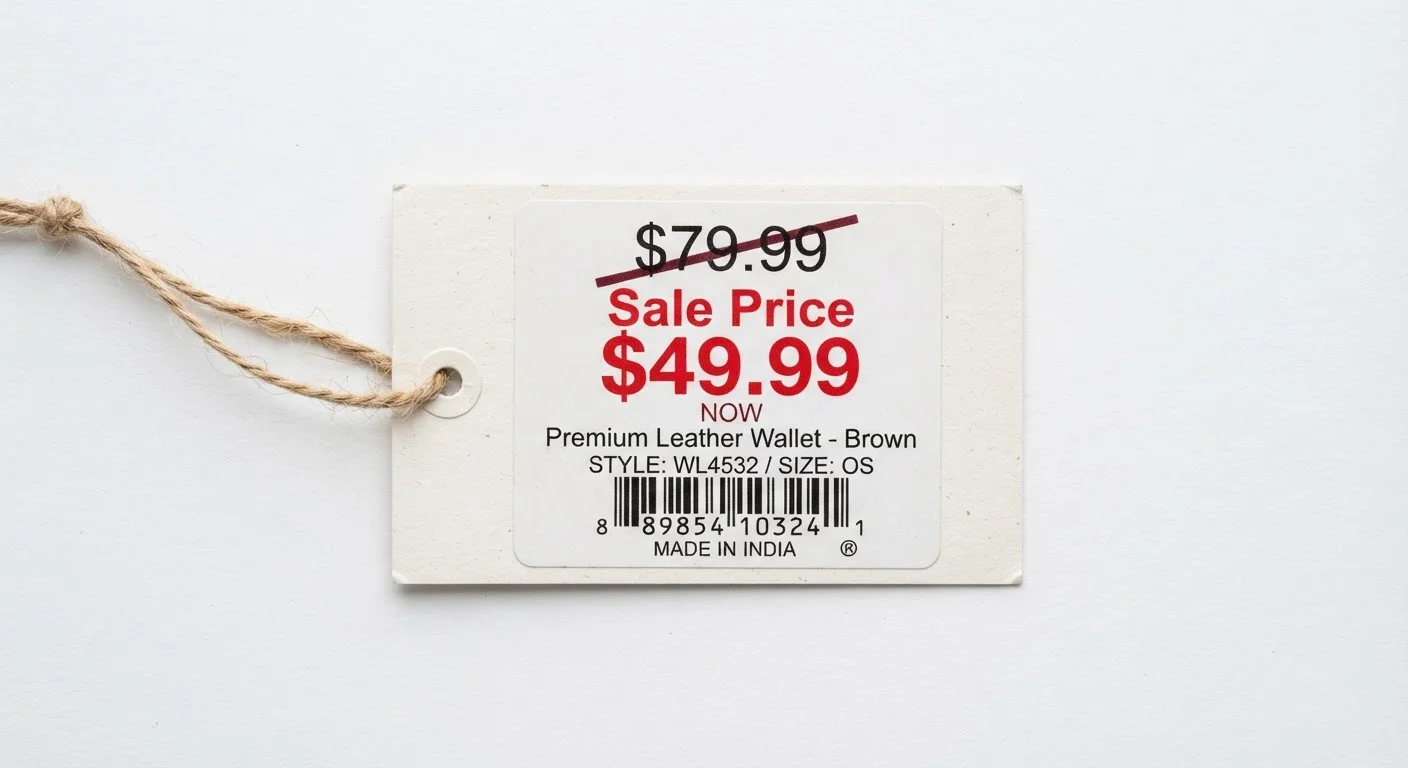
Anchor pricing is a retail tactic in which a higher reference price — such as a "was" or "original" price — is displayed alongside the current selling price. That reference number acts as a psychological anchor, making the current price feel like a bargain by comparison. The anchor doesn't have to reflect a price the item ever genuinely sold for; its job is simply to shift your perception of value.
In behavioral economics, this effect is rooted in Tversky and Kahneman's anchoring-and-adjustment heuristic: people estimate value by starting from an initial number and adjusting, often insufficiently, from there.
The Number That Changes Everything
Walk through any retail environment — physical or digital — and you'll encounter the same visual pattern: a higher number, often struck through in gray, sitting above a bolder, lower price in red. That crossed-out figure is the anchor. Its entire purpose is to reframe what you're about to pay.
The effect is well-documented in behavioral economics. When people encounter an initial number — even a random or arbitrary one — it disproportionately influences subsequent judgments about value. A $200 jacket marked down to $120 feels like a win. The same jacket priced at $120 with no reference point prompts more scrutiny. The product hasn't changed. Only the framing has.
Understanding this mechanism is the first step toward evaluating whether a markdown represents genuine savings or a carefully constructed perception. See our guide to decoding retail price tags for a closer look at how these numbers are structured.
“The first piece of information we receive acts as a reference point that shapes all subsequent judgments — even when we're aware of its potential irrelevance.”
— Daniel Kahneman, Nobel laureate in Economic Sciences; author of 'Thinking, Fast and Slow'
Where Anchor Prices Come From
Not all reference prices are equivalent. Retailers draw on several sources when setting an anchor, and each carries a different level of credibility:
- MSRP (Manufacturer's Suggested Retail Price): Set by the maker, often optimistically high, and rarely what most consumers actually pay. Using MSRP as an anchor is common and legal, but it can overstate the discount.
- Former selling price: A price the item genuinely held for a defined period. This is the most defensible anchor — and the one most consumer-protection guidelines require when a "was" price is displayed.
- Competitor pricing: Some retailers anchor against what a rival charges. This is legitimate only if the comparison is accurate and the competing item is truly equivalent.
- Inflated "original" prices: In documented cases, retailers have set a high list price briefly, then placed the item on perpetual "sale." Regulators have pursued this as deceptive pricing, though policing is uneven.
The FTC's guidelines on deceptive pricing state that a former price is only a valid reference if the item was openly offered at that price for a reasonable, recent period — but what counts as "reasonable" leaves room for creative interpretation.
4x
Sales lift from displaying a reference price
Research published in the Journal of Consumer Research found that reference prices can increase perceived value and purchase likelihood substantially, even when consumers are skeptical of the anchor.
~60%
Shoppers who check prices elsewhere before buying
A National Retail Federation consumer survey found a majority of US shoppers compare prices across at least two sources, though most still begin from the displayed reference price as a baseline.
Why Your Brain Struggles to Ignore the Anchor
Anchoring isn't a quirk of the naive shopper — it affects everyone, including people who understand it. The cognitive mechanism involves two steps: latching onto an initial value and then adjusting from it. The problem is that adjustments tend to be insufficient. We end up closer to the anchor than objective analysis would suggest we should be.
Retailers exploit this by placing the anchor prominently — in larger type, positioned first visually — so it's processed before the sale price. Strikethrough formatting adds another layer: it implies the anchor was once "real," even when that history is murky. Pair anchoring with manufactured scarcity signals and the pressure to decide quickly compounds the effect.
Try the "No Anchor" Test
Before deciding whether a price is good, mentally cover the crossed-out reference price and ask yourself: would I consider this item worth buying at the sale price alone, with no comparison number? If the answer is uncertain, that uncertainty is worth exploring before you buy. This simple habit short-circuits the anchoring effect by removing the reference point from your evaluation.
The practical implication: your instinct to calculate savings from the anchor rather than assess the absolute price independently is essentially automatic. Counteracting it requires deliberate effort — specifically, asking what you'd think of the price if no reference number were displayed at all.
How to Evaluate a Price Without the Anchor
Reframing your evaluation away from the anchor is a learnable habit. A few approaches that work:
- Check price history first. Tools that track historical pricing show whether the "original" price was ever the norm or just a brief placeholder. Price histories reveal patterns that a single tag never will.
- Compare the absolute price, not the discount. Ask whether the sale price is competitive across multiple retailers, independent of any anchor. This reframes the question from "how much am I saving?" to "is this a fair price?"
- Assess cost-per-use or long-term value. A lower price on a poor-quality item may cost more over time than a higher price on a durable one. The relationship between price and value is rarely linear.
- Treat percentage savings claims with skepticism. "40% off" is only meaningful if the base price is legitimate. Percentage-off language is one of retail's most elastic claims.
None of these steps are complicated, but they all require pausing before the anchor does its work. That pause is where informed shopping happens.