

Key Takeaways
- Morning routines prioritize protection against UV rays and environmental damage throughout the day.
- Evening routines focus on cleansing, repair, and supporting skin's natural overnight regeneration cycle.
- Certain active ingredients — like retinoids — are best used at night due to sun sensitivity.
- Antioxidant serums in the morning enhance sunscreen's protective effect against free radical damage.
- Both routines share core steps like cleansing and moisturizing, but product choices and goals differ significantly.
- Skipping either routine means missing a distinct window of skin health your body naturally provides.
Option A
Morning Skincare Routine
The protective, defense-first approach.
Best for: Shielding skin from UV exposure, pollution, and daily environmental stressors before you step outside.
Option B
Evening Skincare Routine
The restorative, repair-focused approach.
Best for: Clearing the day's buildup and supporting the skin's natural overnight renewal cycle.
If you only have time for one routine right now
Morning Skincare Routine
Daily sun protection is considered the single most impactful habit for long-term skin health. A simple cleanse, moisturizer, and SPF cover the essentials.
If you want to address concerns like uneven tone or texture
Evening Skincare Routine
Active ingredients such as retinoids and exfoliating acids work best at night, when skin is in repair mode and not exposed to UV light.
If you have sensitive or reactive skin
Evening Skincare Routine
Nighttime allows you to layer targeted treatments without worrying about photosensitivity reactions, letting your skin respond without external stressors.
If you wear makeup or spend time outdoors
Morning Skincare Routine
A well-prepped morning base — with hydration and SPF — supports both skin protection and a more even makeup application throughout the day.
Why Timing Actually Changes What Your Skin Needs
Skin doesn't operate the same way around the clock. Research in chronobiology — the study of biological timing — has established that the skin follows a circadian rhythm, shifting its priorities between daytime defense and nighttime repair. During the day, the skin's barrier function ramps up to guard against UV radiation, pollution, and moisture loss. At night, cell turnover accelerates and the skin becomes more permeable, absorbing topical ingredients more readily.
This biological shift is why using the same products at every hour isn't the most effective approach. A routine designed around these windows allows you to work with your skin's natural cycle rather than against it. For a fuller picture of how individual steps fit together, see The Anatomy of a Skincare Routine.
Morning Routine: Defense as the Core Goal
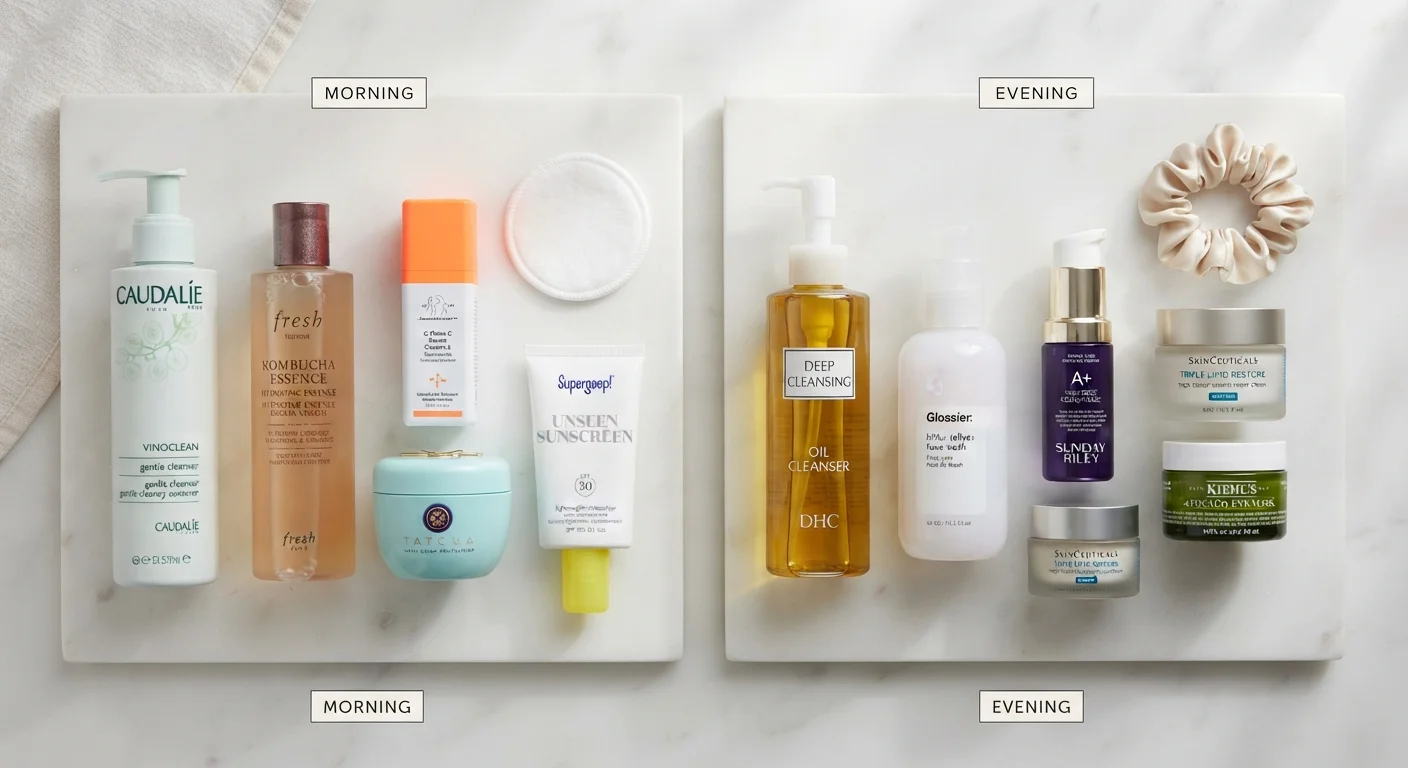
The morning routine is fundamentally about protection. After sleeping, your skin has already done its repair work — now it needs to face the environment. The key priorities are:
- Gentle cleansing — A light cleanse removes overnight sebum without stripping the barrier. Many people with normal or dry skin find a simple rinse with water is sufficient in the morning.
- Antioxidant serum — Vitamin C and similar antioxidants neutralize free radicals generated by UV light and pollution. Applied before sunscreen, they add a layer of chemical defense that SPF alone doesn't provide.
- Moisturizer — Locking in hydration before external stressors deplete it sets the skin up for the day.
- Broad-spectrum SPF — Sunscreen is the non-negotiable final step. It should be applied every morning, even on overcast days or when spending most of the day indoors near windows.
For a deeper look at what SPF labels mean and why dermatologists consistently recommend daily use, our article SPF in Your Routine explains the details clearly. If you want a structured checklist for your full morning regimen, the Morning Personal Care Routine Checklist is a practical reference.
| Criterion | Morning Routine | Evening Routine |
|---|---|---|
| Primary goal | Protect skin from external stressors | Repair damage, support cell renewal |
| Cleansing focus | Remove overnight sebum gently | Remove sunscreen, makeup, and pollutants |
| SPF | Essential final step | Not needed or appropriate |
| Retinoids / exfoliating acids | Generally avoided (photosensitivity) | Ideal time for application |
| Antioxidant serum | Recommended to boost UV defense | Optional; repair serums prioritized |
| Moisturizer texture | Lighter, fast-absorbing formulas | Richer emollients acceptable |
| Skin permeability | Barrier in active defense mode | Higher absorption rate overnight |
Evening Routine: Repair and Renewal
The evening routine begins with removal — everything that has accumulated on the skin throughout the day must come off before anything else is applied. This includes sunscreen, makeup, pollution particles, and excess oil. A thorough cleanse (sometimes a double cleanse for heavy SPF or makeup wearers) is the foundation of an effective PM routine.
Once skin is clean, nighttime is the window for treatment-focused products:
- Exfoliating acids (AHAs like glycolic or lactic acid, BHAs like salicylic acid) — These encourage cell turnover but increase sun sensitivity, making them better suited to evenings.
- Retinoids — Vitamin A derivatives are among the most researched ingredients for supporting skin renewal. They degrade in sunlight and can cause irritation if sun exposure follows application, so nighttime use is standard practice. Anyone new to retinoids should introduce them gradually and consult a dermatologist if irritation persists.
- Richer moisturizers or facial oils — Nighttime is a good moment to use heavier emollients that might feel occlusive during the day, helping maintain the skin barrier while you sleep.
Environmental conditions also shift overnight, which affects what skin needs. Seasonal changes in humidity and temperature can influence how rich or lightweight your evening products should be.
~28 days
Average skin cell turnover cycle in adults
This natural renewal cycle, which slows with age, is one reason nighttime ingredients targeting cell turnover are used consistently over weeks rather than expecting immediate results.
80%
UV radiation that can reach skin on cloudy days
The American Academy of Dermatology notes that UV rays can penetrate cloud cover substantially, supporting the case for daily morning SPF application regardless of weather.
What Both Routines Share — and Where They Diverge
Both routines benefit from the same foundational logic: cleanse, treat, and moisturize. The difference lies in what you cleanse away, which treatments you apply, and what you're moisturizing against. A few key divergences are worth noting:
- SPF is exclusively a morning step — It serves no protective purpose while you sleep and doesn't need to be in your PM routine.
- Retinoids and exfoliating acids belong at night — Photosensitivity concerns aside, these ingredients also benefit from the skin's naturally elevated permeability overnight.
- Texture choices shift — Lighter, fast-absorbing formulas work better in the morning under SPF or makeup; richer textures can be used freely at night.
If you're wondering whether a more elaborate multi-step approach is worth adding, The Trade-Offs of a Multi-Step Skincare Routine offers a balanced perspective on complexity versus results. For a comprehensive overview of how ingredients, habits, and skin changes interact over time, Everything That Shapes a Good Skincare Routine is a useful deeper read.
Consistency Matters More Than Complexity
A simple, consistent two-step routine performed morning and evening will generally outperform an elaborate regimen applied irregularly. Skin benefits from repetition over time — the same way that skipping a full night of sleep periodically affects recovery more than the quality of any single night. Starting with just cleanser, moisturizer, and morning SPF is a legitimate and effective foundation.
This article is for general informational and educational purposes only. It is not a substitute for personalized advice from a licensed dermatologist or healthcare professional. If you have specific skin concerns, conditions, or reactions to products, consult a qualified professional before making changes to your routine.