

Key Takeaways
- Multi-step routines allow targeted treatment of specific skin concerns like acne, hyperpigmentation, or dehydration.
- More products increase the risk of ingredient interactions, irritation, and sensitization over time.
- Consistency matters more than quantity — an elaborate routine you skip is less effective than a simple one you follow daily.
- Layering products in the correct order is essential for effectiveness and skin tolerance.
- Cost and time commitment are meaningful barriers that deserve honest consideration before expanding any routine.
Allows targeted treatment of multiple skin concerns
Each product can be chosen for a specific function — hydration, brightening, barrier repair — rather than relying on one formula to do everything. This level of customization is particularly useful for people managing more than one skin concern simultaneously.
Enables use of more active ingredients
A multi-step framework creates room for evidence-backed actives like retinoids, vitamin C, niacinamide, and AHAs that serve distinct purposes. Incorporating them at the right concentrations and in the right order can produce measurable improvements in texture and tone over time.
Supports AM and PM skin needs separately
Morning skin needs differ from evening skin needs — daytime focuses on protection; nighttime focuses on repair. A multi-step system makes it practical to tailor products to each cycle rather than using a one-size-fits-all approach.
Builds detailed knowledge of your own skin
Testing and tracking products individually tends to make people more attuned to what triggers breakouts, sensitivity, or improvements in their skin. This self-awareness often leads to more informed, confident decisions over time.
Higher cost that accumulates quickly
Each additional product adds to the overall spend, and quality formulations of serums, exfoliants, and treatments can be expensive individually. A routine of six or more products can represent a significant monthly outlay, particularly when products need to be replaced regularly.
Increased risk of ingredient interactions and irritation
More products mean more potential for incompatible ingredient combinations. Mixing certain acids with retinoids, or overusing active ingredients, can compromise the skin barrier and cause redness, flaking, or increased sensitivity.
Time demands reduce consistency
A lengthy routine requires a meaningful time commitment twice daily. Research and clinical observation consistently suggest that consistency is a stronger predictor of skincare results than complexity — and elaborate routines are statistically harder to maintain.
Difficulty identifying what is and isn't working
When skin reacts — positively or negatively — to a new product, a multi-step routine makes it harder to pinpoint the cause. Isolating variables requires introducing products one at a time, which slows the process considerably.
Risk of over-treating or over-exfoliating
More steps can lead to using too many active ingredients too frequently, which disrupts the skin's natural barrier. Over-exfoliation in particular is a common consequence of layered routines and can worsen conditions like dryness, breakouts, and sensitivity.
Our Verdict
A multi-step skincare routine offers genuine benefits for people with complex or multiple skin concerns — provided each product is chosen intentionally and used correctly. The risks of irritation, cost, and inconsistency are real, however, and should not be dismissed. For many people, a thoughtfully built moderate routine outperforms either extreme.
Best suited to individuals with specific, identified skin concerns — such as persistent hyperpigmentation, acne, or significant dryness — who have the time, budget, and patience to introduce products methodically.
What Counts as a Multi-Step Routine?
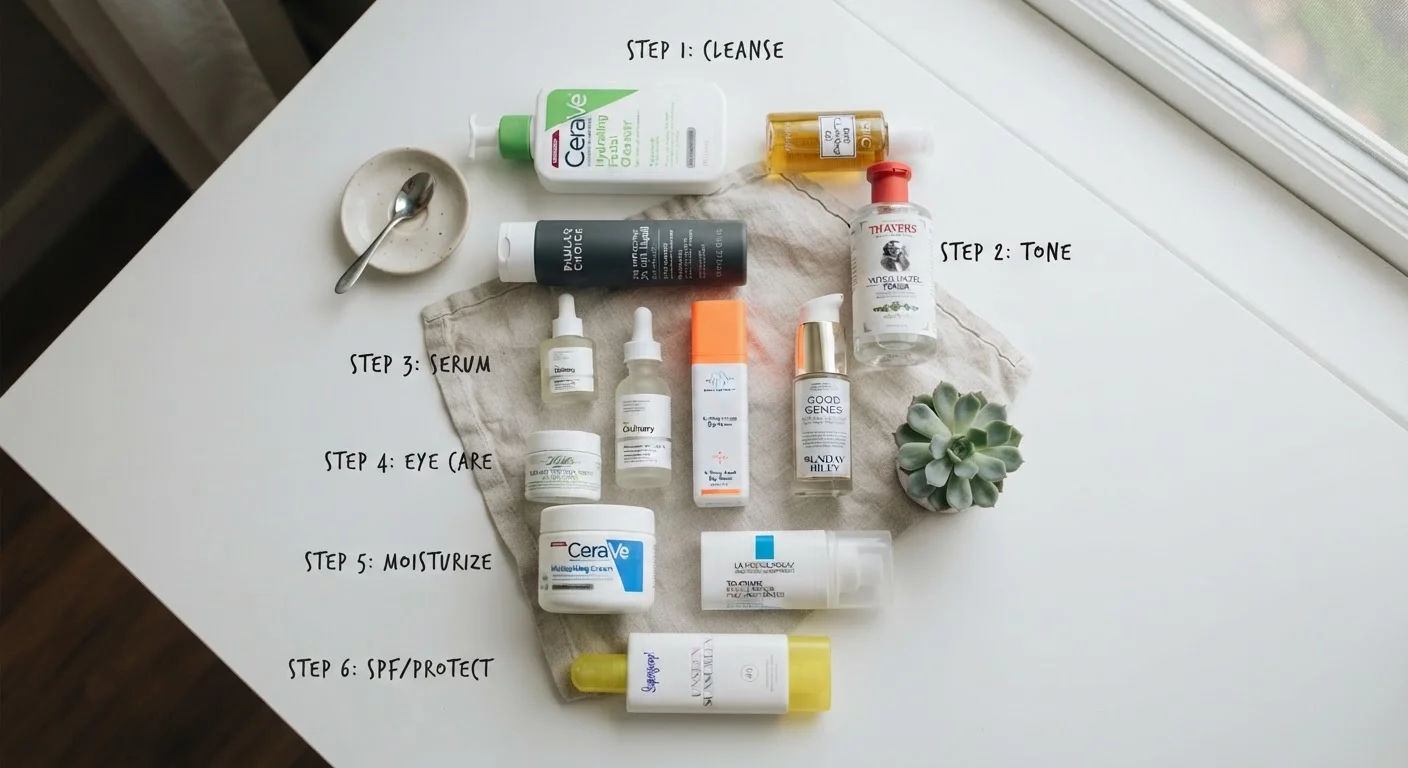
A multi-step skincare routine generally refers to any regimen that goes beyond the three core actions — cleansing, moisturizing, and sun protection. In practice, it might include a toner, one or more serums, an eye cream, a face oil, an exfoliant, a sheet mask, or specialty treatments targeting a specific concern. Some popular frameworks, particularly those influenced by Korean skincare culture, can involve seven to ten steps or more.
The appeal is specificity: rather than one product doing everything passably, each step can be chosen to address a distinct skin need. But specificity introduces its own complications — from ingredient compatibility to the sheer logistics of a lengthy daily ritual. See our comprehensive guide to what shapes a good skincare routine for deeper context on how individual factors affect product choices.
The Real Advantages
When built with care, a layered routine can meaningfully improve outcomes for people with complex or persistent skin concerns. Here's what the evidence and expert consensus generally support:
Allows targeted treatment of multiple skin concerns
Each product can be chosen for a specific function — hydration, brightening, barrier repair — rather than relying on one formula to do everything. This level of customization is particularly useful for people managing more than one skin concern simultaneously.
Enables use of more active ingredients
A multi-step framework creates room for evidence-backed actives like retinoids, vitamin C, niacinamide, and AHAs that serve distinct purposes. Incorporating them at the right concentrations and in the right order can produce measurable improvements in texture and tone over time.
Supports AM and PM skin needs separately
Morning skin needs differ from evening skin needs — daytime focuses on protection; nighttime focuses on repair. A multi-step system makes it practical to tailor products to each cycle rather than using a one-size-fits-all approach.
Builds detailed knowledge of your own skin
Testing and tracking products individually tends to make people more attuned to what triggers breakouts, sensitivity, or improvements in their skin. This self-awareness often leads to more informed, confident decisions over time.
It's also worth noting that AM and PM routines serve genuinely different purposes. Our article on morning versus evening skincare explains how daytime protection and overnight repair call for distinct product choices — which multi-step routines are well-positioned to accommodate.
The Genuine Disadvantages
Complexity carries costs — financial, practical, and dermatological. These are not hypothetical concerns:
Higher cost that accumulates quickly
Each additional product adds to the overall spend, and quality formulations of serums, exfoliants, and treatments can be expensive individually. A routine of six or more products can represent a significant monthly outlay, particularly when products need to be replaced regularly.
Increased risk of ingredient interactions and irritation
More products mean more potential for incompatible ingredient combinations. Mixing certain acids with retinoids, or overusing active ingredients, can compromise the skin barrier and cause redness, flaking, or increased sensitivity.
Time demands reduce consistency
A lengthy routine requires a meaningful time commitment twice daily. Research and clinical observation consistently suggest that consistency is a stronger predictor of skincare results than complexity — and elaborate routines are statistically harder to maintain.
Difficulty identifying what is and isn't working
When skin reacts — positively or negatively — to a new product, a multi-step routine makes it harder to pinpoint the cause. Isolating variables requires introducing products one at a time, which slows the process considerably.
Risk of over-treating or over-exfoliating
More steps can lead to using too many active ingredients too frequently, which disrupts the skin's natural barrier. Over-exfoliation in particular is a common consequence of layered routines and can worsen conditions like dryness, breakouts, and sensitivity.
Skin Barrier Disruption Is a Real Risk
The skin barrier — the outermost protective layer — can be compromised by overuse of active ingredients, particularly acids and retinoids. A disrupted barrier may present as increased sensitivity, redness, tightness, or breakouts. If any of these symptoms persist after introducing new products, scaling back and consulting a dermatologist is advisable. This article provides general information only and is not a substitute for professional skin assessment.
If you're weighing a simpler approach, our guide to building a minimal routine that works outlines how to cover the essentials without added risk or expense.
The Layering Problem Most People Overlook
One of the most underappreciated pitfalls in multi-step routines is product order. Applying products in the wrong sequence can impede absorption, reduce efficacy, or trigger irritation — even between products that are individually well-tolerated. A general rule of thumb is to go from lightest to heaviest texture and to apply water-based formulas before oil-based ones, but exceptions exist.
7–10
Steps in a typical elaborate skincare routine
Multi-step frameworks popularized in Korean skincare culture commonly include up to ten distinct steps, each serving a defined purpose in the layering sequence.
~4 weeks
Minimum time to assess a new skincare product
Dermatologists generally recommend allowing at least four weeks before evaluating whether a new product is benefiting the skin, as skin cell turnover takes time.
Some ingredient pairings also require caution. Retinoids combined with certain acids, for instance, can increase skin sensitivity beyond what many people anticipate. Our article on why layering order matters covers the logic behind sequencing in detail.
How to Decide What's Right for You
There is no universal answer to how many steps a routine should have. The honest benchmark is whether the routine you follow consistently — on tired evenings, busy mornings, and travel days — produces results. An elaborate regimen that gets abandoned mid-week offers little advantage over a simpler one performed daily.
If you're new to skincare altogether, starting from scratch with the basics is a more practical foundation than jumping into a multi-step system. For those curious about the other end of the spectrum, the trade-offs of skipping a routine entirely provides a balanced look at what minimal or no care actually means in practice.
Introduce any new product one at a time, allow two to four weeks to assess its effect, and consult a dermatologist if you experience persistent irritation or are managing a diagnosed skin condition. General skincare information — including this article — is educational and does not substitute for personalized professional guidance.
This article is for general informational purposes only and does not constitute medical or dermatological advice. Consult a qualified healthcare professional for concerns about your specific skin health.